


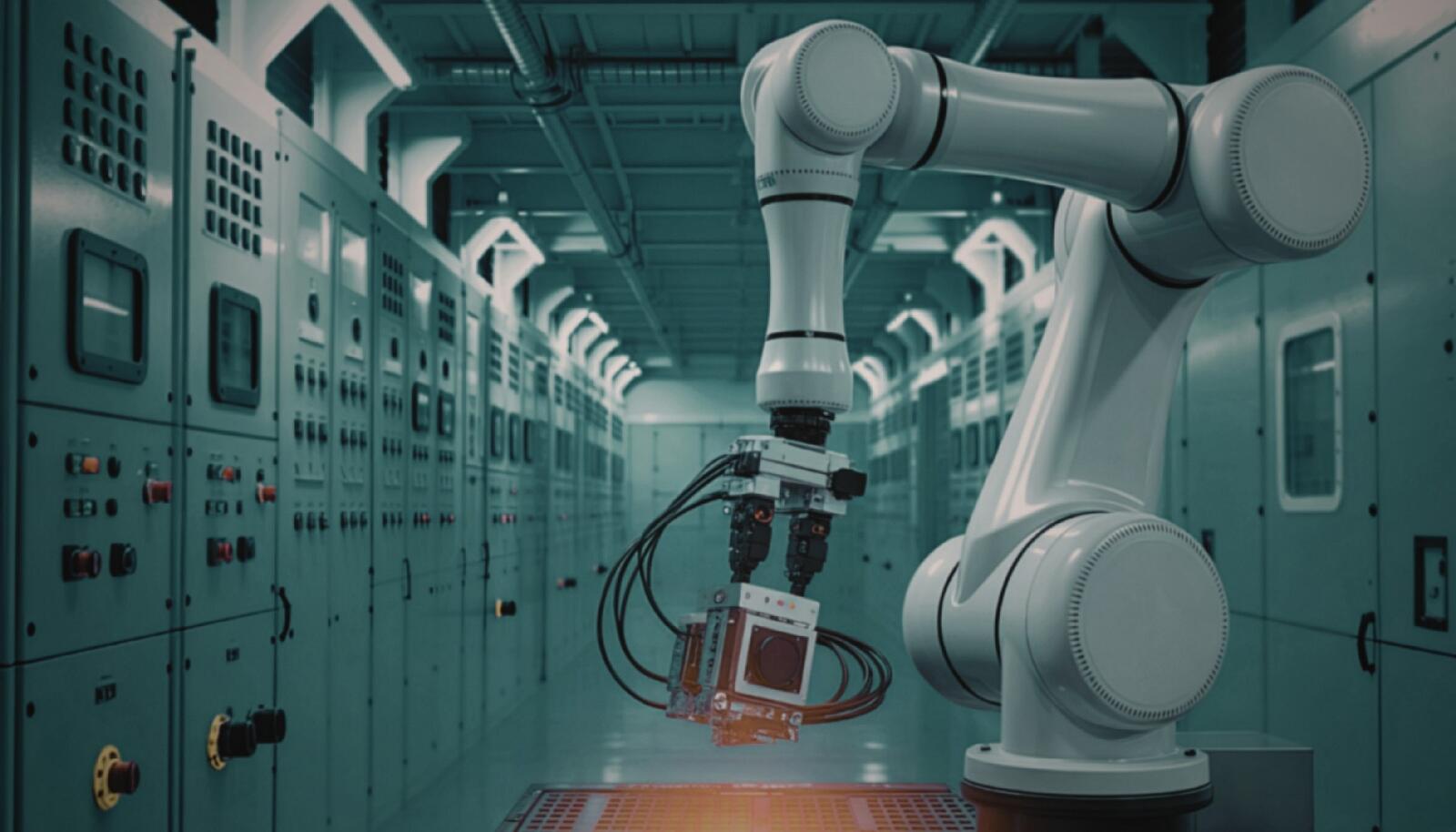
Watch enough robot demos and you start to notice what they all have in common: nothing goes wrong. Put the same system in the real world – a box in the wrong place, a light that changed, a gauge it had never seen before – and the gap between demo and deployment becomes very clear, very fast.
That chasm between demo and deployment has been the defining limitation of robotics for years. Google DeepMind’s release of Gemini Robotics-ER 1.6 on 13 April 2026 is a serious attempt to close it.
The model is described as a major improvement over its predecessor in spatial and physical reasoning, the cognitive layer that lets a robot understand where things are in three-dimensional space, how they relate to each other and what is likely to happen if it interacts with them. It was developed in collaboration with Boston Dynamics and is available via Google AI Studio, meaning startups building in the physical AI space can access it through an API without needing to train a model of comparable scale from scratch.
This is a research and infrastructure development, not a consumer product launch. Understanding what it actually does is more important than the headline.
What Gemini Robotics-ER 1.6 Actually Does
The model acts as a high-level reasoning layer for robots, sitting above the lower-level systems that handle physical movement. Rather than directly controlling a robot arm, it processes visual input from cameras, applies spatial reasoning and produces instructions that lower-level systems execute. Think of it less as the robot’s muscles and more as its ability to understand what it sees and decide what to do next.
The specific improvements in version 1.6 paint a clearer picture than most model release notes. The model shows significant gains in precise pointing, which means identifying the exact spatial relationships between objects, such as which items would fit inside a container or which can be safely moved given weight or liquid constraints. It improves on counting occluded objects, which is the ability to reason about items that are partially hidden. It handles multi-view reasoning better, synthesising input from multiple cameras to build a more accurate picture of a dynamic scene.
The standout new addition is instrument reading: the model can now interpret analogue gauges, sight glasses and similar industrial instruments by combining zooming, pointing, code execution and general world knowledge. This capability was developed specifically with Boston Dynamics for facility inspection use cases. It represents a concrete step toward robots that can operate usefully in real industrial and physical environments without requiring every instrument to be retrofitted with a digital interface.
Safety reasoning has also been improved – the model outperforms its predecessor on adversarial safety benchmarks, including hazard identification from injury reports, by six to ten percentage points compared to Gemini 3.0 Flash. For robots operating in environments where humans are present, those numbers mean something in practice.
More from Tech
- Why Is It So Hard To Put Tech Down? The Design Choices Behind Our Attention
- Can A Trading App Truly Be Risk-Free When Real Financial Habits Are On The Line?
- The Tech F1 Teams Use To Prepare For Unfamiliar Tracks
- Beauty Tech Explained: The Cosmetic Treatments Changing Aesthetic Medicine
- Could An App Help Families Manage Allergies More Confidently? ACE Launches Allergy Assist
- Wi-Fi 8 Is Arriving – What Does It Actually Change For Your Home?
- The Unexpected Role Of Consumer Tech In Space Engineering
- How To Optimise Your VoIP System For Better Performance
Benchmarks Are One Thing – Here’s The Bigger Picture
The robotics industry has a long history of impressive benchmark results that do not translate into useful products. What gives Gemini Robotics-ER 1.6 it’s star quality goes beyond the performance improvements but what those improvements represent architecturally.
Current robotics systems are mostly brittle. They work well in highly structured environments where the variables are predictable and controlled – warehouses with standardised shelving, manufacturing lines where the same component appears in the same position every cycle. The moment conditions deviate, performance degrades rapidly. The path to truly useful general-purpose robots runs through what researchers call embodied reasoning, the ability to build and update a causal model of the physical world in real time.
Gemini Robotics-ER 1.6 moves in that direction. Better spatial reasoning, multi-view synthesis and the ability to read instruments it has never encountered before all contribute to a system that is less dependent on having seen an exact scenario during training. That is not the same as general-purpose autonomy, but it represents progress toward the kind of AI-driven automation that can operate in environments which have not been purpose-built for robots.
Good News, Bad News, Or Both? Depends On Your Startup
For startups building in the physical AI and robotics space, a Google DeepMind model at this level creates a familiar dynamic: a powerful foundation model becomes available as infrastructure, raising the floor for what is possible while simultaneously raising the bar for what a specialist startup needs to offer.
The API access via Google AI Studio opens a door that was previously shut for most teams. Startups working on vision-language-action models for dexterous manipulation, workflow planning or facility inspection can now build on top of a reasoning layer they could not have trained themselves. That accelerates development timelines and reduces the compute investment required to reach a viable product. In categories like warehouse automation, logistics and industrial inspection, this could substantially compress the time between prototype and deployment.
The competitive angle is whether access to the same foundation model levels the playing field or concentrates advantage with the best-resourced companies. BCG has noted that as VLA models become the programming paradigm for robots, the competitive advantage shifts toward those who can accumulate specialised domain data and hardware integration expertise, rather than those who can train the largest models.
A startup with proprietary data from a specific industrial vertical, or deep integration with a particular hardware platform, cannot be simply replicated by a better foundation model.
Google DeepMind is, in effect, building the infrastructure layer of physical AI. For the startups operating on top of that infrastructure, the question is the same one facing SaaS founders watching a platform expand into their category: is the foundation model a threat to your product, or the enabler of a better one?
Let’s Not Get Too Carried Away
Gemini Robotics-ER 1.6 is a big step forward, but it does not resolve the fundamental challenge of deploying robots in unstructured real-world environments.
Benchmark performance and reliable autonomous operation in the real world remain two very different things. The distance in a factory, hospital or home is still considerable. Boston Dynamics has been building and deploying physical robots for decades and the limitations are well understood: hardware reliability, edge cases that training data failed to cover, the cost of failure in safety-critical contexts.
What the model does represent is a credible signal about the trajectory. The reasoning capabilities that make robots useful in the real world are improving at a pace that was not expected even two or three years ago.
For founders building at the intersection of AI and physical hardware, that signal is the relevant data point, not any single model release


