


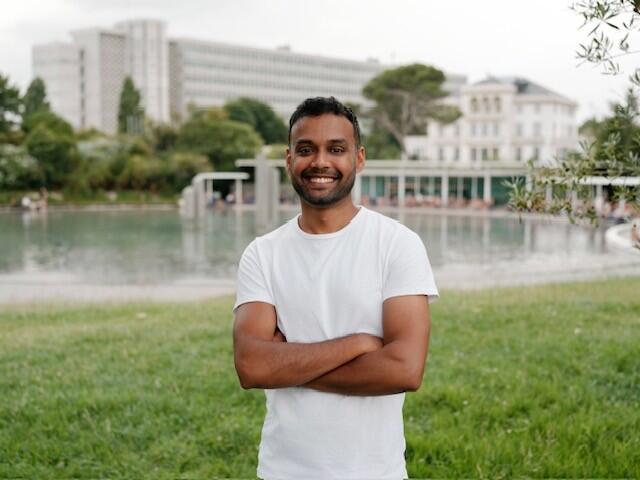
There’s a growing narrative around people building and launching things independently, do you think that shift is actually happening?
Yes, but it’s quieter than the headlines suggest. The visible version is solo founders posting revenue numbers on X, the actual version is consultants, designers and small business owners who used to need a developer for everything and now don’t.
What’s powering it isn’t one thing. AI takes a slice, cheaper infrastructure takes another, the collapse of agency dependency takes another, and put together the cost of getting something live has fallen by an order of magnitude in five years.
The proof is in our own user base. 2 million people have signed up to Tiiny, and most of them aren’t founders, they’re people who had work to put online and didn’t want to wait.
You promote this concept of “Do It. Yourself”. It used to be shorthand for amateur effort and rough edges. What does it mean to you?
DI.Y is in the DNA of my business and drives everything we do.
DIY has always come with the negative association of labour – you have to do the hard work yourself.
We flipped that. DI.Y is about the power of the individual. How an idea can be made into reality in an instant. Removing barriers and empowering people to be the masters of their own destiny.
With Tiiny, you get all the independence and ownership of doing it yourself, without any of the actual building. That’s why 2 million people have used us.
You were passed over by Y Combinator, Google and investors, and an angel investor ghosted you. How much of how you build now comes from never having had permission?
All of it, honestly. When nobody picks you, you have a choice – keep waiting, or stop waiting to be picked. I decided to stop. Instead of pitching to investors, I started creating for users.
I’d bought into the Silicon Valley mythology: get into YC, raise a round, hire from FAANG, and suddenly you’re a ‘real’ founder. Without those stamps of approval, I genuinely believed I didn’t matter.
But rejection gave me something invaluable: it forced me to trust my own view on how the world should be. Shape the company around the customer experience at every single point of the journey. I learned skills that founders outsource from day one.
Practically, that meant I couldn’t hire an agency or burn £100K on paid ads. So I taught myself SEO for £50, an Ahrefs subscription, keyword research, and content built around what real people were actually searching for.
That took nearly a year to gain traction. Any VC-backed founder would’ve pivoted three times by then. I just kept building two hours a night until it worked.
Today we get 35 million Google impressions and 150,000 organic clicks a month with zero advertising spend. I probably would never have built that distribution engine if someone had handed me a cheque.
The lesson I’d pass on: the things you’re forced to learn when nobody believes in you become your biggest competitive advantages. The lesson I’d pass on: the things you’re forced to learn when nobody believes in you become your biggest competitive advantages.
More from Interviews
- A Conversation With Semrush On AI Search, Brand Visibility And Spotlight 2026
- A Chat With Ollie Whiting, CEO Of La Fosse, On The Human Side Of Digital Change
- A Chat With Chris Kincade, Founder Of Starling Memory Works, On Why Your AI Doesn’t Know Your Business
- A Chat With Mark Boost, CEO And Co-founder Of Civo, On Data Sovereignty And The Case For A UK-First Cloud Strategy
- An Interview With James Murdoch, Director Of Kynekt, The UK’s Leading Equipment Protection Platform For The Construction And Trades Industry
- Dear Mr. Prime Minister: Helen Crisostomo, VP Business Development At De Novo Solutions
- A Chat With Siyi Hao, Principal At Roland Berger On Europe’s AI Data Centre Developments
- Interview With Ravina Bhanot, Founder At One Labs+ On Her Experience Building An SME In The UK
Critics will say that simpler tools produce shallower work, that you can’t compress real craft into a click. How do you respond?
The premise assumes the alternative is craft. For most of the work people are trying to put online, a proposal, a portfolio, a client microsite, the alternative isn’t a craftsperson, it’s a queue.
Simpler tools haven’t replaced craft, they’ve replaced waiting. The craft conversation matters when you’re building a brand from the ground up, it doesn’t matter when you’re sharing a PDF as a web page on a Tuesday afternoon.
The depth question also gets the direction of travel wrong. When you remove friction around, say, publishing, people don’t produce shallower work, they produce more of it, they iterate faster and are free to translate their ideas into reality.
If independence stops being the fallback and starts being the default, does that mean the death of the team in the future?
People will always work in teams, and rightly so, but it will change what a team is for. When one person can design, write, build and ship to a credible standard, the case for the team shifts from execution to judgement.
The teams that survive this shift will look smaller and more senior, fewer junior executors and more people whose value is in deciding what to build and how to position it.
What dies isn’t the team, it’s the org chart that assumes scale equals headcount. Plenty of companies are still hiring like it’s 2018 and wondering why they’re not moving faster.
You’re building Tiiny into this shift rather than just commenting on it. What does the next chapter look like?
The next frontier is the gap between AI-generated work and live work. People use ChatGPT and Claude to generate websites and prototypes, but almost none of it ever ships because the path to live still goes through a developer.
More broadly, the things that still require permission today won’t in five years. Publishing a microsite, running an analytics-tracked campaign page, password-protecting a client deliverable, these still default to asking someone, and they shouldn’t.
Building independently looked like a stepping stone for a long time, and it’s starting to look like an advantage. The next chapter for us is making sure it becomes the obvious choice for anyone with work to put online.


