



Digital transformation has long been sold as the answer to Britain’s productivity problem. Companies have spent millions rolling out new software, digitising workflows and modernising operations. But according to new research from AI platform Cogna, many workers on the ground are still relying on spreadsheets, messaging apps and homemade processes just to get their jobs done.
The findings raise an uncomfortable question and a bit of a paradox. That is if it’s true that digital transformation is working so well, why are employees still creating their own workarounds?
The report, Can AI Solve the Productivity Crisis in the UK’s Physical Industries?, surveyed both senior decision-makers and frontline workers across construction, manufacturing, logistics and utilities. What emerged was a clear disconnect between how leaders view technology investments and how employees experience them on the day to day.
Leaders Think Progress Is Being Made
On the surface, the numbers appear to be rather encouraging. Three-quarters of senior leaders surveyed said productivity at their organisations has improved over the past three years. Nearly 90% attributed those gains to technology, while 83% said their digital investments had either met or exceeded expectations.
Given the scale of spending, perhaps this isn’t surprising. Organisations involved in the study reported investing an average of £13 million in digital transformation initiatives over the last five years, with more than a fifth spending over £20 million.
For executives, the bottom line seems to be that investment has gone in and productivity has come out. The challenge, however, is that workers tell a very different story.
More from Artificial Intelligence
- Because AI Says So: What Happens When A Chatbot Becomes The Office Expert?
- Hotels Are Letting AI Agents Handle Bookings – What Could Go Wrong?
- When AI Copies Style In Seconds, Does Artistic History Become Obsolete?
- Can AI Help Us Better Understand Animal Behaviour?
- Your AI Agent Can Now Shop For You – Banks Say That Opens The Door To Scams
- The Gender Gap In AI Adoption May Be About Caution, Not A Lack Of Interest
- What Are The Real-World Risks Of AI Hallucinations?
- If OpenAI Goes Public, Will That Validate Or Burst The AI Bubble?
But the Frontline View Looks Very Different
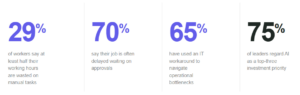
According to the research, operational staff estimate that 39% of their working week is still spent on repetitive or unnecessarily manual tasks that could potentially be automated or improved with better technology.
Nearly a third said that at least half of their week is consumed by these activities.
Instead of relying entirely on official systems, 65% of workers admitted to creating their own unofficial solutions. These range from spreadsheets and templates to personal messaging groups and ad-hoc processes designed to fill gaps left by company software.
In many ways, this is a sign of ingenuity rather than resistance. Workers aren’t rejecting technology, they’re finding ways to make it work and they’re being creative in the process.
But, on the other hand, it also suggests that many digital transformation projects may have digitised existing processes without fundamentally fixing them, and that’s more of an issue than one might think.
Britain’s Productivity Problem Isn’t Just About Labour
The UK has kind of always wrestled with sluggish productivity growth. While discussions often focus on labour shortages or skills gaps, the Cogna report points to another issue entirely: workflow inefficiency.
Workers identified slow approval processes, poor communication and outdated systems as some of the biggest barriers preventing them from working effectively.
These aren’t necessarily problems that can be solved by hiring more people. In many cases, they stem from how work moves through organisations.
It’s a finding that aligns with a growing trend in enterprise technology. Increasingly, businesses are discovering that productivity gains don’t come from simply adding more software. They come from removing friction.
AI Could Be The Next Test
The report arrives as businesses continue to race towards AI adoption at full speed. Many organisations are already deploying AI across data analytics, forecasting, cybersecurity, customer service and operations. More than a third of workers said AI or automation has already made parts of their job easier, but only a small minority reported a negative impact.
Interestingly, workers actually appear more open to AI than some headlines might suggest. That is, when AI solves a clear problem, adoption tends to follow naturally.
That may be why the report’s most important takeaway isn’t really about AI at all. It’s about identifying operational bottlenecks first and applying technology second.
Too often, businesses start with the technology and search for a problem afterwards. The organisations seeing the greatest returns appear to be taking the opposite approach.
So, What’s the Real Opportunity?
Perhaps the most revealing statistic in the entire report is that 79% of leaders worry competitors are moving faster with AI.
That pressure creates a temptation to deploy new tools quickly. But if existing digital systems still leave employees relying on shadow IT, speed alone may not be enough.
The next phase of digital transformation is unlikely to be about adding another dashboard or AI assistant. Instead, it may be about understanding why workers created unofficial fixes in the first place and building solutions that actually reflect how work happens on the ground.
For UK industry, that could prove to be a far bigger productivity unlock than any single AI tool.
After all, if two-thirds of employees have already built their own workaround, they’ve effectively highlighted where the real problems are. The challenge now is whether businesses are willing to listen.


