


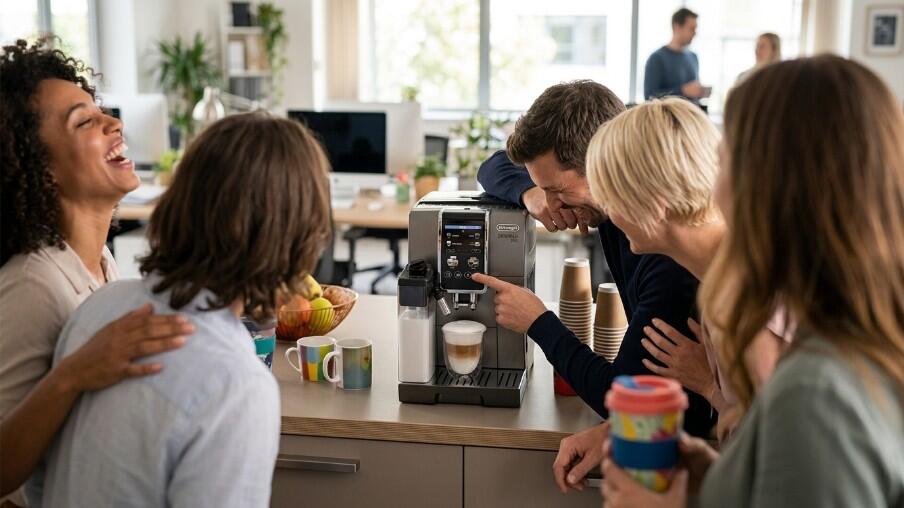
Office culture is rapidly changing, and so are the people who shape it. Many companies still try to make workplace culture visible through flashy perks like ping-pong tables, beanbags, free snacks, and nicely designed break rooms where people can gather. These perks are meant to create energy, creativity, and community, but they can sometimes feel staged or appeal only to certain groups of people.
In the hybrid era, employees have become more selective about what makes the office worth the journey. They are no longer commuting just to sit at a different desk. What still brings them in is something simpler and more meaningful: the chance to connect with people in real life. More often than not, that connection begins with a chat around the espresso machine.
Coffee Breaks Create Community
The coffee break has survived every reinvention of office life because it was never really about coffee alone. It is a ritual, a pause, a low-pressure invitation to interact. Unlike scheduled meetings or team-building activities, coffee breaks do not demand an agenda. They create a space where people can drift into conversation. In an increasingly digital world, that kind of informal contact is becoming more valuable than ever.
Recently, this need for connection has become one of the main reasons employees choose to commute. A high-quality coffee setup becomes a big part of that. It gives people a reason to gather. The smell of fresh beans, the sound of grinding, the small queue before a morning meeting – these are subtle cues that the workplace is alive. They remind people that work is not only a stream of tasks, messages, and deadlines, but also a shared human experience.
The Office Tradition That Has Always Worked
Office games like ping-pong can still be a good way to socialise, but they are not for everyone. They often require people to ask others to join in, which can feel awkward, especially for more introverted employees. The coffee machine, meanwhile, creates the meeting point itself. Everyone has a reason to be there: the early riser getting a first cup, the busy employee taking a quick breather, the new colleague finding an easy way into conversation, or the outgoing teammate turning a refill into a chat.

This matters because collaboration does not only happen in conference rooms. Some of the most useful workplace moments are spontaneous: a colleague overhears a challenge and offers a shortcut, two departments discover they are solving the same problem. Digital tools are excellent at preserving communication, but they are less effective at creating a community. The coffee break fills that gap.
Coffee Badging: A New Reason to Come Into the Office
The rise of “coffee badging” makes this even clearer. The term is often used to describe employees who come into the office briefly, make an appearance, enjoy a good coffee, take their imaginary badge for it and then leave to continue to focus on their work elsewhere
At first, it might look like employees are just coming in to tick a box. Seen in another way, coffee badging shows that people are not rejecting the office itself. They are rejecting the idea of being there just for the sake of it. They come in when the office offers something genuinely useful: connection and conversation.
The Coffee Break as the Office’s Social Glue
Ultimately, coffee is the office’s social glue. It softens hierarchy and turns coworkers into friends. It helps create moments of trust that later make difficult conversations easier. A five-minute chat over coffee can do what a dozen Slack messages cannot: build trust, read tone, and spark ideas through presence. These interactions may seem small, but over time, they shape whether a workplace feels transactional or alive.


