


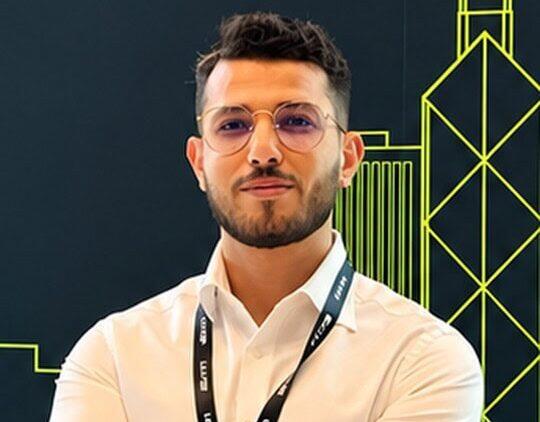
Originating from Gafsa, Tunisian founder Yahya Hmida launched XWorld as a self-funded international technology venture without initial staff or investor capital. After departing Tunisia on 24 August 2024, he chose Da Nang, Vietnam, as his operational base, leaning on early connections and a sharp determination to compete on the world stage.
XWorld LTD was incorporated in the UK on 20 February 2025, followed by XWorld LLC in the US in September that year, with contributors joining from several countries. The company’s focus is NORA, an enterprise AI operating system currently in development. In July 2026, XWorld exhibited as a startup at LEAP East in Hong Kong, and on 24 August 2026, exactly two years after leaving Tunisia, Yahya pitched remotely as an IPHatch Asia finalist before the company went on to win IPHatch Asia 2026.
The focus now is turning that progress into a reliable product and first customer relationships. Yahya shared with us how he built XWorld from Da Nang, what NORA is designed to do and where the company goes next.
You left Tunisia in August 2024 and made Da Nang your base, with no investors or established support network. What made you choose Vietnam, and what were those first few months like?
I originally came to Vietnam planning to stay for three months as a digital nomad, then move to another country and continue that lifestyle. But I enjoyed life in Da Nang and decided to stay. What began as a temporary stop became my home and the base from which I built XWorld.
The first months were difficult. I was far from my family and my country, rebuilding my everyday life from the beginning. Starting a company at the same time added another challenge. I was building from zero, without outside funding or a ready-made organisation behind me.
What I had was belief in the vision and the willingness to use my connections and build new ones. After settling in Da Nang, I established XWorld, brought people together and began developing the company. The team and support network grew gradually. That beginning is an important part of the story for me: I started with the conviction that the company could exist, then worked to bring the people and resources around it.
What problem is NORA built to solve, and how does it differ from the enterprise AI tools organisations already use?
We’re developing NORA as an AI operating system that connects an organisation’s knowledge, tools and everyday operations. I want it to understand business context, help people make decisions and carry work through to a clear outcome, with governance and human oversight built into the process.
The experience I envision includes a conversational 3D avatar. People would be able to speak naturally with NORA about their business, understand what is happening across operations and coordinate work through that interaction. The avatar would be the human-facing interface to a deeper operational system.
Underneath that experience, we’re building towards a reusable core that can adapt to different organisations, industries and languages, while working with their existing tools and other AI platforms where supported.
Our intended distinction is the connection between natural interaction, business understanding and continuity of work. A request should retain its context, ownership and progress as it moves between people and systems. That complete experience is the vision guiding NORA’s development.
You’ve described NORA as an early MVP with broader enterprise capabilities still in development. What can it do today, and what’s still to come?
The MVP supports user registration, AI chat and voice interaction in a local development environment. The existing build also contains early components for documents, tasks and reporting. We’re working with our technical partner on a structured assessment of the platform and the next stage of development.
The immediate priority is to connect and strengthen those foundations into a dependable end-to-end business workflow. That includes reliable access to company knowledge, work that continues across sessions, clear permissions and approvals and actions whose results can be checked.
The broader roadmap includes the conversational 3D avatar, deeper understanding of business operations and selected integrations with the systems an organisation already uses. We’re developing that vision in stages, with the first pilot as the next practical goal.
Your team spans Tunisia, Bangladesh and other countries while you’re based in Vietnam. How do you coordinate work across borders and time zones, and what has that taught you about building a company remotely?
Over the course of building XWorld, contributors have come from Tunisia, Bangladesh and other countries. The team has evolved, and coordinating across time zones has required personal flexibility, especially at the beginning.
I have had to adjust my hours, stay available when colleagues were working and make time for discussions that didn’t fit a normal Vietnam schedule. When much of the team lives in a different time zone, the founder has to make an extra effort to keep things moving while the foundations are being established.
Alongside that availability, I focus on written product requirements, task tracking and clear review points. I define the business outcomes, and the technical team recommends how to deliver them.
The lesson is that early commitment needs to develop into a sustainable way of working. Clear ownership, documented decisions and good handovers help the company become less dependent on everyone being online at the same time.
Why did you choose to incorporate XWorld in the UK, and what led you to add a US entity in September 2025?
For me, as a Tunisian founder living in Vietnam, the UK was the most practical and accessible route to establishing the company. It suited my circumstances and my ambition to build an international business while continuing to work from Da Nang.
I incorporated XWorld LTD in February 2025, then established XWorld LLC in the United States in September as part of developing a broader international structure.
Da Nang remains my personal and working base, while the company develops through people and relationships across borders. At this stage, the priority is making that structure support product development and future commercial activity.
XWorld has been accepted into programmes including Google for Startups Cloud, Atlassian for Startups and AWS Activate, and was selected for an ElevenLabs Grant. What has that support meant in practice for a self-funded company, and what would you tell other founders applying?
The practical support has helped our limited resources go further. Google Cloud and AWS credits support eligible infrastructure costs and Atlassian provides tools and resources for organising work, while our selection for an ElevenLabs Grant connects with our interest in voice interaction. Guidance and founder communities have also been valuable.
There is a personal side to it too. Being accepted into programmes run by companies whose products you respect gives you a real boost. For me, it strengthened my confidence and encouraged me to keep building.
My advice is to give yourself the opportunity to apply. Don’t decide you are too small or too early simply because the organisation has a big name. Check whether the programme fits your stage, explain your idea honestly and show how you intend to use the support.
You still have to do the work, but you should not rule yourself out before anyone has had the chance to consider you.
XWorld was named an IPHatch Asia 2026 winner and is in the process of receiving a Panasonic-origin US patent. What does the patent cover, how does it fit with NORA, and where is the transfer process now?
The patent, US9825773B2, concerns device control using speech commands together with camera-derived information about the user’s line of sight.
Its relevance to our vision is in more natural interaction between people and intelligent systems. We plan to explore how voice and gaze could support specific NORA experiences, particularly as we develop the broader conversational interface. This is a focused research and development direction alongside the enterprise operating core.
XWorld and Piece Future have signed the patent assignment agreement through IPHatch. We’re now working through the formal transfer and recordation procedures. Those administrative steps take longer than signing the agreement, and that’s the stage the process has reached.
XWorld is self-funded, pre-revenue and doesn’t have customers yet. What does the route to your first paying customer look like, and are you planning to raise funding?
Our immediate priority is the first pilot. We want to work with an organisation on a specific operational problem, agree on a manageable scope and demonstrate a complete workflow in practice.
That means establishing clear measures, such as the time a process takes, the manual steps involved and the ability to trace the result. The route to a paying customer is to show value through that pilot and build a commercial relationship around the outcome.
Our planned sequence is to establish that initial proof, then raise funding to develop and expand from it. We want prospective investors to see evidence of what NORA can do for an organisation. We remain self-funded and pre-revenue, and the pilot is the next milestone we’re working towards.
What has been your biggest setback so far, and how did you work through it?
The biggest challenge has been translating the vision in my head into something a technical team could understand and build consistently. I am a non-technical founder. At the beginning, I could picture the experience I wanted, but I didn’t always know how to express it in a form developers could implement.
That created misunderstandings and rework. People could be putting in effort while working from different interpretations of the product. Changes in the team made continuity more difficult as well.
I learned that communicating the vision was a responsibility I had to develop as a founder. I have put more emphasis on written requirements, concrete examples, user journeys and reviews before development moves too far in a particular direction. We’re also using a structured technical assessment to decide what to retain, improve and prioritise.
The work continues, but I now have a clearer approach: make the intended outcome understandable, check that the team shares that understanding and review what is actually being built.
What advice would you give to founders trying to build an international company from outside the established tech hubs?
You have to be the first person who believes in what you are building. Before asking a team, a programme or a potential partner to commit, you need to understand your own vision and communicate why it matters to you.
That belief should be visible in the way you speak, the decisions you make and how you keep working through difficulties. It can give other people the confidence to take the next step with you.
Then make the vision concrete. Start with a problem you understand, build something you can show, follow through on your commitments and be honest about your stage. Give yourself the chance to approach people and apply to programmes, even when their names feel much bigger than your company.
I started far from the established technology hubs, and XWorld is still early. My experience has taught me that conviction, relationships and consistent work can help you begin building from where you are.


