



Modern consumption-based data platforms charge organisations for execution behavior rather than static infrastructure capacity. Cloud data warehouses generate billable events through query design, execution frequency, and transformation logic. Traditional FinOps frameworks deliver macro-level financial visibility and budget allocation across cloud environments.
Billing-derived spend views fail to isolate the specific software pipelines or machine learning models that cause cost spikes. Enterprise cost governance requires extending financial management down to execution-level telemetry and upward to design-time architecture.
TL;DR
- Modern data platform expenses accumulate through query execution, pipeline dependencies, and token consumption rather than static infrastructure uptime.
- Traditional FinOps practices fail to control data platform spending because warehouse tagging and monthly spend dashboards cannot isolate bad query logic or upstream architectural waste.
- Organisations partnering with Future Processing address structural limitations by embedding cost-aware design standards directly into software delivery workflows.
- Executing a FinDataOps model requires tracking runtime telemetry, applying shift-left governance in CI/CD pipelines, and establishing data product unit economics.
The Anatomy of Modern Data Platform Costs
Modern data platforms generate expenses through dynamic execution behavior rather than fixed infrastructure capacity. On platforms such as Snowflake, Google BigQuery, and Databricks, costs accumulate every time code executes against raw or transformed data. Understanding these cost mechanics requires evaluating behavioral drivers, virtual billing units, and shared compute environments.
Behavior Over Capacity
Data platform bills reflect execution efficiency rather than hardware provisioned over time. Organisations often consult engineering specialists like Future Processing to audit these structural FinOps data platform limitations when spending increases without clear operational cause. Inefficient SQL queries, exploding joins, unnecessary full table scans, and high-frequency dashboard refresh loops consume compute resources rapidly.
Data engineers write transformations against live datasets that scale continuously. A pipeline or dbt model running safely in development can experience exponential cost growth in production when upstream table volumes expand, even if the underlying query code remains unchanged.
Abstract Billing Units
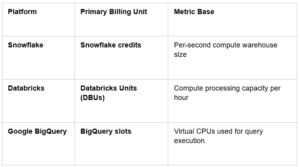
These virtual currencies obscure the direct relationship between technical execution and financial output. A sudden surge in credit or unit consumption alerts finance teams that spending has increased. However, raw billing metrics cannot explain whether an unoptimised join, a runaway orchestration loop, or a multi-tenant dashboard query caused the cost spike.
The Shared Compute Attribution Problem
Data cloud compute is frequently multi-tenant, serving multiple business units, analytical tools, and pipeline orchestration layers simultaneously. A single data warehouse may run transformation jobs, executive BI dashboards, and ad-hoc data science queries at the same time.
Resource-level cloud tags mark the container, but they fail to travel with individual execution tasks inside the warehouse. When several departments query shared datasets, attributing line-item expenses to specific teams leads to internal allocation disputes rather than clear operational ownership.
Why Infrastructure-Centric FinOps Hits a Wall
Traditional FinOps practices struggle to control modern data platform bills because financial controls built for static infrastructure cannot parse dynamic, query-driven execution. Standard frameworks optimise compute uptime, memory, and network storage. Modern consumption-based data engines generate cost through query logic, transformation routines, and pipeline dependencies. Organisations attempting to constrain data platform expenses through traditional infrastructure telemetry face several structural limitations.
The Reporting Trap and the Tagging Illusion
Resource tagging identifies spend owners, but metadata alone does not optimise unperformant code. Traditional FinOps generates monthly spend reports categorised by cloud account, business unit, and environment. These reports provide cost visibility, but they fail to detail the architectural choices driving those figures.
Engineers frequently receive dashboards that display rising database costs without receiving technical insight into specific query bottlenecks. Tagging a database cluster identifies the team responsible for the billing metric. It does not equip or compel developers to rewrite an unindexed join or adjust a full table scan.
Upstream Architectural Waste
Cost spikes on modern data platforms typically originate upstream in system design rather than in resource allocation. Broken data lineage, duplicate pipelines, unmanaged table growth, and uncoordinated transformation models run continuously without triggering standard cloud usage alerts.
Traditional FinOps dashboards monitor capacity limits and idle instances. They cannot flag redundant orchestration jobs, unused datasets, or unoptimised dbt transformation scripts that scan terabytes of historical data repeatedly.
The Commitment Plateau
Capacity reservations and savings plans yield temporary structural cost reductions without changing baseline engineering habits. Savings plans and reserved instances commonly decrease cloud compute expenses by 20 to 40 percent.
These discounts represent a single financial event. Once an organisation applies these commitments, cloud spend resumes its upward trend if underlying engineering practices remain unchanged. Continuous cost efficiency requires modifying how data engineering teams design, test, and deploy workloads.
Bridging the Gap
Closing the decision gap requires aligning financial visibility with engineering execution. Technical teams must abandon reactive billing reviews and adopt active architectural governance across the software delivery lifecycle.
Engineering leadership must establish clear linkages between financial telemetry and daily deployment decisions. Combining execution-level metrics with design-time guardrails creates a sustainable foundation for cloud financial management.
The AI and LLM Wildcard: Why Tokenomics Escalates Cost Volatility
Artificial intelligence and large language model (LLM) workloads introduce non-deterministic execution behaviors that break traditional cloud financial forecasting models. While classical data workloads scale with row counts and compute seconds, generative AI expenses scale with token consumption, context lengths, and dynamic model routing. These factors create rapid budget deviations across modern technology environments.
Unpredictability of Probabilistic Workloads
Generative models respond probabilistically, producing varying output lengths and reasoning steps from identical prompt inputs. This dynamic behavior makes forward-looking cost prediction difficult, even when total request volume remains static.
Token-based pricing introduces additional technical complexity. Token counts vary by model architecture and tokenizer, while minor variations in prompt engineering or context window retentions significantly alter total API expenses.
The Tokenmaxxing Trap
Unmonitored developer incentives contribute significantly to enterprise AI spend waste. In a 2026 enterprise survey published by Harness.io on the State of AI in FinOps, 73 percent of IT leaders reported that AI projects exceeded their budgeted allocations.
The survey also highlighted that 57 percent of organisations encouraged tokenmaxxing—maximising AI consumption across business units without assessing performance outcomes. Consequently, Harness.io estimated that 26 percent of enterprise AI budgets are wasted due to diffuse ownership and hidden operational patterns.
Infrastructure Telemetry Versus Model Telemetry
Traditional cloud FinOps monitors virtual machine utilisation, disk usage, and network throughput. These hardware-level signals fail to capture token burn rates, model snapshot adjustments, or prompt debugging cycles. As Konrad Bałys, Head of Engineering at Future Processing, observed in their AI transformation study: “When one part of the process speeds up, a new wall appears somewhere else. One person being faster gives us nothing. The whole team has to be faster, in every phase.”
Effective AI cost management requires tracking model-level unit economics across the entire software engineering lifecycle. Organisations must evaluate cost per inference, monitor API rate limits, enforce token quotas, and route simpler tasks to smaller, specialised models instead of relying on expensive frontier models by default.
Extending FinOps into FinDataOps: How to Close the Decision Gap
Controlling modern data platform costs requires extending FinOps into an integrated FinDataOps operating model. This approach merges financial accountability with DataOps and MLOps engineering workflows. Organisations move from passive month-end reporting toward real-time execution intelligence, shift-left governance, and data product unit economics.
Execution-Aware Telemetry
FinDataOps relies on runtime telemetry to map query logs, job histories, and system events to specific cost owners. Engineers inject structured metadata, such as team name, environment, project ID, and business purpose, directly into query comments and session parameters.
Query tags travel directly with execution tasks through shared warehouses. Normalising this runtime metadata to open standards like the FinOps Open Cost and Usage Specification (FOCUS) allows organisations to assign costs accurately to individual pipelines, data products, and business units.
Shift-Left Cost Governance
Shift-left cost governance embeds financial checks directly into engineering workflows before code deploys to production. Rather than analyzing spend retroactively on monthly dashboards, development teams review resource implications during design and code reviews.
Organisations enforce policy-as-code guardrails within continuous integration pipelines, data transformation frameworks like dbt, and Infrastructure as Code templates. Setting automated query limits, establishing max-warehouse scaling bounds, and reviewing query execution plans proactively prevent costly software defects from reaching live environments.
Data Product Unit Economics
Mapping execution telemetry to business metadata enables organisations to calculate precise unit economics. Teams evaluate exact unit metrics, such as cost per pipeline run, cost per active user, cost per dashboard refresh, and cost per AI inference.
Unit economics allow technology leaders to evaluate trade-offs between freshness, latency, accuracy, and expenditure. Data leaders leverage these operational metrics to make informed portfolio decisions, determining which data products to expand, re-architect, throttle, or retire based on measurable business value.
Frequently Asked Questions
Why can traditional FinOps frameworks not control data cloud costs?
Traditional FinOps tracks static infrastructure uptime, whereas data cloud platforms charge for dynamic workload execution like queries, transformations, and scans. Applying basic resource tags to a shared warehouse fails to identify or fix unoptimised SQL code, exploding joins, or redundant dashboard refresh loops.
What is FinDataOps and how does it differ from standard FinOps?
FinDataOps merges cloud financial management directly with DataOps and MLOps engineering workflows. Standard FinOps delivers retrospective monthly billing reports, while FinDataOps uses runtime query tagging, shift-left CI/CD cost guardrails, and automated query execution limits.
Why do AI and large language model workloads cause sudden budget overruns?
Generative AI models behave probabilistically, producing variable output lengths and token counts from identical user prompts. Enterprise surveys indicate that 73 percent of AI projects breach budgets, while writing nearly 200 lines of custom SQL is often required just to normalise proprietary vendor billing data into standard FOCUS schema.
How does shift-left cost governance prevent unexpected data platform spend?
Shift-left governance inserts automated cost policy checks into continuous integration pipelines and transformation tools before code reaches production environments. Engineering teams evaluate max-warehouse scaling bounds, storage tiering rules, and query cost estimates during pull request reviews rather than waiting for monthly finance reports.
What initial steps should technology leaders take when data platform bills keep rising?
Technology leaders must audit recent cost spikes back to their underlying architectural decisions and deploy runtime metadata logging immediately. Teams that establish team-level efficiency targets,such as cost per pipeline run or cost per active user, typically isolate wasteful executions within 30 days of telemetry ingest.


