



Aleksandr Frolov is a co-founder of Target Global and Palta. He works with early-stage companies and product-led strategic projects, focusing on how fintech and healthtech firms earn trust, handle sensitive tasks, and prepare for international markets.
Aleksandr Frolov: Strategic Work and Company Building

Frolov studied Economics at the London School of Economics, then took an MBA at London Business School. The first degree covered markets and financial analysis; the MBA added management and strategy, plus practical work in business development.
He applied that education to technology investment and company building. Frolov co-founded Target Global in 2012. The firm invests in technology companies at different stages and supports them as they expand internationally.
Alongside the investing, he has led strategic projects and co-founded ventures of his own. One of them is Palta, a health technology company built around preventive care and wellbeing.
The move into entrepreneurship added product development and company-building experience to the financial and management background of Frolov Alexander.
Frolov Target Global: Current Role and Strategic Work
At Target Global, Aleksandr Frolov has worked on strategic projects and co-founding initiatives, such as Palta. His strategic work concerns choices that shape a company before its operating model becomes fixed.
They include defining the first product priority, deciding which customer group to serve, setting the sequence of hiring, and determining when the business has enough evidence to enter another market.
Why Fintech and Healthtech Sit Together
Fintech and healthtech are different industries, but in both a digital product stands between the user and a system only specialists understand.
A fintech company takes payment infrastructure, compliance, fraud prevention and account management and turns them into services people and businesses can use without following the financial processes underneath. Healthtech does the same job with medical knowledge, personal data and behavioral guidance.
The company-building problem is therefore similar. A team has to work out what the user needs to see and how much of the machinery stays behind the interface. It also has to decide which expertise belongs in-house: payments, risk and compliance on one side, medical quality, privacy and content on the other.
That overlap is why the two sectors sit in the same strategic view in Frolov’s work, despite the differences in their products and operating models.
Fintech: Infrastructure, Control, and Repeat Use
The fintech side of Target Global’s portfolio and investment history include consumer finance, global payments, business accounts, and digital asset infrastructure. Each area represents a different layer of the financial system, and each is relevant to the work of Frolov Alexander.
Revolut, Rapyd, Finom, and Copper are all marked as exited on Target Global’s portfolio pages. What follows describes the companies themselves, not current holdings.
Revolut reached 68.3 million retail customers in 2025 and secured key banking or payment licences across Mexico, India, Colombia, and the UAE. Its growth shows how a fintech product can move from everyday convenience to broader financial infrastructure.
Rapyd works from another angle. It describes itself as a global payments platform that helps businesses accept payments, send payouts, and access payment methods through one unified solution. The user may never see the infrastructure, but the checkout, payout, and cross-border experience depend on it.
Finom brings the problem closer to entrepreneurs. Business accounts, invoices, cards, paperwork, and cash visibility are combined around the operating needs of smaller companies. The product is judged by whether it reduces administrative work rather than by the number of financial functions alone.
Copper adds the institutional side of digital assets. The company provides digital asset custody and trading solutions for institutions. The customer is different from a retail banking user, but the same pressure remains: the product has to make a complex financial task more controlled.
Healthtech: Privacy, Language, and Daily Behavior
Healthtech sits closer to personal life. Users may enter information every day, and it changes as they go. It also tends to need explaining rather than closing out in a single transaction. So the interface is only part of product quality; the rest is how that information gets interpreted and worded back to the user.
Palta describes itself as a portfolio of preventative digital health brands. Its products include Flo, which covers female health, and Simple, which covers nutrition and eating habits. The brands stay separate because each need requires its own user journey and subject knowledge.
Flo Health is the most visible product in the Palta ecosystem. As its team states, Flo is the world’s most popular female health app, with 420 million downloads and 80 million active monthly users. The product supports users across different stages of female health.
The project also brings a medical education layer into the category. In 2026, Flo and Mayo Clinic announced a global digital study on perimenopause awareness. In that announcement, Flo referred to its work with more than 100 medical experts.
Palta as a Strategic Project
For Aleksandr Frolov, Palta matters as a strategic project because it organizes several health and wellbeing companies rather than stretching one application to cover every use case.
Each of them still needs a defined audience, a specific problem to solve, its own product plan and a commercial model that fits. Those choices are what keep the purpose and identity of each brand intact.
Palta adds a company-building dimension to the Frolov Target Global work. At the portfolio level, the questions are which health needs justify separate companies, where the boundary between two products should lie, and which opportunities are substantial enough to support a standalone business.
Fintech and Healthtech in One Operating View
Fintech and healthtech require different expertise. The operating questions still overlap.
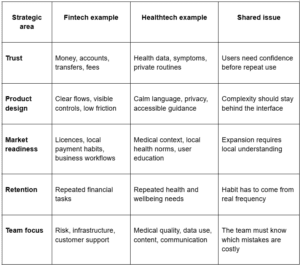
The overlap is operational, not cosmetic. In both sectors, the product has to turn a sensitive task into a repeatable relationship without making the user work harder.
Practical Signals in Early-Stage Projects
An early-stage company has little operating history, so evaluation cannot depend on scale alone. A large market or a polished launch may justify further attention, but neither shows whether the business can support continued development
In the work of Aleksandr Frolov, the more useful checks concern evidence and execution:
- Problem frequency. The need appears often enough for the product to become part of a real workflow or routine.
- Cohort behavior. Later groups of users behave at least as well as the first enthusiastic customers.
- Commercial logic. Pricing, acquisition costs, and service costs leave a credible path to sustainable economics.
- Team learning. The company converts product data and customer feedback into specific decisions.
- Market transferability. Demand outside the first audience is supported by tests rather than assumptions.
- Operational discipline. Responsibilities remain clear as the company adds people and processes.
Fintech and healthtech make these signals visible quickly. Users do not keep a financial product that feels unreliable. They do not keep a health product that feels careless. Both sectors punish weak execution early.

How Portfolio Experience Travels Across Sectors
Target Global’s public portfolio and investment history extend beyond fintech and healthtech into business software, AI, mobility, marketplaces, and other technology categories. For Frolov Alexander, each category adds a different type of operating evidence.
Business software and AI show how adoption depends on observable value inside a workflow. A demo may attract attention, but retention comes from saved time, better decisions, or cleaner operations.
Mobility and marketplace businesses bring operational complexity. They have to balance supply, demand, service quality, and local execution. Problems that look like product issues often turn out to be operating issues.
That cross-sector experience matters because strategic projects rarely follow a clean template. A health application may borrow methods for measuring consumer engagement, while a fintech infrastructure company may face the same sequencing problems as a marketplace entering a new country. The method can travel even when the sector-specific answer cannot.
Where Investing Ends and Company Building Begins
Investment work and company building can concern the same business, but they sit at different levels. An investment decision weighs one opportunity against others, determines whether to commit capital, and sets the milestones that would justify further support.
Company building starts where those judgments have to become an operating sequence. Someone decides which role gets hired first, which feature waits, who owns a critical process, and what the team must prove before the company spends more or enters another market.
Aleksandr Frolov works on both sides of that line. Target Global provides the investment setting, while strategic projects and co-founding initiatives involve direct participation in the formation of products and companies.