



When a company acquires another business, the immediate priorities are often financial integration, employee transitions, operational continuity, and customer retention. Telecom contracts and corporate mobile accounts rarely receive the same attention.
Yet every acquisition can bring hundreds of new wireless lines, overlapping carrier agreements, unfamiliar billing structures, and services that continue generating charges long after they are no longer needed.
Rapid expansion creates similar challenges. As enterprises open new offices, facilities, and operating locations, their telecommunications environments become increasingly difficult to manage. What once involved a handful of carriers and invoices can evolve into a fragmented network of contracts, devices, services, and billing accounts.
For companies navigating these transitions, Telecom Expense Management (TEM) and Wireless Expense Management become essential to maintaining financial visibility and operational control.
IntraTEM, an enterprise Telecom Expense Management provider founded in 2005, helps organisations address these challenges through a human-led, fully managed approach to telecom and mobility spending. Rather than relying exclusively on software to identify discrepancies, the company combines technology with experienced professionals who manage carrier relationships, resolve billing issues, and implement ongoing cost-saving opportunities.
Why Acquisitions Create Hidden Telecom Expenses
Acquiring a company means inheriting its technology environment, including services and contracts that may have been managed independently for years.
The acquiring organisation may already have preferred wireless carriers, negotiated pricing, and established procurement processes. The newly acquired business may operate under entirely different agreements, with separate billing accounts, equipment inventories, and service providers. Voice and data services add another layer of complexity, as inherited internet circuits, phone systems, and connectivity contracts must be evaluated for redundancy, contract obligations, and compatibility with the acquiring company’s infrastructure.
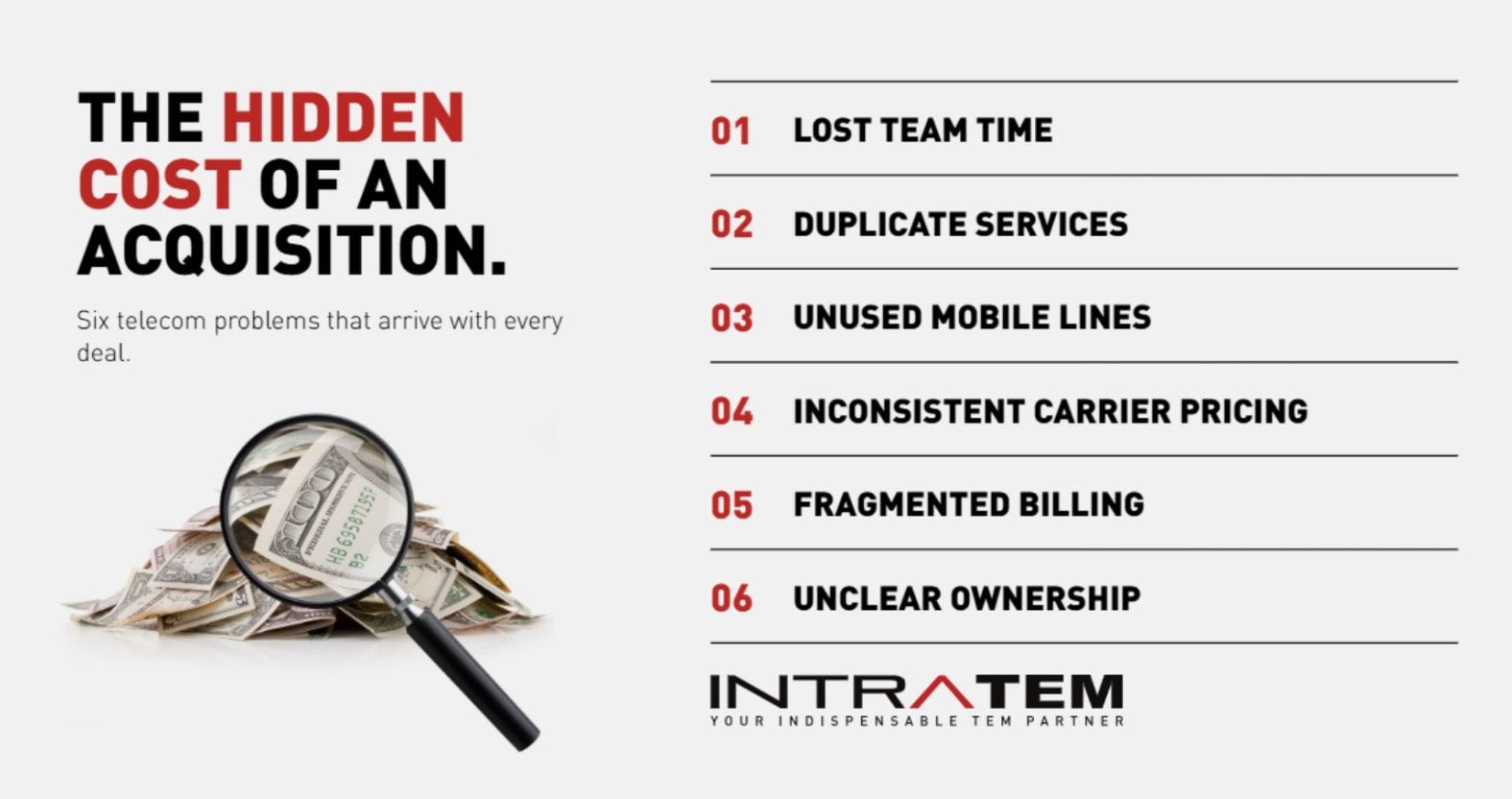
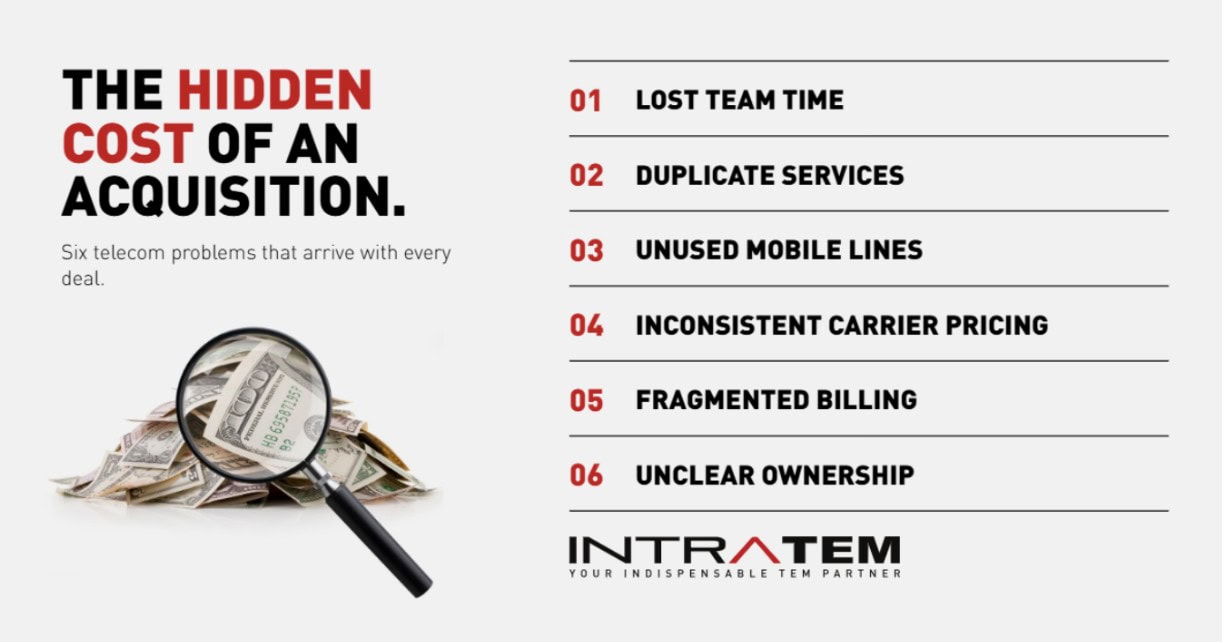
Without a coordinated Telecom Expense Management strategy, several challenges can emerge.
Duplicate services and overlapping contracts. Two organisations may maintain similar telecom services, carrier agreements, or wireless plans even after their operations are consolidated.
Unused mobile lines and devices. Employee departures, organisational restructuring, and role changes can leave wireless lines active without an assigned user.
Inconsistent carrier pricing. Different business units may pay different rates for comparable services, making it difficult to determine whether existing agreements remain competitive.
Fragmented billing and inventory records. Invoices, contracts, and device inventories may be maintained across multiple departments and systems, limiting visibility into total telecom spending.
Unclear ownership. During an acquisition, responsibility for managing telecom expenses can shift between IT, Finance, Procurement, and Operations, allowing billing discrepancies and service issues to go unresolved.For organisations with large mobile fleets, Mobile Expense Management adds another layer of complexity, from employee provisioning and device inventory to carrier billing and service cancellations.
These challenges do not necessarily indicate poor management. They are often the natural result of combining organisations that previously operated independently.
The difficulty is establishing a consistent process for identifying, correcting, and preventing unnecessary expenses while the business continues operating.
More from Business
- Anthropic’s CEO Reportedly Floated Video Games As A Fix For AI Job Losses: Is That A Plan Or A Punchline?
- University Of Washington: Successful Alumni Who Founded Companies
- When Bad Publicity Becomes Good Marketing: Why Brands Are Embracing Controversy
- Poor Offboarding Processes May Leave Former Employees With Access To Sensitive Data
- HeyGen Alternative Platforms For Training Teams: 2027 Comparison
- Could The Landline Switch-Off Create New Opportunities For Rural Businesses?
- Why Are Startups And VCs Suddenly Hiring “Ecosystem Leads”?
- Could GTA 6 Turn Gaming Into An Even Bigger Money-Making Machine?
Rapid Expansion Creates Similar Challenges
Acquisitions are only one source of telecom complexity.
Enterprises expanding into new markets, opening additional facilities, or growing distributed workforces face many of the same challenges, even without acquiring another company.
Each new location may require internet connectivity, voice services, wireless devices, and additional carrier accounts. Field employees may need smartphones, tablets, hotspots, or cellular routers. Meanwhile, existing services must be adjusted as staffing levels and operational requirements change.
The result is a telecom environment that rarely remains static.
A company opening ten new locations, for example, must do more than establish connectivity. It must coordinate provisioning, track service activation, verify billing accuracy, manage equipment, and ensure unnecessary services are disconnected when requirements change.
Without centralised oversight, expenses can accumulate across locations without a clear picture of what the organisation is purchasing or using.
This is where outsourced Telecom Expense Management services can help. A managed TEM provider can take responsibility for recurring administrative and operational tasks while internal IT teams concentrate on integrating new locations, supporting employees, and maintaining business operations.
How IntraTEM Helps Enterprises Manage Telecom Growth
IntraTEM’s approach centers on managing the work behind enterprise telecom spending, not simply reporting the numbers.
The company provides Telecom Expense Management and Mobile Expense Management services that help organisations maintain control as their environments become more complex.
Its services include invoice auditing, inventory reconciliation, carrier management, contract oversight, dispute resolution, and ongoing cost optimisation.
For an enterprise integrating an acquisition, that can mean identifying inherited services, reconciling billing accounts, reviewing carrier agreements, and determining where consolidation or optimisation opportunities exist. Integrating employees from an acquired company also requires coordinating wireless account transfers, individual user transfers of liability, device inventories, service plans, provisioning, and support to ensure mobile users transition without unnecessary disruptions or expenses.
For a company opening new locations, it can mean coordinating service changes, managing carrier relationships, and maintaining accurate records as new services and devices are added.
IntraTEM also maintains longstanding relationships with major wireless carriers and supports integration with enterprise systems, including IT service management (ITSM) and human resources information systems (HRIS) platforms. These capabilities help connect telecom management with existing operational workflows.
The company’s human-led model is particularly relevant during periods of organisational change. Identifying an unnecessary charge is one step; coordinating with a carrier, correcting the account, and verifying the resulting savings requires additional follow-through.
That distinction is central to IntraTEM’s positioning among enterprise TEM providers.
A Healthcare Organisation Recovers Millions in Telecom Costs
The financial impact of effective Telecom Expense Management can be substantial.
In one documented engagement with a major U.S. healthcare organisation, IntraTEM identified $1.67 million in annualised telecom savings and secured $268,000 in one-time billing credits within six months.
The results demonstrate the potential value of detailed invoice auditing, carrier coordination, and ongoing expense optimisation in a complex enterprise environment.
For organisations undergoing acquisitions or rapid expansion, these capabilities can be especially valuable because new services and billing arrangements are continually being introduced.
While not every organisation will experience savings of the same magnitude, the case illustrates how reviewing inherited contracts, billing records, and active services can uncover costs that might otherwise persist after a transaction.
Managing Mobile Services Across Acquired Businesses
The operational challenge is not limited to fixed telecom services. In a documented engagement with an energy-sector organisation expanding through acquisitions, IntraTEM helped centralise management of more than 273 mobile lines across two carriers. The initial review identified approximately $34,000 in projected annual savings, with more than $27,000 realised during the first nine months.
The work extended beyond finding lower rates. It included bringing wireless billing, procurement, provisioning, and carrier coordination into a more consistent process as the organisation incorporated additional businesses. The engagement subsequently expanded to other companies within the group.
The example shows how Mobile Expense Management can support acquisition integration by helping enterprises account for inherited users and devices, maintain service continuity, and reduce fragmented administration.
Telecom Management as an Ongoing Part of Integration
Acquisitions and expansion can change an enterprise’s telecom footprint faster than its records, contracts, and internal processes can keep up. Reviewing voice and data services, reconciling carrier accounts, and managing the transition of mobile users are therefore ongoing operational tasks, not simply one-time opportunities to cut costs.
For enterprises comparing Telecom Expense Management providers, the practical consideration is whether a service model can maintain accurate inventories, coordinate changes with carriers, and follow through on billing corrections as the business evolves. Those capabilities can help organisations establish greater control over telecom spending while continuing to grow


