


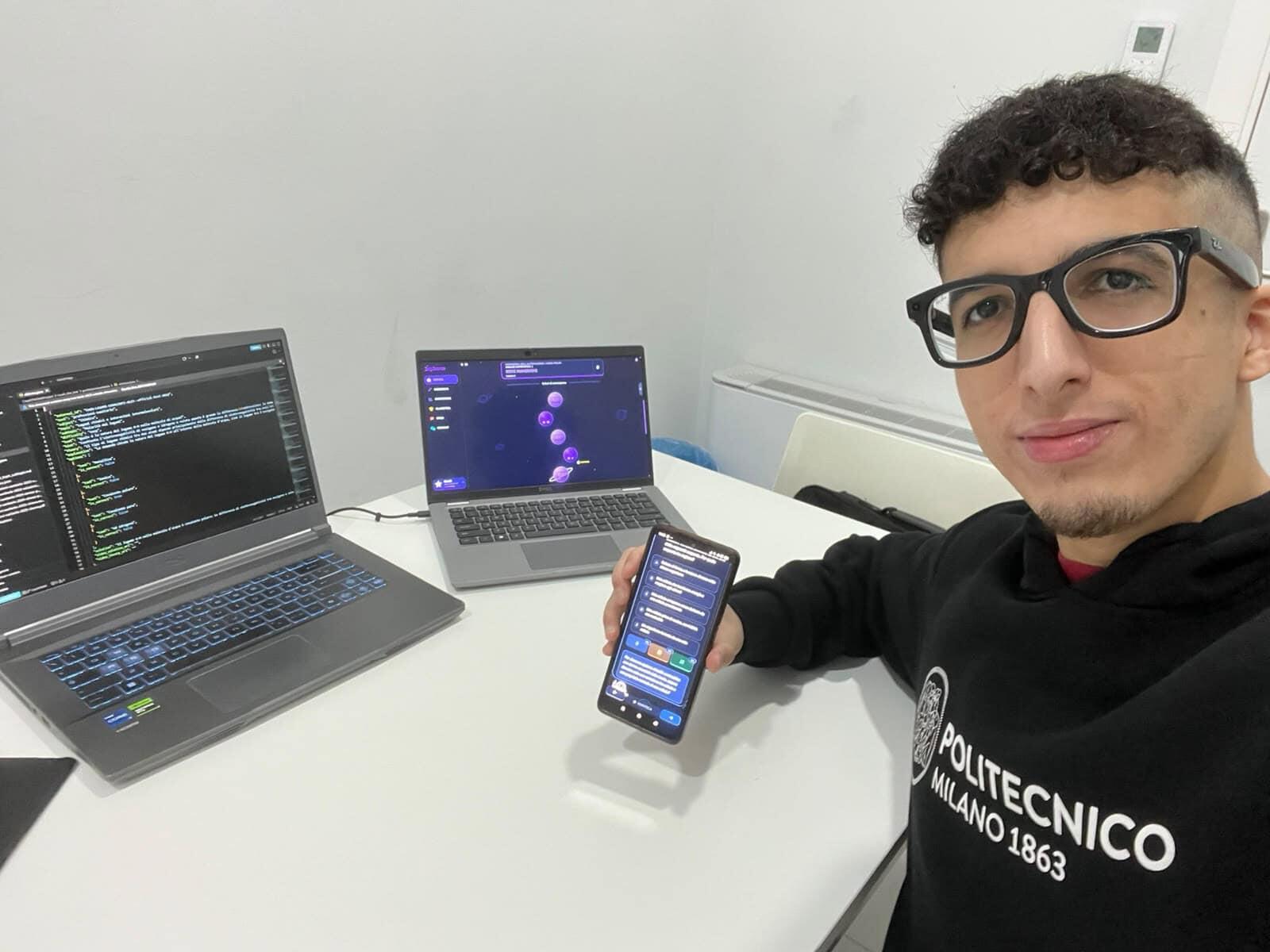
Most students can lose an entire evening to a video game and then struggle to get through an hour of revision. Chadi Guerrandou, an Italian founder who studied Computer Engineering at Politecnico di Milano, decided studying could borrow a few tricks from games. His app, Sapiverse, turns preparing for entire university exams into a video game, and he sums it up as Duolingo for every subject.
Students work through learning paths of illustrated lessons and interactive exercises, earning rewards as they go. They can also take on their friends in multiplayer challenges. Chadi built the whole platform himself with the help of AI, paying for it with his university scholarship and no investors. Sapiverse has since attracted thousands of users, paying customers among them, and he’s now working on bringing it to students worldwide.
Chadi shared with us how he borrowed ideas from Fortnite and Clash Royale to get students hooked on studying.
2. What inspired you to start Sapiverse, and what problem were you trying to solve?
I’ve loved video games since I was a kid, and I’ve always wondered why people can spend hours playing games but struggle to stay motivated while studying.
I realised that one of the biggest differences is how rewards work. When studying, you might work for months before getting the satisfaction of passing an exam. In video games, you’re constantly rewarded for making progress. I wanted to bring those immediate rewards into studying, so students could enjoy the process rather than just the final result.
Another thing I’ve always disliked about traditional education is being taught concepts without first understanding what they’re useful for in the real world.
The idea became a real project when I was preparing for my engineering entrance exam and couldn’t find a platform that offered the complete learning experience I wanted.
That’s why I started building Sapiverse.
3. What has been your biggest challenge so far, and how did you overcome it?
Building an entire educational platform on my own, with almost no money. I had to handle everything: programming, design, infrastructure, educational content, payments and user experience.
The hardest part wasn’t simply getting the software to work. It was designing a learning experience that was both engaging and genuinely useful for preparing for exams.
I spent years testing features, removing things that didn’t work, and rebuilding entire parts of the platform.
AI allowed me to develop at a speed that would previously have required a team, while feedback from real students helped me understand what needed improvement.
I overcame the challenge by continuously iterating until I had a complete product that students were actually using and paying for.
4. How does Sapiverse work, and how do the challenges, hints and game-like progression keep students motivated?
Sapiverse divides an entire course into a learning path made of illustrated lessons, interactive exercises and tests.
Every lesson starts by showing what a concept is useful for in the real world. Then students learn it through clear explanations and illustrations, with space to take notes in their own words. Immediately afterwards, they practise what they’ve learned.
During exercises, they have three tools: a hint to help them get started, a theory reminder if they’ve forgotten something, and a step-by-step explanation to understand the solution.
For the gamification, I’ve used the mechanics of the most successful games. From Duolingo, I took XP, streaks, rewards and progression through small levels. From Clash Royale, I took 1v1 duels, where students challenge their friends by answering questions from their exams. From Fortnite, I took the idea of a lobby where players can choose between different game modes.
In Sapiverse’s lobby, students can choose between three modes: Duels, Exercises, and Tests. And from Chess.com, I took the idea of interactive assistance that helps you understand how to solve a problem instead of simply giving you an answer. There’s also a UFO mascot that encourages students throughout their learning journey.
The principle is simple: turn the long-term satisfaction of passing an exam into small, immediate rewards every time you make progress.
I want students to feel the same urge to complete the next lesson that makes them want to play one more game.
5. What was it like designing and building the platform on your own while studying?
It was incredibly demanding. Sapiverse was always my main focus because I believed its potential impact could be huge.
I was spending almost all my time working on the platform. At the same time, I had to keep passing my university exams to renew the scholarship that was funding Sapiverse. Balancing those two things was extremely difficult, but I managed to do both.
I had to handle everything myself, from programming and designing the learning experience to managing infrastructure and running a business. There were periods when I spent weeks building something, only to realise it wasn’t good enough and start again.
Being a solo founder also had advantages. I could make decisions immediately, experiment quickly, and change direction without waiting for anyone.
Eventually, I decided to dedicate myself to Sapiverse full-time.
6. How did you fund Sapiverse, and how has working with limited resources shaped your decisions?
I funded everything with my university scholarship, without raising money from investors. I kept my personal expenses as low as possible and invested what I could into developing and maintaining the platform. Having almost no budget forced me to find creative solutions.
One of the most important was building a system that allows users to create educational materials using frontier AI models within their free daily usage limits.
These materials can then be shared and reused by other students, creating a positive network effect: the more students contribute, the more learning resources become available to everyone, while keeping the cost of providing the learning experience low.
For the business model, I’ve decided to follow an approach similar to Duolingo Super: students can access the core learning experience for free, while a Premium subscription offers additional features.
For now, I’ve decided not to introduce advertising. I believe everyone should have access to high-quality education, regardless of their financial situation.
7. How did you find your first users, and what has helped the platform grow through entrance-exam preparation in Italy?
I found my first users by physically going to schools around Milan.
I visited dozens of schools, personally showing Sapiverse to students, helping them try it and collecting feedback. That’s how I acquired my first few hundred users.
Then I started making videos on social media, demonstrating how the platform worked and how students could use it to prepare for engineering entrance exams.
Those videos helped me reach thousands of users relatively quickly, without spending money on advertising or influencer campaigns.
Focusing initially on engineering entrance exams was important because I was solving a specific problem that I had experienced myself.
The students who joined during that phase also helped me improve Sapiverse through their feedback and how they used the platform.
Eventually, I expanded the product from entrance-exam preparation to entire university courses.
8. What have you learned from watching how students use the platform?
The most interesting discovery has been how much time some students are willing to spend studying when the experience is engaging.
I’ve seen students use Sapiverse for hours and return to continue their learning paths. By analysing how students progress through their courses and their overall usage patterns, almost like you would analyse player behaviour in a video game, I’ve seen very encouraging signs of how compelling the experience can be.
But I also learned that getting someone to register is very different from getting them to actually start studying.
Initially, too many students dropped out during onboarding, before experiencing the product. So I simplified the process to help them reach their first lesson faster.
Another important point is that Sapiverse isn’t just designed to make studying more engaging. The learning method itself is designed to be more effective than simply reading and repeating information.
Before learning a concept, students understand what it’s useful for in the real world. The course is broken down into small, manageable steps to avoid overwhelming them, and every lesson is immediately followed by exercises that require active recall.
Instead of passively rereading information, students have to retrieve it from memory and apply it. Then, through tests, they regularly check whether they’ve actually understood what they’ve learned.
It’s a much more structured approach to studying, combining motivation with learning techniques such as active recall, practice and frequent testing.
The engagement results are encouraging, and the next step is to measure how these methods translate into retention of knowledge and real exam performance.
9. What’s next for Sapiverse?
Right now, my priority is distribution. I’ve spent years building the product, and now I want to bring it to millions of students, starting with Italy and expanding internationally, especially into the United States.
I’m also focusing on growing Sapiverse through its own users. Students can already create and share learning paths, study together, compare their progress, and challenge their friends. The more students contribute, the more valuable the platform becomes for everyone.
But my long-term ambition is much bigger.
I want to build for education what Amazon built for commerce, what Netflix built for entertainment, and what Spotify built for music.
Education is one of the largest industries in the world. According to HolonIQ, global education spending is projected to approach $10 trillion annually by 2030.
Yet education is still extremely fragmented. We have universities, schools, online courses, tutoring platforms and countless learning tools, but no single global platform that people instinctively turn to whenever they want to learn something.
I believe there’s room for a global giant in education, a platform that makes learning accessible, effective and as engaging as entertainment. And I want Sapiverse to become that giant.
That’s the scale I’m building for.


