


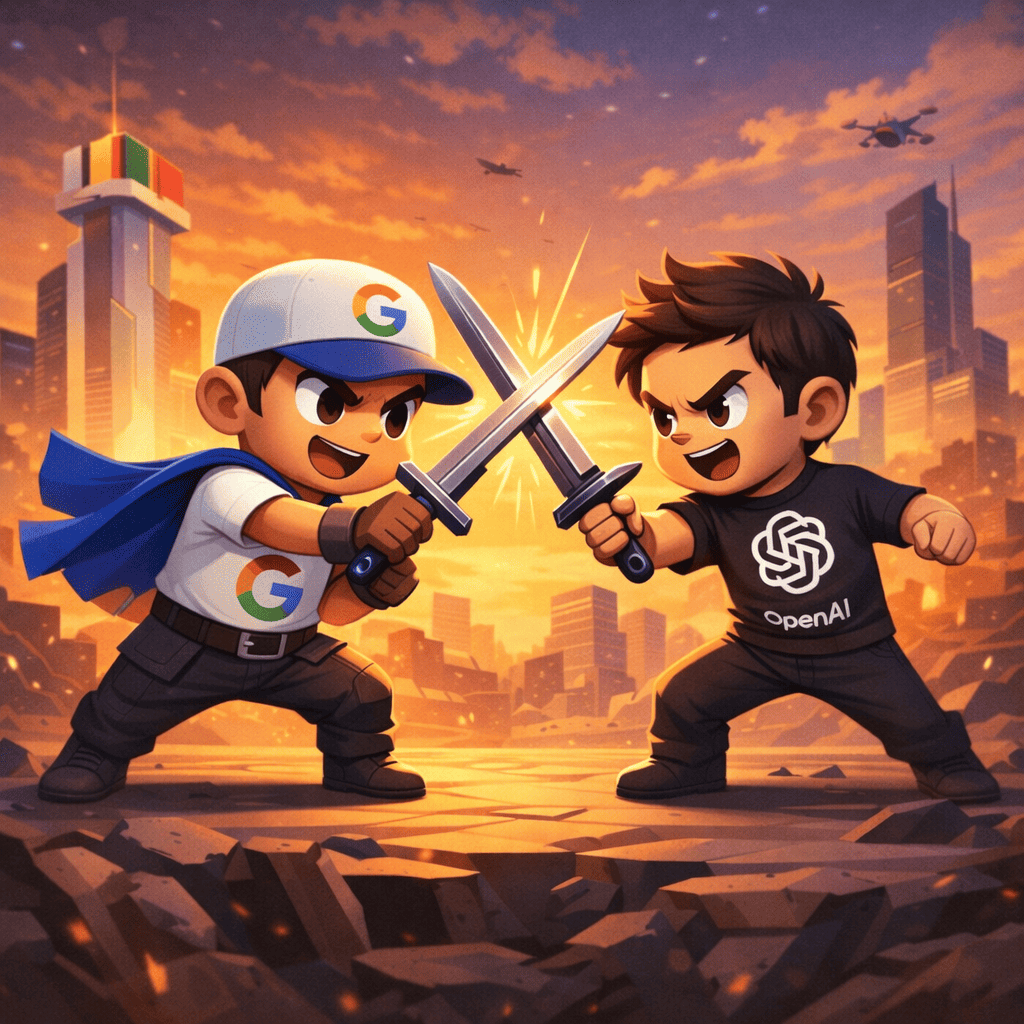
Since ChatGPT took the world by storm a few years ago, OpenAI has pretty much dominated public perception of artificial intelligence. ChatGPT became shorthand for generative AI itself, reshaping how people search, write, code and make decisions.
But, in 2025 and heading into 2026, that narrative is beginning to shift.
Google, long criticised for moving too cautiously despite its deep AI research roots, is mounting what many experts see as a credible comeback. It finally feel like they’re back in the game.
Through rapid advances in its Gemini models, heavy investment in infrastructure, and the deep integration of AI across Search, Workspace and Android, Google is reasserting its relevance in a race it once appeared to be losing (and not by a little bit).
At the same time, OpenAI continues to push product innovation and influence user behaviour, even as it faces constraints around compute, partnerships and scale.
According to industry experts, the rivalry isn’t just about who has the best model, but about ecosystems, trust, distribution and how people actually use AI in their daily lives.
Google’s Infrastructure Advantage and Ecosystem Strategy
Several experts point to Google’s infrastructure as its biggest strategic advantage in the current phase of the AI race. Unlike OpenAI, which relies heavily on Microsoft Azure for compute, Google owns and operates vast data centre networks, fibre infrastructure and cloud services at global scale. This vertical integration allows Google to deploy multimodal AI systems with lower latency and far more reliability, expecially for enterprise use cases.
Gemini’s evolution into a deeply multimodal system is central to this strategy.
Rather than positioning AI as a standalone product, Google is embedding it across tools people already use and love – from Search and Gmail to Docs, Maps and Chrome. This approach prioritises scale and continuity, enabling AI to operate quietly in the background of everyday workflows.
However, this same integration is also reshaping industries like journalism and digital marketing.
AI-generated overviews and prioritised snippets are changing how content is discovered, often reducing traffic to traditional websites. For businesses and publishers, Google’s AI resurgence brings both powerful new tools and difficult trade-offs, forcing a rethink of visibility, attribution and value in an AI-mediated web.
But, just because it’s difficult doesn’t mean it isn’t the way forward, and many people believe that this is, indeed, what a reliable, sustainable and realistic future of AI integration looks like. Perhaps Google didn’t immediately jump on the bandwagon with flashy AI tools like OpenAI and competitors did, but have they been quietly building something far more important all along?
OpenAI’s Product Momentum and the Battle for User Trust
While Google may have the infrastructure edge, OpenAI continues to lead in how users emotionally and practically engage with AI – and that’s no small win.
Experts working directly with businesses report that ChatGPT is no longer just a research tool, but a decision-making platform. Users are turning to it not only to gather information, but to choose services, evaluate options and take action.
This shift is already affecting how companies think about discoverability.
Some businesses are seeing early but meaningful referral traffic from AI platforms, with higher intent and stronger conversion rates than traditional search. OpenAI’s strength lies in clarity, speed and perceived neutrality – qualities that build trust even without an integrated ecosystem.
That said, OpenAI also faces real constraints, and these are becoming more and more of a problem as time goes on.
Its dependence on external cloud infrastructure limits scalability and raises costs, while competition with partners creates strategic friction. As both companies push toward autonomous agents and more proactive AI systems, the rivalry will likely hinge on who can balance power, usability and trust.
The next phase of AI leadership may belong not to the loudest innovator, but to the platform that best aligns technology with how people actually want to use it.
So, will that come down to OpenAI’s creation of platforms and features people have suddenly become dependent on? Or, will it be Google’s existing infrastructure, ability to scale and inclination to integrate AI into its plethora of existing platforms and features?
Only time will tell. But for now, we’ve had a few experts weigh in.
More from Artificial Intelligence
- Anthropic Accidentally Leaked Its Own Source Code, And The Internet Made 8,000 Copies Before Anyone Noticed
- Oracle Shrinks To Scale. Is This A Strategic Reset Or A Frantic Scramble To Stay In The AI Race?
- Harvey Just Hit An $11 Billion Valuation Without Building A Single AI Model, Here Is What That Means For Startups
- AI Is Now Sitting In On Your Therapy Session, We Should Probably Talk About That
- Are Oral Exams The Solution To AI Cheating? Education Leaders Weigh In
- Google Just Made It Easy To Leave ChatGPT. The AI Wars Are No Longer About Who Has The Best Model
- No More Dirty Talk: ChatGPT’s “Adult Mode” Suspended “Indefinitely” Over OpenAI’s Age Prediction Inaccuracy
- Artists Will Now Have More Control Over What Appears On Their Spotify Profiles
Our Experts:
- Mark Temnycky: Non-Resident Fellow at the Atlantic Council’s Eurasia Center
- Maddison Ryan: Founder of The Digital Hub
- Ivan Vislavskiy: CEO and Co-Founder of Comrade Digital Marketing Agency
- Sasha Berson: Co-Founder and Chief Growth Executive at Grow Law
Mark Temnycky, Non-Resident Fellow at the Atlantic Council’s Eurasia Center

“Launched in 2023, Google’s Gemini has evolved into a multimodal powerhouse. It was rebranded in 2024 to Gemini 2.5, which powers Google’s AI resurgence.
“Google’s Gemini 2.5 excels at multimodal reasoning, powering scalable enterprise tools such as Project Astra agents that automate finance workflows. Backed by $75 billion in cloud investments, it operates gigawatt-scale data centers that provide unmatched infrastructure, outpacing OpenAI. This is because of Google’s vertical integration with fiber networks and search ecosystems, which delivers reliable, low-latency AI at hyperscale. Meanwhile, OpenAI innovates models but is bottlenecked by power/partners, which risks delays in agentic rollout.
“Aside from these points, AI algorithms in Search Generative Experience are also reshaping journalism by prioritizing verified sources over clickbait, forcing outlets to optimize for AI-driven snippets while enabling defense and logistics applications via top GPQA benchmarks. This has also affected the number of views on articles.
“Regarding the original questions, OpenAI struggles with compute shortages—requiring vast GPU clusters of 100,000+ H100s for models such as o1—but lacks owned data centers, forcing reliance on rented Microsoft Azure capacity that limits performance and inflates costs. This heavy dependency on Microsoft adds bottlenecks, as Azure prioritizes its own Copilot tools and competes directly, stalling OpenAI’s path to independence despite ambitious $100B+ plans like Stargate. Meanwhile, o1 uses advanced reasoning for puzzles and code, yet lacks ecosystem depth—there is no seamless integration with search, cloud services, Android, or enterprise suites like Google’s stack.
“Finally, Google’s surge benefits its investors and businesses craving reliable AI workflows, as journalism pivots toward depth in an AI-summarized world. Users embrace autonomous agents, but U.S.-China export controls will sharpen the rivalry.”
Maddison Ryan, Founder of The Digital Hub

“Google is making big strides in the AI space, but in a different way to OpenAI. In 2025 Google launched its latest LLM, Gemini 3, which is designed to run alongside Google products that users already use, like Google Search and Google Workspace. Instead of positioning AI as a separate tool, Google is baking it into everyday tasks such as email replies, document editing, and AI overviews. This has allowed users to handle text, images, and data together, and at scale.
“We know that one of Google’s strengths is its network of products, and the availability of data at scale, which is collected from products like Google Search, YouTube, Gmail and Maps. This access means faster training of AI and deployment of it across multiple touchpoints. Google’s recent investments in data centres and energy infrastructure also show an intent for a long-term commitment to expanding AI capabilities.
“On the other hand, OpenAI, is pushing the boundaries on product innovation with its latest GPT family. It’s anticipated to be more cost-effective and fast, with transparent features that are aligned with user expectations.
“For businesses and investors, competition will remain strong in 2026. Google’s range of products and data are an advantage for rolling out AI across businesses, while OpenAI’s flexibility and developer partnerships support rapid growth and innovation. Moving forward, companies that have a mix of AI with human oversight, compliance, and clear goals in mind will be the early adopters for the next phases of AI.”
Ivan Vislavskiy, CEO and Co-Founder of Comrade Digital Marketing Agency

“I work directly with law firms across the US, helping them get found online. And what I’m seeing right now is OpenAI quietly taking real estate from Google. We track where new clients come from, and ChatGPT has gone from zero to 2 percent in under a year. That is already affecting how businesses invest in visibility. And yeah, Google’s trying to catch up by layering AI into its existing structure, but let’s be real, that structure was built for a totally different internet. Meanwhile, OpenAI is just faster, more useful, more to the point.
“Don’t get me wrong, Google still has the edge in infrastructure, traffic, and monetization. But in my opinion, OpenAI is ahead where it really counts: product trust and experience. ChatGPT is where people are making decisions, not just gathering info. For my clients, this changes the whole approach. We’re now working on visibility inside AI platforms like ChatGPT, not only on Google. And if Google can’t keep up with how fast user behavior is shifting, they’re gonna fall behind even more than they already are.”
Sasha Berson, Co-Founder and Chief Growth Executive at Grow Law

“My team and I work with dozens of law firms across the country and I can tell you firsthand, Google’s AI push is already hitting small businesses hard. With AI Overviews now prioritizing Google Business Profiles over websites, and Chrome pushing users directly into AI Mode, search traffic has dropped significantly. Some of our clients have lost up to 20 percent of their organic leads in weeks.
“OpenAI, on the other hand, is taking a very different route. Their model builds trust through clarity and simplicity. We are already tracking real client leads coming from ChatGPT, and while the volume is still small, the conversion rate is significantly higher. The user comes in more educated and ready to engage.
“Yeah, Google still controls distribution through Android, Chrome, Gmail. But OpenAI is winning hearts and usage habits. So I’m thinking the next 12 months are really gonna show us if Google’s infrastructure can actually compete with how fast and easy OpenAI is making things.”


