


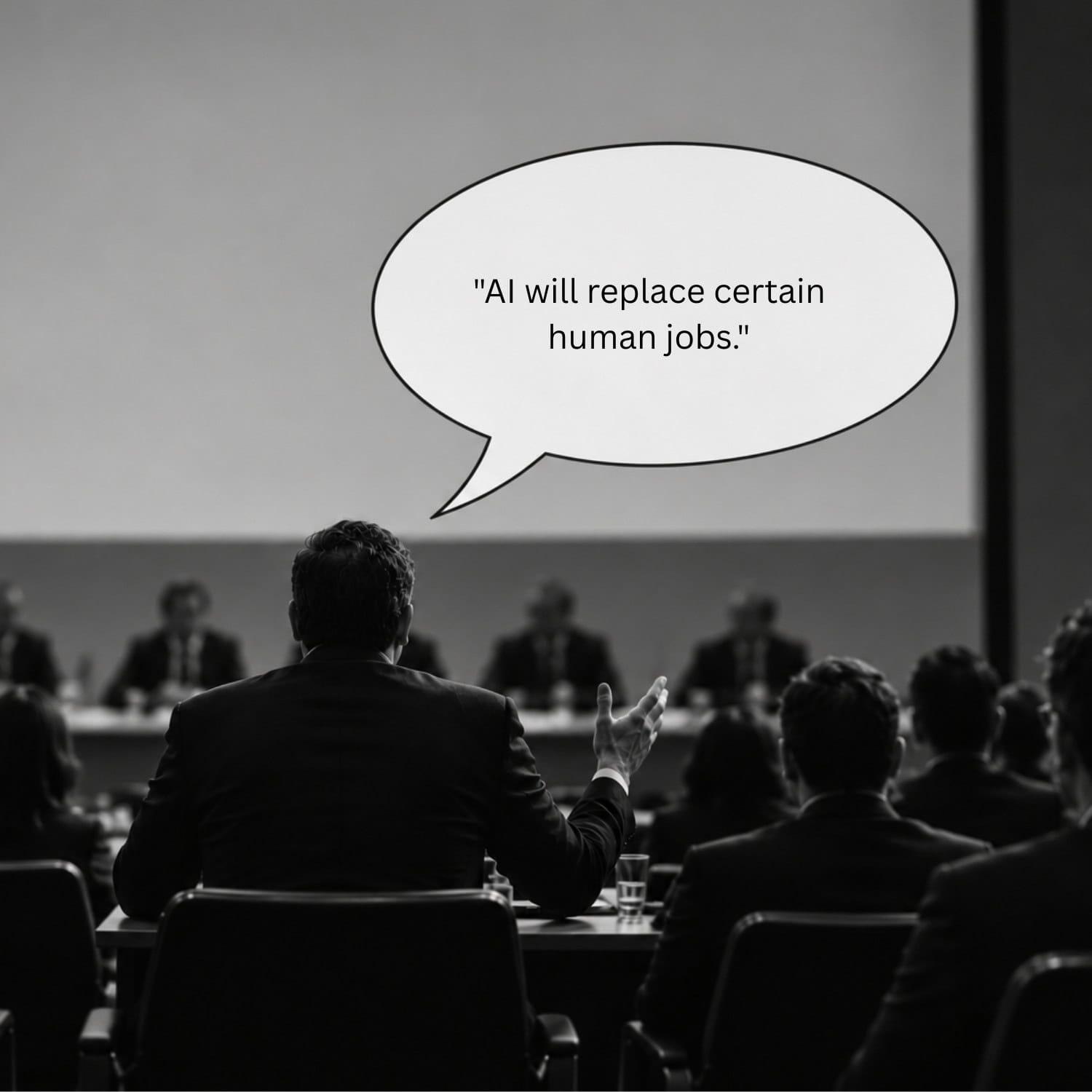
“AI will replace certain human jobs.”
Sometimes, the most important things to talk about are the issues that are most difficult to deal with. Topics that are awkward, uncomfortable or highly contentious.
But that doesn’t mean we shouldn’t engage. In fact, in many respects, it indicates that it’s more important than ever to talk about these issues, understand what other people think and speak openly about all parts of the discussion.
That’s what Quite Contrary is all about. We’re deliberately looking for topics that people may not agree on but are important to discuss, so that we can facilitate constructive conversations between experts who may have opposing views, but have a lot to contribute nonetheless.
This Week’s Contrarian
This week, our contrarian is Philip Huthwaite, CEO at 5app, an AI-powered leadership development company. Philip believes that while many people are struggling to accept the reality of it, the simple truth is that AI will, invariably, end up replacing many people and “taking their jobs”. That is, in the sense that certain forms of AI technology will end up making specific job titles redundant.
But his point is more complicated than that, according to Huthwaite. Rather than going on the defensive, we should be looking at how we can use this as an opportunity to upskill and free up employees to perform higher-order tasks.
Philip Huthwaite, CEO at 5app

Philip Huthwaite is the CEO at 5app, an award-winning learning technologies company. Philip specialises in learning and development (L&D), AI, digital transformation, workplace trends and the future of work.
Philip’s Hot Take
“AI will replace certain human jobs.”
“People don’t always like to hear this, but AI will replace certain human jobs. We shouldn’t be defensive about this, especially when it comes to automating routine, repetitive tasks. If AI can automate a tedious process that takes a human hours to complete, and it can do it accurately, why not let it happen?
“It may feel ominous for the people already in these roles, but it presents us with a tremendous opportunity to upskill and benefit from the efficiencies AI can give us. For those in roles which can be easily automated, it’s time to start developing AI-proof skills (primarily human skills) right now to stay relevant in a challenging market, though familiarising yourself with AI itself can also help you get ahead.”
- Nikita Khandheria: Founder and CEO at ERIA
- Shannon Cline: Founder and Principal Strategist at Menopause, Workplace Readiness Expert
- Chase W. Hughes: Three-Time Founder Who Built ProAI
- Marsha Familaro Enright: President at Reliance College
- Philip Huthwaite: CEO at 5app
- Kade Robertson: CEO and Founder of Viral Distributors
- Brian Gorman: Executive Advisor to Boards, CEOs and Leadership Teams; Author of “Leading Into the Age of Wisdom”; host of “Beyond AI: Wisdom at Work” podcast
- Val Narodetsky: CEO at Odesa
- Karthik Satya Sai: CEO of Testers Community
- Ville Teikko: Marketing Technology Consultant and Founder of Quanome
Nikita Khandheria, Founder and CEO at ERIA


“I agree. AI will replace certain jobs, but I think it is more useful to think about which tasks disappear than which job titles disappear. At ERIA, we already use AI to compress administrative work that once required hours of human time: organizing information, synthesising context, supporting lead workflows and handling repetitive operational tasks. That doesn’t make people less valuable; it changes where their value is highest.
“If technology can do a repetitive task accurately in minutes, I don’t think protecting that task is a good long-term career strategy. The opportunity is to become exceptional at the things AI struggles to replicate: judgment, relationships, creativity, leadership, taste and navigating messy real-world situations. The people who learn to use AI while strengthening those distinctly human skills will become more valuable, not less.”
Which roles are the safest from being replaced with AI, and what protects them?
“Roles built around human trust, judgment, relationships and unpredictable physical-world problem-solving.
“Hospitality is a great example: AI can help run the operation, but taking care of a guest in a complicated real-world moment is fundamentally human.”
Shannon Cline, Founder and Principal Strategist at Menopause, Workplace Readiness Expert

“AI will absolutely replace certain tasks, and some jobs will fundamentally change because of it. But I think the bigger opportunity is what happens when we stop asking humans to spend so much of their capacity doing work a machine can repeat.
“In my work around menopause and workplace readiness, I see how much organizations still depend on distinctly human skills: noticing when someone is struggling, navigating sensitive conversations, adapting to individual circumstances, building trust and creating cultures where people can actually perform well.
“Automation can give us back time, but what we do with that time matters. The professionals who thrive alongside AI will develop the skills technology struggles to replicate: empathy, discernment, relationship-building, contextual judgment and creative problem-solving.
“The future isn’t simply humans versus AI. It’s humans becoming more valuable by becoming better at the things that make us human.”
Which roles are the safest from being replaced with AI, and what protects them?
“Roles built around trust, nuanced judgment, human connection and responsibility for other people will be the most resilient, including healthcare, coaching, leadership, caregiving, skilled trades and relationship-driven advisory roles. AI can support these professionals, but replacing the human relationship is a very different proposition.”
Chase W. Hughes, Three-Time Founder Who Built ProAI

“I have built the systems that do this, and the work that fell first in my own company was not the most repetitive. It was the work where we could cheaply tell whether the output was right.
“When we built financial projections at ProAI, the model on its own was not trustworthy enough to ship, so we ran it against a deterministic rules engine that could say “wrong”. That check is what made automation safe to put in front of 300,000+ users. Not the model.
“Plenty of tedious work fails that test. If nobody can separate a good answer from a merely plausible one for weeks, an agent does not replace the person — it moves the error somewhere quieter and more expensive.
“So the upskilling advice is half right. The durable skill is checking machine work, not racing it.”
Which roles are the safest from being replaced with AI, and what protects them?
“The ones where being wrong is expensive and hard to detect, and where a named person has to carry the consequence. Not seniority and not creativity — accountability plus a slow feedback loop. Conversely, any role with a fast, cheap correctness check is exposed, however skilled it looks from the outside.”
Marsha Familaro Enright, President at Reliance College

“Yes, AI will take routine jobs, and the defensiveness is misplaced. The harder truth is what ‘AI-proof human skills’ actually means. People say creativity and empathy. I’d say judgment: the ability to look at a fluent, confident answer and know whether it is right. That is not a personality trait. It is a trained capacity, built by repeatedly being wrong in front of other people and working out why.
“Most schooling and most jobs have quietly removed that practice, and AI removes the last of it, because the answer now arrives before the struggle starts. So the people who will be fine are not the most creative. They are the ones who kept doing the uncomfortable part when a machine offered to skip it. I have spent thirty years training that in students. It works. It also cannot be automated.”
Philip Huthwaite, CEO at 5app
“It’s not always a popular opinion, but I believe AI will replace some jobs – primarily those where work is repetitive, predictable and rules-based. We’re already seeing AI bots take over from humans in first-line customer support.
“But we need to be realistic about what AI will actually replace. In many cases, it will automate specific tasks, not entire roles. An administrator, for example, may spend less time on data entry and more time analysing data or communicating its implications.
“That’s why human skills like empathy, decision-making, and critical thinking will become increasingly important, particularly where context and relationships matter.”
Which roles are the safest from being replaced with AI, and what protects them?
“The roles that will be safest from AI will be those that rely heavily on human skills. I can’t imagine many businesses being fully run by AI with no human oversight in the future, so leadership roles will be relatively safe.
Broadly speaking, AI also can’t replace human plumbers, farmers, hairdressers, car mechanics or carers. These hands-on, vocational roles will be protected from AI as you need human capabilities (and bodies!) for execution, though AI could play a supporting role in planning or business strategy.”
Kade Robertson, CEO and Founder of Viral Distributors

“Yeah, I agree that routine and super boring work is going away, I mean. Simple scheduling, repetitive reporting, data entry, etc. That’s in the past and it’s foolish to behave any other way. But I believe that the notion of AI replacing humans completely is hype. There will still be someone to monitor the machine. Airports aren’t on autopilot, nor are warehouses, right? I think AI doesn’t take jobs away, it takes tasks away, and people who learn how to use the AI tools will retain their jobs and become new roles.”
Which roles are the safest from being replaced with AI, and what protects them?
“I’ve been doing biohacking for a long time, I have a ring that tracks my sleep and recovery. That data influenced my training, my eating and yes, made me healthier. The issue is when you gamify it too much, then the numbers become the end goal. Don’t worry too much about a poor recovery score or you’ll be creating a new problem to stress about. Otherwise it’s great and it’s certainly helped improve my quality of life.”
Brian Gorman, Executive Advisor to Boards, CEOs and Leadership Teams; Author of “Leading Into the Age of Wisdom”; host of “Beyond AI: Wisdom at Work” podcast
“AI will replace some tasks and eliminate some jobs. But “AI can do it, so why not?” is too narrow a leadership question. Work does more than produce output. It develops expertise, relationships, discernment, confidence, and future leaders.
“Before automating, leaders should ask what else the work is accomplishing, what will be lost when it disappears, and whether those benefits need to be preserved differently. Nor can responsibility simply be shifted to employees to become “AI-proof.” Organisations have choices about how work is redesigned, how people are developed, and who captures the value AI creates. Those choices should remain human.”
Which roles are the safest from being replaced with AI, and what protects them?
The roles least likely to be replaced by AI are those where the value extends well beyond producing an answer or completing a task. Skilled trades, many caregiving professions, relationship-based sales and advisory roles, and many leadership positions are examples not because AI cannot assist them, but because the work depends heavily on human presence, trust, accountability, physical adaptability, and context.
“The people best protected are those who keep developing the qualities AI can’t substitute for: curiosity, discernment, adaptability, relationship-building, and creativity. They know how to use AI without becoming dependent on it, and they remain accountable for the choices they make. The safest career strategy is not to become more like AI. It is to become more fully human in the ways that matter.”
Val Narodetsky, CEO at Odesa

“I agree, and I’d add that the jobs AI replaces often aren’t the ones people expect. My teams build custom software for growing companies, and the roles that disappeared first weren’t junior developer positions. They were the internal coordinators who spent their days copying data between systems, reformatting reports, and chasing status updates across Slack threads. Those tasks got automated almost overnight once the right tooling was in place.
“What happened next surprised me. The people who previously did that coordination work and were willing to learn became some of the best AI workflow managers on those same teams. They already understood the processes, the edge cases, and where things broke. They just needed new tools instead of spreadsheets.
“What I’ve watched happen has almost nothing to do with losing your job to AI. It’s waiting too long to get your hands on it. When automation hit a role on my teams, one person treated it like a threat and froze. Another started experimenting with the tools immediately, even clumsily, and within a few months was running processes that used to require three people.”
Karthik Satya Sai, CEO of Testers Community

“While I acknowledge that certain occupations will disappear, I believe the statement “AI will replace jobs” is overly simplistic. Typically, a task rather than a whole profession disappears first. A person’s job may quickly decrease if they spend half of their day duplicating data, reviewing routine activities, or creating simple reports.
“Judgment, communication, problem-solving, and the ability to recognize when an automated response is incorrect become crucial. Those who compete with machines on speed will not be the most adaptable. They will be the ones who understand how to employ them without sacrificing the human abilities that give their work credibility.”
Ville Teikko, Marketing Technology Consultant and Founder of Quanome

“In my own work, I now do things with AI that I’d previously have bought as hours from someone else, so yes, work stops being bought. But I’d push back on “replace”. The pure coding job died years ago, and the role changed instead. That’s the pattern I keep seeing: the manual part of the work disappears and something new appears in its place. What strikes me most now is the pace.
“Almost daily, something that needed manual work before doesn’t anymore, so the amount I can hand to an agent keeps growing, at the same time the amount of work that I can personally manage is not unlimited so to scale i need more humans in the loop eventually. “


