


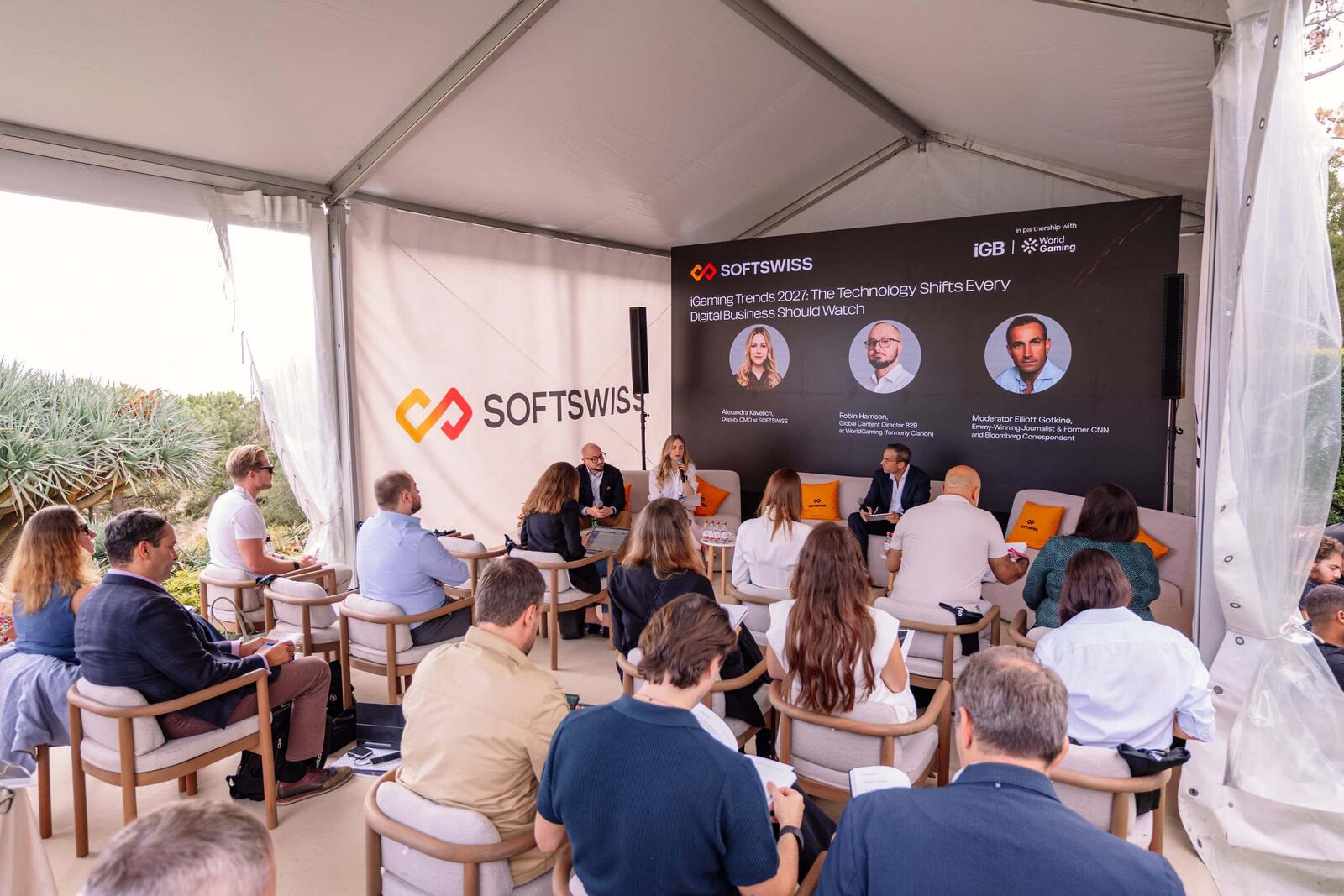
This week, SOFTSWISS officially launched the 2027 iGaming Trends Report, with the presentation taking place in Lisbon, Portugal ahead of the SBC Summit. As the 5th annual edition of the report, published by SOFTSWISS and in partnership with iGB and World Gaming, expectations were high regarding its anticipated evaluation of the impact AI has had on the industry over not only the last year, but the last five years.
The overall message, however, wasn’t completely clear. Not due to any fault of the report writers, researchers or partners, but perhaps more due to an overarching theme we seem to be observing when it comes to the impact of AI on different industries. That is, most people want to use it, plenty of people are concerned about it, and almost everybody is still pretty unsure about exactly what a future of working with AI looks like with so many moving parts.
The report itself was created because, according to Alexandra Kavelich, Deputy CMO at SOFTSWISS, there simply wasn’t enough reliable data available about the iGaming industry. As a company sitting at the intersection of operators, platforms, payments, compliance and technology, SOFTSWISS argued that it was uniquely positioned to collect and analyse information that could provide a clearer picture of where the sector is heading.
And according to that picture, iGaming is no longer a niche corner of the gambling industry.
The report compares the sector against other digitally-driven industries including e-commerce, esports, crypto and streaming platforms. It estimates that global iGaming revenue will reach €307.3 billion in 2026, making it one of the largest digital industries in the world.
Perhaps more noteworthy, however, is that the sector appears to be entering a new phase of maturity. While iGaming recorded almost 30% compound annual growth between 2019 and 2026, future growth is forecast to slow to around 9% annually through to 2031.
Ordinarily, slower growth might be interpreted as bad news, but in this case, we heard the exact opposite sentiment. That is, rapid growth often signals a market still finding its feet, whereas more moderate growth can indicate that an industry is maturing, becoming more stable and establishing itself as part of the wider digital economy rather than operating on the fringes of it.
AI Is Moving From Experimentation To Production
The report repeatedly returns to AI, although not always in the way many might expect.
While public discussions often focus on AI replacing jobs or generating content, much of the industry’s investment appears to be directed elsewhere. Fraud detection, security monitoring, risk management and compliance were repeatedly highlighted as some of the most valuable applications. One theme that emerged throughout the discussion was the shift from analysing recorded actions to making decisions in real time, something that makes safety and security easier to achieve in an incredibly fast-moving environment.
AI allows operators to identify suspicious behaviour, potential fraud and security risks as they happen rather than after the fact. In a sector where financial transactions, identity verification and compliance checks occur constantly (and tediously), the value of this increased capability is quite obvious.
But simultaneously, speakers emphasised how early the industry remains in its AI journey. Shayan Sanyal, Global Games Industry Business Development Leader at AWS, noted that organisations are only now beginning to move beyond experimentation and into production-level deployments. It’s no longer just about playing around with the shiny new tool and trialling AI models, testing use cases and running pilots. Now, we’re seeing the next phase of integrating AI into the day-to-day operations of the business itself.
More from Artificial Intelligence
- What Is AI Inference?
- Is AI Making It Easier To Build A Startup, Or Just More Difficult To Stand Out? The Experts Weigh In
- Beyond Headcount: How AI Is Changing The Way Businesses Plan Their Workforces
- Can AI Weather Models Accurately Predict Extreme Events Like El Niño?
- AI Was Supposed to Replace Us. Could Originality Be the One Thing It Can’t Compete With?
- The AI Governance Gap: Why Global Agreements Mean Little Without Corporate Action
- The Best AI-Native Gateways For Developer-First Teams In 2026
- What Does A Planned US “Freeze AI” Walkout Say About Public Attitudes Towards Big Tech?
The Regulation Problem…Again
If there was one tension running through both the report and the panel discussion, and probably in just about every discussion about AI these days, it was the relationship between innovation and regulation.
Few speakers argued against regulation itself, but the overarching concern was that poorly designed regulation can sometimes produce the opposite effect to the one (hopefully) intended. And when things change quickly and unexpectedly, the entire future of the industry can be caught in the crossfire.
Enter Brazil…
The timing of Brazil’s recently announced ban on iGaming was quite stark, and served not only as a recurring theme in the discussions but also as a very real reminder that external issues and circumstances such as economic conditions and political instability can and do have very real consequences for industries like this.
Recent debate around restrictions on gambling has, unsurprisingly, created uncertainty for operators and investors alike. Indeed, as we’ve seen mirrored in plenty of other fringe industries and sectors, if legal, regulated operators are forced out of a market, demand for gambling doesn’t just simply disappear. Instead, users may migrate towards offshore or unregulated alternatives, and this is where a great deal of risk lies.
That creates a situation where consumer protections, identity checks, responsible gambling measures and fraud controls can become weaker rather than stronger, and users are at serious risk being defrauded, or worse.
Undoubtedly, it’s a challenge that extends beyond gambling. Across AI, fintech and digital services more broadly, policymakers are increasingly being asked to regulate technologies that are evolving faster than legislation can keep pace with. The result is often a balancing act between encouraging innovation and protecting consumers; like a nightmare in which you’re not able to get off a seesaw oscillating back and forth between good and bad outcomes until the end of time.
Nobody Has The Answers Yet
Perhaps the most honest conclusion from the report was that nobody really knows what the end state looks like, but the report certainly provides a clearer picture on where things stand today.
Brooke Petersen, Chief Marketing and Growth Officer at Pentasia, argued that AI is likely to increase the value of human capabilities in the industry rather than eliminate them entirely. Skills such as judgement, relationship building and decision-making may become more important as routine tasks become increasingly automated.
Her view was relatively straightforward: people who learn to work alongside AI are likely to be in a stronger position than those who ignore it. And that is broadly consistent with the wider message emerging from the report. AI is clearly becoming more capable. Businesses are moving beyond experimentation and beginning to deploy it in critical workflows, and real-time monitoring, fraud detection and customer support are already producing tangible benefits.
But, at the same time, regulation remains uncertain, adoption is still incredibly uneven, and the long-term implications remain difficult to predict.
In that sense, the 2027 iGaming Trends Report doesn’t exactly provide a picture-perfect forecast or precise prediction for 2027 and beyond, but how could it? It’s not really possible, in an environment full of uncertainty, constant innovation and the never-ending cycle of governance that’s simply always trying to keep up. Rather, it’s offered a detailed look at the industry and where it stands, both in terms of promising growth and maturity, as well as in the context of the many challenges still being faced.
And with the pace of AI and innovation we’ve seen over the last few years, I think it’s safe to say that the next year in iGaming will be an incredibly interesting one to dissect come the 2028 iGaming Trends Report.


