


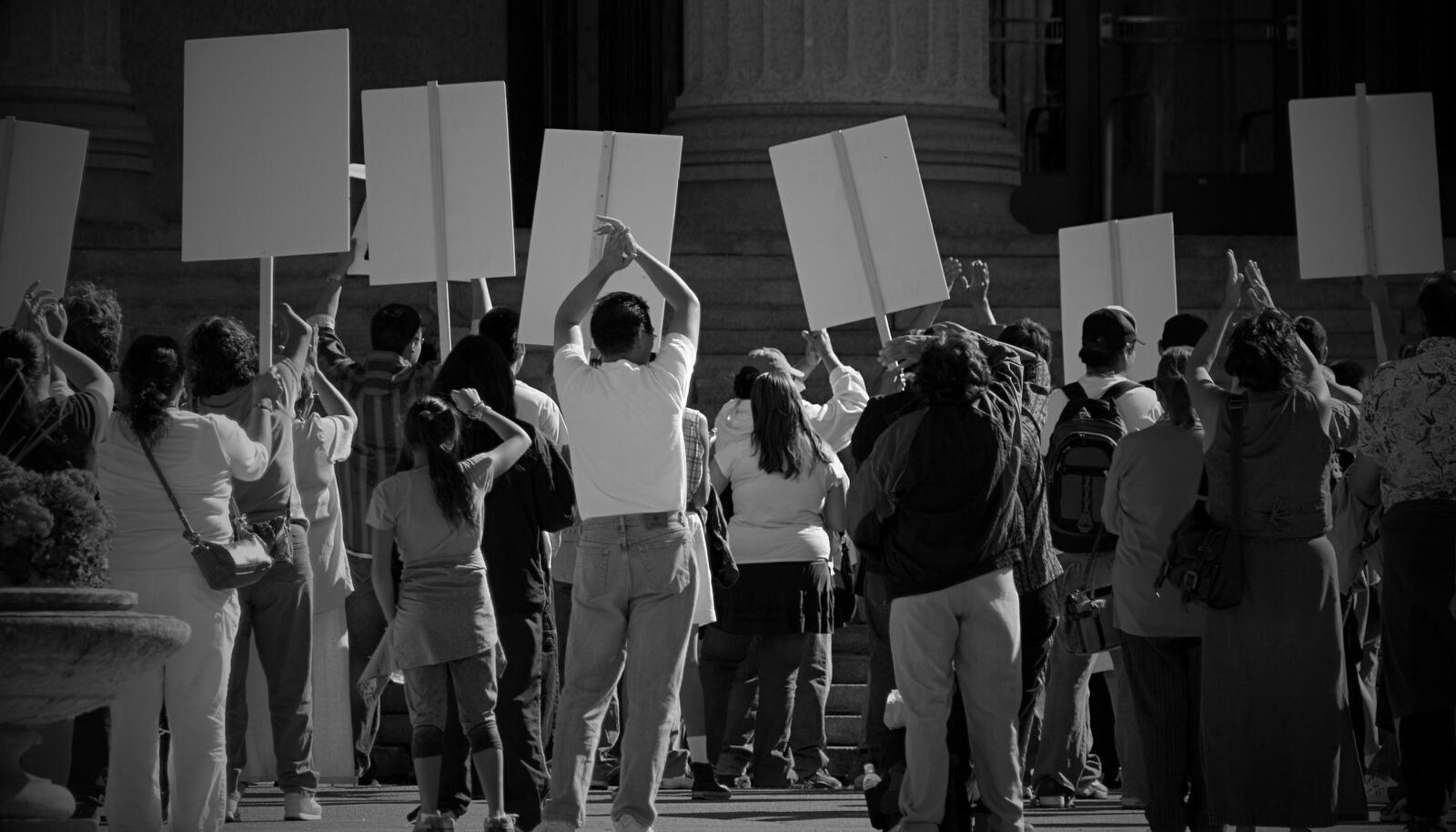
A “National Walkout to Freeze AI” is planned across the US on Tuesday 20 October. Organised by the advocacy group Irreplaceable, it invites people to walk out of universities, workplaces, data centres, public offices and AI companies.
Their demand is straightforward: “Freeze AI Now”. Campaigners argue that the future of AI should be decided by people rather than “big tech CEOs”. They say the technology shouldn’t advance until people have “a real say, a real stake, and real safety guardrails”. Irreplaceable says its partners include Women’s March, Sunrise Movement, Public Citizen and National Nurses United.
The campaign page doesn’t give an attendance target, and many of the listed locations are still marked “details coming soon”, so it’s too early to say how big the walkout will be. What it does show is organised opposition to how AI is being built and who gets to decide, at a time when public trust in AI companies has already been tested by controversy over how the technology is used.
It’s a US story on the surface, but the questions apply to any founder or investor building on or alongside AI. They cover how much say the public should have, how regulators might respond and how far worker anxiety about AI replacing jobs will shape the market these companies are selling into.
A Movement Built To Turn Anger Into Leverage
Having launched in late August 2026, Irreplaceable draws heavily on environmental campaign strategy, led by executive director Phil Aroneanu, a co-founder of 350.org.
The group openly models its strategy on the 1982 nuclear freeze movement, pointing to the 1982 rally in Central Park, which it says drew a million people. That’s the team’s chosen historical parallel, though it gives us no real clue about the actual headcount to expect on the day.
For now, the protest website offers a broad list of demands rather than policy proposals. Irreplaceable envisions a multi-year road map: assemble a coalition across 2026, build a unified policy agenda in 2027, make AI a voting issue in 2028 and push for binding regulation by 2030. Aroneanu candidly admitted the group aims to channel public anger into tangible political leverage before settling on a specific policy framework.
We asked experts from in AI policy, healthcare and startups what the walkout says about public attitudes to AI and Big Tech, and what it could mean for AI companies and the founders building alongside them.
More from Artificial Intelligence
- Why UK Allied Health Is Using AI To Cut The Paperwork
- Quite Contrary: Most Startups Don’t Have An AI Problem, They Have A Distribution Problem.
- AI Models Are Mentioning Your Brand, But Is Your Website Being Cited?
- AI Could Move From The Cloud To The Phone – What Does That Mean For App Developers?
- What Happens When A Startup’s Entire Codebase Is Written By AI?
- The Most Important AI Design Decision Is Where The Model Stops
- OpenAI’s Astra Could Change How Startups Are Built, Says OpenAI’s Tricia Troth
- AI Influencers Vs. Real Humans: What Actually Works In Marketing?
Our Experts
- Caterina Maniscalco, US Change Management Lead, Baringa
- Jeet Pattanaik, Founder and CTO, Glokal AI
- Dr Daniel Fagbuyi, Emergency Physician and Founder, Orzyn
- Mykyta Chernenko, Founder, AIWriteBook
- Viktor Bulanek, Founder, Penetrify
- Emre Benian, Founder, Benian Technologies
Caterina Maniscalco, US Change Management Lead, Baringa

“The significance of the walkout isn’t whether a freeze on AI is ultimately practical; it’s that some people increasingly feel they have too little agency over a technology that could profoundly reshape their lives.
“The AI debate tends to focus heavily on capability: what models can do, how quickly they are improving and what economic value they may unlock. But ultimately, technological capability alone doesn’t create social legitimacy.
“Increasingly, decisions about AI aren’t confined to the digital world. They can affect jobs and privacy, but also the physical environments and resources communities depend upon, from energy infrastructure to water availability and quality. When decisions have consequences for people’s everyday quality of life, those affected cannot simply be treated as passive recipients of choices made elsewhere.
“For AI companies and startups, dismissing protests like this as resistance to progress would be a mistake. Trust is becoming part of the licence to operate. The companies most likely to thrive won’t necessarily be those that move fastest at any cost, but those that can demonstrate that innovation and responsibility reinforce rather than oppose one another.
“I don’t believe the answer is to stop innovation. AI has extraordinary positive potential. But developers, businesses and policymakers need to give people meaningful agency in shaping how that future develops, with transparency, safeguards and accountability built in from the outset.
“When all is said and done, while AI may be built by technologists, its future cannot be a technology conversation alone.”
Jeet Pattanaik, Founder and CTO, Glokal AI

“I’ll be honest: as someone running a small AI company, my first instinct was to roll my eyes at ‘Freeze AI’. It isn’t going to happen, and I don’t think it should. But the more I read, the more I think the people walking out have a point.
“Most people don’t feel like they get any say in this. They hear a handful of CEOs talk about how AI will change their work and their kids’ futures, and when something goes wrong, nobody seems to be responsible. I’d be frustrated too.
“What struck me is that the demand isn’t really anti-AI. Asking for a real say and real guardrails is asking for governance. Here in Europe, the AI Act is already pushing companies to explain how their systems work and who’s accountable for them. It’s not perfect, but it shows this is a solvable problem.
“For startups like mine, this cuts both ways. We don’t have a big brand to hide behind, so when trust in AI drops, it hits us too. But it’s also a chance. If you can show a customer exactly what your AI is allowed to do, keep a record of what it actually did and let a person stop it, you’re offering something the big players often can’t.
“I’d read this walkout as feedback, not a PR problem.”
Dr Daniel Fagbuyi, Emergency Physician and Founder, Orzyn

“Frankly, the walkout is a trust signal, not a technology literacy problem. People aren’t confused about AI. They’ve noticed the companies building it are grading their own homework, and ‘trust us, safeguards are coming’ is not a safeguard or credible.
“I’m an emergency physician and a founder in this space, so I’ll concede the protesters’ strongest point that voluntary guardrails don’t hold when the incentive is speed. Where I differ is the remedy. A blanket freeze stops the careful builders and the careless ones alike. Enforceable accountability is what is needed.
“Here’s the question too few can answer today. When an AI system acts, which human answered for it?
“For startups, the lesson is practical. Accountability is heading from optional to required. Build it in now, before regulators or lawsuits force it. Fear of AI is a rational response to unaccountable AI. Fix the accountability and the guardrails, and the fear has less to feed on.”
Mykyta Chernenko, Founder, AIWriteBook

“The walkout tells me people aren’t scared of AI in the abstract. They’re tired of decisions about their jobs, their data and their kids’ schools being made by five or six companies without asking anyone. Nurses and climate groups marching side by side shows the worry is about power and consent more than the technology itself.
“A freeze would land on the wrong people, though. My company, AIWriteBook, helps people write books, and we run on models from several of the big labs, Google and Anthropic among them. The big labs can absorb a pause. They have cash and lawyers. A small company that lives on those models and ships every week can’t, so a blanket freeze would mostly lock in the incumbents it’s aimed at.
“What I’d rather see is rules people can actually check: tell users when text or an image is AI-made, ask before training on someone’s work and let people see and delete what you keep about them. Those cost a small company very little and answer most of what the marchers are angry about.
“Startups shouldn’t wave this away. If the public decides AI is something done to them, every one of us loses the customer.”
Viktor Bulanek, Founder, Penetrify

“I build AI agents for a living, so I am not on the side of a freeze. But I think small AI companies would be making a mistake if they read this walkout as people who simply do not understand technology. Most of the anger I see is not about what AI can do. It is about who decides, and who carries the cost when it goes wrong. People have been told to trust systems they cannot inspect, built by companies they cannot hold to account. That is a fair complaint.
“The irony is that a freeze would mostly help the companies the protesters are angry at. The largest labs already have their models trained and their data centres built. A pause locks in whoever is ahead and makes life very hard for everyone trying to catch up.
“For startups, I think the useful response is to stop asking for trust and start showing evidence. My company uses AI agents to test websites for security holes, which is exactly the kind of thing that should make people nervous. So the agents only touch systems the customer has proven they own, and when we said our engine solved all 104 challenges of a public security benchmark, we published every log so anyone can check. That is a small thing, but it is the kind of real guardrail the organisers are asking for. Smaller companies can offer it faster than Big Tech can.”
Emre Benian, Founder, Benian Technologies

“AI companies should expect resistance when their success is measured in seats sold while the customer carries the cost of making the product useful. That gap is a trust problem built into the business model.
“I read the planned walkout as a demand for control over where AI is introduced, whose work it changes and who answers when it fails. One planned protest cannot tell us what the whole public thinks, but founders should take the underlying questions seriously.
“For smaller AI companies, the practical consequence is a higher burden of proof. We should be able to explain the specific job being improved, what data the system can access, what decisions still belong to a person and how the customer can leave. Selling another subscription without solving those questions adds to the distrust everyone in this sector inherits.
“The customer’s ability to understand and control the result has to be part of the product. A successful rollout should leave people with more capability and a clear owner for problems. Counting users alone tells us very little about either.”


