


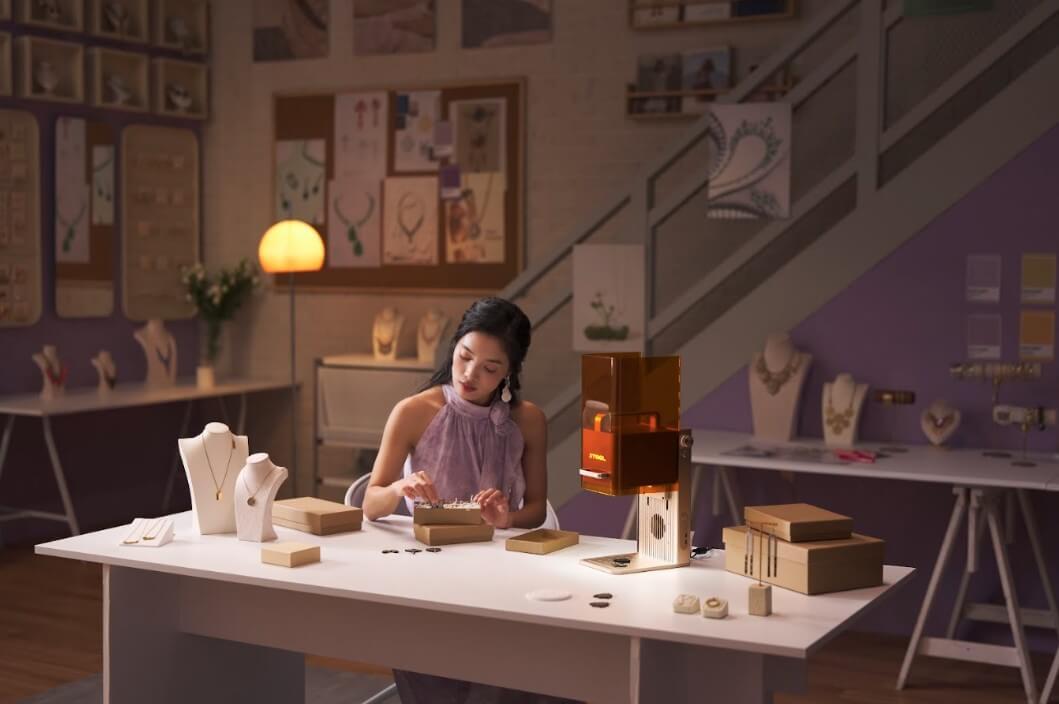
Crafts are no longer confined to weekend projects or passion hobbies. Across the UK, more independent makers are building businesses by creating personalised products such as engraved jewellery, home décor and custom merchandise, selling through online marketplaces, craft fairs and their own websites. As these businesses grow, they need production tools that can keep up with demand while maintaining the quality and craftsmanship that make handmade products stand out.
Choosing the right digital craft equipment, however, is not simply a matter of selecting the machine with the most features. Makers need to consider the products they plan to create, the materials they regularly use, the space available in their studio or market stall, and whether they intend to expand into new product categories. Portability may be important for creators working at craft fairs, while material compatibility, production speed and workflow flexibility may matter more to businesses handling larger or more varied orders.
One company developing tools for this growing market is xTool, a global consumer technology brand focused on digital fabrication. Its ecosystem combines laser engraving, UV printing, software and creative materials, offering independent makers and small businesses different options based on the products they create, the materials they use and how they operate. The following examples illustrate how different types of digital craft equipment can support different creative-business needs.
Choosing A Portable Tool For Craft Fairs And Small Workspaces
For makers working from home studios, shared workshops or market stalls, portability and workspace requirements are important considerations. A compact machine can be easier to transport and position, particularly when products are personalised on demand at craft fairs or other events. Creators should also consider the materials they work with, the size of their typical products and whether they need a visual preview before engraving.
The xTool F2 is one example of a portable desktop laser engraver designed for this type of working environment. It allows creators to engrave jewellery and personalised items directly at craft fairs and fits into a home studio, workshop or market stall. It can engrave and cut a range of materials, including wood, acrylic, leather and metal. Features such as camera preview and high-speed engraving can support both creators learning the process and growing businesses that need greater speed and precision.
At the time of publication, the xTool F2 has an MSRP of £1,299. The promotional code [PR80F267] provides a saving of £80 on eligible orders, subject to availability and applicable terms.
Choosing Equipment For Glass, Crystal And Premium Gifts
Material compatibility becomes more important when a business plans to move beyond common craft materials. Glass, crystal and ceramics can require different technology from the equipment used for wood, leather or acrylic. Makers entering these categories should consider the level of detail they need, whether they require surface or subsurface engraving, and whether there is sufficient customer demand to justify investing in more specialised equipment.
The xTool F2 Ultra UV provides an example of this more specialised approach. Combining laser engraving with UV technology, it works across materials including glass, crystal and ceramics, while enabling intricate 3D subsurface engraving inside glass. These capabilities can be used to create personalised keepsakes, awards and premium gifts, allowing creative businesses to explore higher-value product categories without moving to industrial-scale equipment.
At the time of publication, the xTool F2 Ultra UV has an MSRP of £3,699. The promotional code [PR150F2UUV65] provides a saving of £150 on eligible orders, subject to availability and applicable terms.
Choosing A System For Multiple Product Categories
Some creative businesses eventually expand beyond engraving into full-colour printing, apparel or branded merchandise. At this stage, makers need to decide whether to invest in separate machines for different applications or use an integrated system that supports several production methods. Important considerations include the range of materials, available workspace, expected order volume and how often each printing process will be used.
The xTool O1 Omni Printer is an example of an integrated approach. It combines four printing technologies, including UV Printer, DTG, DTF and UV DTF, bringing rigid-material printing and textile customisation into a single system. This allows creators to work across surfaces such as wood, acrylic, glass, metal and apparel. Its dual-printhead architecture supports different production requirements, from personalised products and branded merchandise to small-batch collections. For businesses considering several product categories, an integrated workflow may reduce the need for multiple single-purpose machines. However, makers should assess whether the additional capabilities match their production plans, workspace and expected order volume.
At the time of publication, pricing for the xTool O1 Omni Printer starts from £1,399. Current pricing and availability can be checked on the official product page.
Making The Right Choice For The Business
There is no single digital craft tool that suits every creative business. Makers focused on jewellery or live personalisation may place greater importance on portability and support for different engraving materials. Businesses producing glass, crystal or premium gifts may require more specialised UV technology, while those expanding into full-colour products and apparel may prioritise a broader printing workflow.
Before investing, creators should compare the equipment with their current product range, available workspace, expected order volume and plans for future growth. Starting with a clearly defined business need can help ensure that new technology supports practical production goals rather than adding features that may rarely be used.
—TechRound does not recommend or endorse any financial, investment, product, services or other advice, practices, products, items, companies or operators. All articles are purely informational.—


