


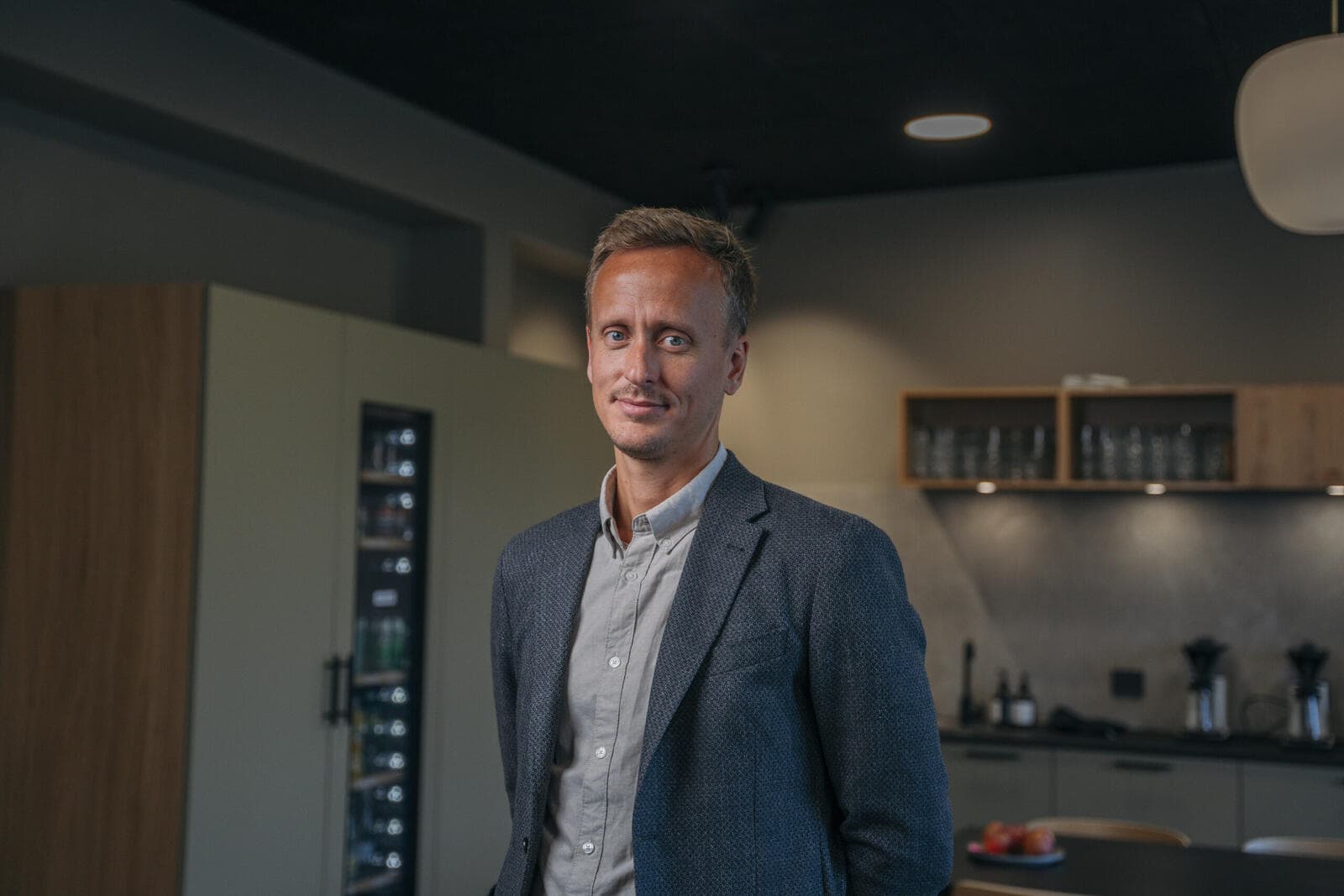
“Noahs is the engine behind a new kind of food retail. It combines high-quality food brands, smart kitchen architecture, and a plug-and-play operating system with hands-on support — taking retailers from zero to one hundred in the digital food economy.”
Tell us about Noahs
Noahs is the engine behind a new kind of food retail. We enable partners like Q8 service stations and MENY supermarkets to stream high quality food brands across delivery platforms, their own native channels like app, web, and kiosk, and over the counter, all through one system run by one team. We package three things in one: technology, a curated brand library, and smart kitchen architecture. It plugs in over Wi Fi, is simple to switch on, and is built for network scale.
We founded Noahs in Copenhagen in 2020. Peter Strøm, Robert Engström, Danny Cavender, Carl Simonsson, and I began with a modular smart kitchen in an underutilised space in Copenhagen, then moved quickly to enterprise partnerships. Today we are rolling out with MENY and Q8, targeting more than one hundred locations in 2025. Our model lets retailers step into food with low capex and minimal added staff for the tech layer, while compact kitchens unlock multiple brands from a single hub.
My mission is to let great food thrive in the digital shift and to turn service stations, supermarkets, and travel hubs into modern food destinations. In 2024 we were nominated by Global Convenience Store Focus for The Best Foodvenience Store in the World, and we are just getting started.

How did you come up with the idea for the company?
I came into this as a chef and restaurant franchise operator first. I formed a team over the past 15 years that built and scaled food brands and franchises, so we know the legacy restaurant world well. That is where we learned the ropes and understood the deeper engine room of a food enterprise. We saw how brand, technology, the physical space, and the daily routines have to lock together if you want scale without chaos.
The real spark came once we understood what was happening on the retail side. Retailers were watching their core categories slow and needed new revenue streams. They sit on prime locations with steady footfall and national networks. An entire supply chain, operations teams looking for new ways to remain competitive in a transforming market.
Food carries healthier margins. Their networks, combined with digital platforms, could create reach that single restaurants struggle to match. At the same time restaurants were getting squeezed by rent, labour, and complicated legacy tech. At the same time, delivery aggregators has hit the industry harder than most wants to admit.
Creators were on one side and distribution was on the other, and no one had built the bridge.
So we did. In 2020 we built our first prototype smart kitchens in Copenhagen. In 2022 we partnered with MENY to launch multi brand kitchens inside supermarkets. From there we pressure tested the model in shopping centres, coworking spaces, railway stations, and service stations. The thesis held. Give retailers a clean way to run many brands with their existing team and one system, and you unlock growth with low capex and powerful unit economics.
We call it Noahs for a reason. We see the platform as a lifeboat for great food brands through a wave of transformation, and a path to flourish on the other side. Retailers are not the downside, they’re the opportunity. Brands that participate in this new distribution model will win. Brands that cling to the old model will struggle.
More from Interviews
- Supporting Sustainability: Didi Gan, Founder And CEO Of N&E Innovations, Zayed Sustainability Prize-Winning Organisation
- Inside The Mind Of Anti Fund Partner Steve Han On Backing The Next Wave Of Disruptive Founders
- A Conversation With Ayoola Samagbeyi, CTO Of 9jaPay, Co-Founder Of Canalis Labs And SportsTech22 2026 Judge
- A Chat With Suzanna Chaplin, Founder And CEO, esbconnect, On The Future Of Acquisition And How Email Is The New Identity Layer
- Meet James Taylor, Founder and CEO at Particular Audience, The Company Bringing Amazon-Style Hyper-Personalisation To Every Other Retailer
- Truly Intelligent Content – Meet HumanCulture
- Interview With Shiv Shankar, CEO Of Boundless On Being The Largest ZK Protocol
- In Conversation With Chris Pettit, CEO And Co-Founder At Revving On How Messy Industries Often Hide The Biggest Opportunities
Tell us about your core product or service: Noahs
We offer one platform with three layers that work as one system run by one team.
First is the Technology Platform. We digitise a retailer’s entire food operation across delivery aggregators, native app, web, kiosks, and the store. We handle menus, pricing, routing to kitchen screens, order throttling, and payments. Our BI shows what sells, what breaks, and what to fix in real time. The goal is simple. Turn on digital revenue with minimal extra labour and minimal capex.
Second is the Brand Platform. We stream a curated library of proven food brands that retailers can activate quickly. Each brand arrives with clear SOPs, training, assets, and menus designed for omnichannel. We focus on dishes that travel well, repeat well, and win on platforms.
Third is Smart Kitchen Architecture. We design compact, high throughput kitchens that support many brands in one footprint. Layout, workflow, equipment, packaging, and menu engineering are built into the system so teams can deliver consistent quality at speed. It plugs into the tech and the brands out of the box.
Together this gives retailers a clean way to run modern food at network scale. One login. One data model. One operating rhythm. We make it easy to start with tech only, then add brands, then add compact kitchens when the site warrants it. This way it is a flexible modular approach that enables every retailer to use the service. From just getting their shops online with their retail offerings and a pizza, to multi-brand kitchens that carry 10+ high quality food brands.
What most excites you about the food tech industry?
When we speak about what excites me the most in food tech right now – it is the fact that the industry is absolutely moving digital.
With the global convenience retail market set to surpass $1 trillion by 2029 and the global online food delivery market projected to reach 505.5 billion USD by 2030 , it’s time for service stations and supermarkets to leap into the future and get fuelled by the digital revolution.
The frontier is vertical. Software on its own is not enough in the age of AI. The real gains live where software meets the kitchen and the product. Kitchen architecture, workflow design, menu engineering, packaging, site layout, and supply all wired into one operating system. That is our sweet spot and it is why we are here.
Therefore what also excites me is turning the kitchen into something programmable. Menus become code. Stations become modules. Routines become scripts that adapt in real time to demand, weather, daypart, and the live order mix. A screen can change the sequence of steps. A layout can cut motion and errors. Packaging can keep quality intact for the ride. When bits meet atoms you win back seconds, reduce waste, lift throughput, and protect margin. Do that across a network and the effect compounds.
We also know the network already exists. Service stations and supermarkets are everywhere with teams on site. Our platform is the link between creator brands and that infrastructure. It lets retailers act like modern restaurants without the drag, and it lets brands reach customers in more places than a single site can. Building that bridge between technology and the verticals is the work that gets us up in the morning.
What has been the biggest challenge you’ve had to overcome along the way?
Shifting large organisations from old habits to a new operating model. That has been the hardest part.
In early pilots we lifted sales fast, then hit the teething pains. Staffing patterns were wrong for digital peaks. Training needed to be tighter. Category owners judged us on yesterday’s KPIs instead of the right ones for omnichannel. We had to prove that one team can run many brands in one system without adding complexity and still protect margin.
Another challenge has been distribution ownership. Delivery platforms bring scale and discovery, but they also take commission and own the customer relationship. Our answer is to win on the platforms while building a direct spine with loyalty, kiosks, and our own app so the retailer grows both channels with clear economics.
The third is alignment. Big retailers have many stakeholders. Getting data, decisions, and accountability in one place is not automatic. We solved it with shared BI, simple weekly dashboards, and very clear site level playbooks that show what to do next, not just what happened.
None of this is solved by a slide. It is solved on the ground. We learned to enter with a simple tech first rollout, prove unit economics, then layer in brands and compact kitchens where the site warrants it. When we do that, the results stick.
We believe that owning the implementation drives the final results and that’s the hardest thing about making a difference in this space, but also why there’s few competitors in the space.
What is your number one piece of advice to aspiring entrepreneurs?
If I need to share one piece of advice to the up-and-coming entrepreneurs, then staying relentlessly valuable to your clients will be the one.
I think within entrepreneurship, what you have to have is a completely open mind on how to be completely invaluable to your clients.
Because this value can in the very end create that long-term interest in you and what you do as well as give this feeling of trustworthiness in this company-client relationship.
It can lead to customer’s willingness to rely on you and to start cooperation with you.
So, yes, continue adding value, because it’s going to change everything!
What can we hope to see from Noahs in the future?
Food is moving into a streaming model. Distribution keeps shifting to digital and retail networks are becoming the rails. This will happen with or without us and we choose to participate with focus and craft.
Our role is practical. Help retailers switch on modern food with one system and one team. Give creator brands a clean path into those networks. Keep the kitchen programmable so quality and speed hold up at scale. We will keep sharpening the tech, tightening the workflows, and lowering the friction to go live. Start light, prove the numbers, expand where the unit economics make sense.
You will see us deepen in the markets where the fit is strongest and replicate with partners who share the standard. More sites running every channel through our platform. More brands are streaming through the library. Compact kitchens added only where performance warrants it. Simple, disciplined, repeatable.
We expect meaningful reach. We anticipate our platform in 600 locations by the end of 2026 and 10,000 by 2030. We are not here to claim we will transform the world. The transformation is already underway. We are here to take part in it so consumers get better food in more places, retailers unlock a new growth engine, and great brands find reach without carrying the weight of the old model.