


Piece written by Rhys James (@r_james4)
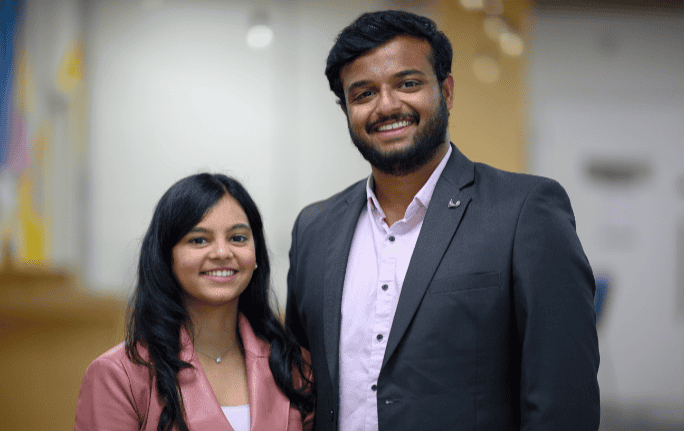
Your Cue, a UK based start-up, is changing how vital signs can be monitored at home and in hospitals. The company, founded by Sonakshi Senthil, 27, and Dr Nikhit Anilbhai, 28, in 2021, is currently in the process of developing the Cue Ring. The small device, which is worn as a ring, monitors vital signs such as heart rate, blood oxygen and blood pressure every three seconds.
This data is then stored in the Cue ecosystem, which creates in depth continuous monitoring of all patient vital signs. The ring will have built in AI that will calculate the severity of changes in a patient’s condition and raise real-time alerts to healthcare professionals.
TechRound spoke to Dr Nikhit Anilbhai about his and Senthil’s journey creating their start-up.

How did you come up with the idea of creating Your Cue?
“Sonakshi and I founded Your Cue in 2021, and the reason we did this was because of the pandemic. So, the first idea that we came up with was an app that nurses and doctors could use to put in the vital signs of patients, and then if something was going wrong the app would immediately inform the doctors. Sonakshi was always of the idea that we need a physical device because a nurse or a junior doctor cannot always be next to a patient. So, to collect data and it have value you need a lot of data, and to collect a lot of data we need a physical device that we can attach to patients. So, then we did a lot of research on how the devices that exist on the market are bulky, wired, expensive, patients hate being tied down to a bed. Using all of those as fundamental things that we wanted to change, we came up with the completely wireless solution that could monitor all the vital signs that a nurse goes to a patient to check for.”
Anilbhai shared with TechRound why Your Cue was personal for him. Anilbhai’s dad passed away in 2022 in a similar fashion that he had seen with his patients.
“That solidified the idea that we needed to make this happen because at the minute in UK hospitals the statistics are very dark when you look at how many patients need to be monitored continuously when they are at the hospital.”
Sonakshi and Nikhit both returned to India during the pandemic, Sonakshi to pursue an online course on Global Health at Harvard, and Nikhit went back to practising emergency medicine.
“We came back to the UK to finish our master’s, and we started making Your Cue happen.”
More from Interviews
- A Chat With Avion Gray (CEO) And Samantha Rosenberg (COO), Co-Founders Of Belong On Wealth Building
- Interview With Bert van der Zwan, CEO at Bizzdesign On Enterprise Transformation
- Supporting Sustainability: Didi Gan, Founder And CEO Of N&E Innovations, Zayed Sustainability Prize-Winning Organisation
- Inside The Mind Of Anti Fund Partner Steve Han On Backing The Next Wave Of Disruptive Founders
- A Conversation With Ayoola Samagbeyi, CTO Of 9jaPay, Co-Founder Of Canalis Labs And SportsTech22 2026 Judge
- A Chat With Suzanna Chaplin, Founder And CEO, esbconnect, On The Future Of Acquisition And How Email Is The New Identity Layer
- Meet James Taylor, Founder and CEO at Particular Audience, The Company Bringing Amazon-Style Hyper-Personalisation To Every Other Retailer
- Truly Intelligent Content – Meet HumanCulture
How has the process of building a start-up been so far?
“We were given free office spaces and a month and a half off from other commitments when we began. We weren’t offered any money, so we still had to go through finding funds for ourselves. So, one of the benefactors’ complaints was we started in 2022, by the time we had a prototype it was 2023 and the market was so bad, so it was a humongous challenge to raise funds then.”
What does the future look like for Your Cue?
“There’s a lot of things you have to do, you have to test it to see if people are happy to wear a device like that, is the design comfortable? Are they safe enough to be put out there? So those are the basics. When you are making a device for patients in critical care or hospitals, or even patients who are known to be susceptible to cardiac events, you have to follow MDR (Medical Device Regulations) guidelines.
“We are almost at the stage where we will be doing clinical trials at the first half of next year. Once we do that we’ll be applying for certification in the second half of the year.”