


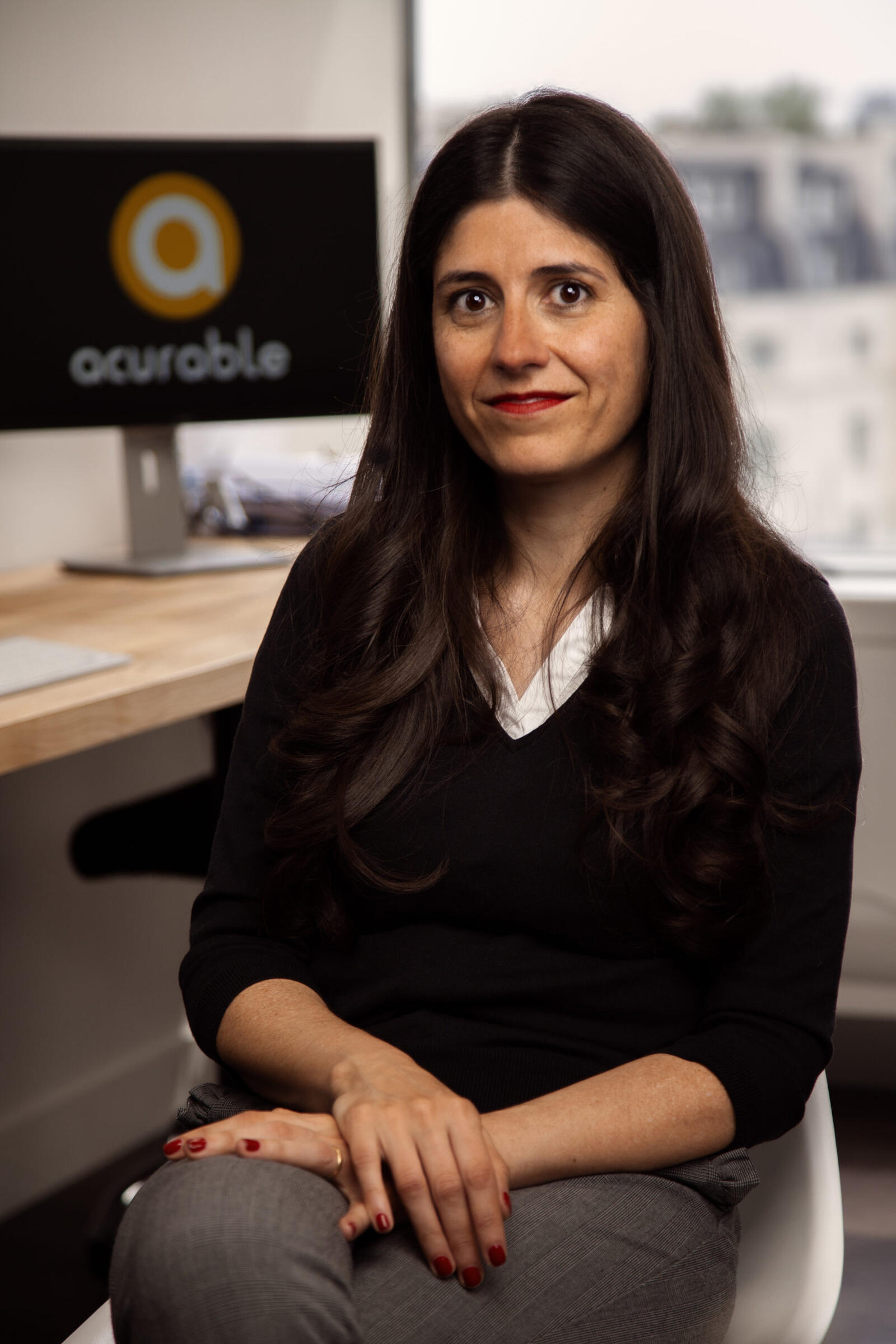
Acurable is a medical device startup that I founded in 2016 to create and commercialise a new breakthrough technology called AcuPebble. This technology was the result of many previous years of research in the lab I founded and still lead at Imperial College London.
The first application of this technology brought to market by Acurable is AcuPebble SA100; a tiny, wearable sensor which is used to diagnose obstructive sleep apnoea (OSA). OSA is a serious condition that affects one billion people globally and AcuPebble is much easier and quicker than current diagnostic methods, which have long waiting lists, require extensive patient training and are demanding on clinicians’ time.
Today we have an office in London and another in Seville, and having just closed an €11m Series A round, we’re looking to expand into new global markets, and continue our work on new products based on the AcuPebble technology.

How did you come up with the idea for the company?
It actually began with epilepsy. I knew I wanted to do something that had a social impact, and decided that that would be healthcare.
A colleague took me to a town called Chalfont, which was founded as a colony for epilepsy sufferers in the late 19th century and is now a centre of excellence for epilepsy diagnosis. There, I saw people walking around covered with cables from the head to abdomen. These patients were being continuously monitored, in some cases for weeks, to see if the focus of epilepsy could be located.
This inspired me, and I set out to create portable and unobtrusive monitoring devices to improve patients’ quality of life. I also wanted these devices to facilitate the clinicians’ job of evaluating signals, by incorporating intelligence which could assist via automatic interpretation.
As my knowledge grew, I did not want this to end up becoming a purely academic exercise. So, I conceived the idea of a device with applications in more than one healthcare context. I decided to enter an XPRIZE competition in 2014, to test the clinical and social need, and market fit of such a device.
Unexpectedly, we were one of the winners, and I started getting emails asking when the device would be on the market. At that point I decided to start a company to make that happen. In 2016 Acurable was born.
More from Interviews
- A Chat With Danny Sullivan, CEO Of Nomada Digital And PR54 Judge
- A Chat With Sisi Ncube, Founder Of FibreTempo, On Building Health Habits That Actually Stick
- A Conversation With Paul Dawalibi, CEO Of Innovation City
- A Chat With Anthony Clements, Head Of Brand Partnerships At Impact On How AI Is Reshaping Affiliate Marketing, Brand Discovery And The Customer Journey
- A Chat With Lisa Miles-Heal, CEO Of Corlytics, On What It Actually Takes To Build A Business Buyers Want
- A Chat With Oluwasesan Kayode Yackson, Co-Founder And COO at ProtonLabs Technology Inc. Ltd. and TechRound SaaS66 2026 Judge
- A Chat With Abiel Ghezae, Founder And CEO Of Ahlan, On Building The Operating System For Global Mobility
- A Chat With Cathie Hall, Chief Customer And Product Officer At IFS, On How AI Can Preserve Institutional Knowledge
How has the company evolved over the last couple of years?
The last couple of years have been very busy and exciting for Acurable! Since obtaining a CE Mark in 2020, we’ve launched AcuPebble SA100 in a number of markets, including Spain, Germany and Portugal, and with several NHS trusts in the UK.
We achieved FDA clearance last year and are now preparing to launch in the US. We’ve grown the team in both London and Spain, and we’ve won a number of grants and awards. And most recently we’ve closed our Series A round with an incredible group of investors led by Kibo Ventures, which will enable us to expand into new markets, and develop more products much more quickly.
What can we hope to see from Acurable in the future?
Our ambition is to diagnose 1 million patients referred for sleep apnoea in the next 5 years. That means expanding into new markets and scaling the company’s operations. We are also working on new products that can fundamentally improve remote patient monitoring across several major respiratory and cardiovascular conditions.


