


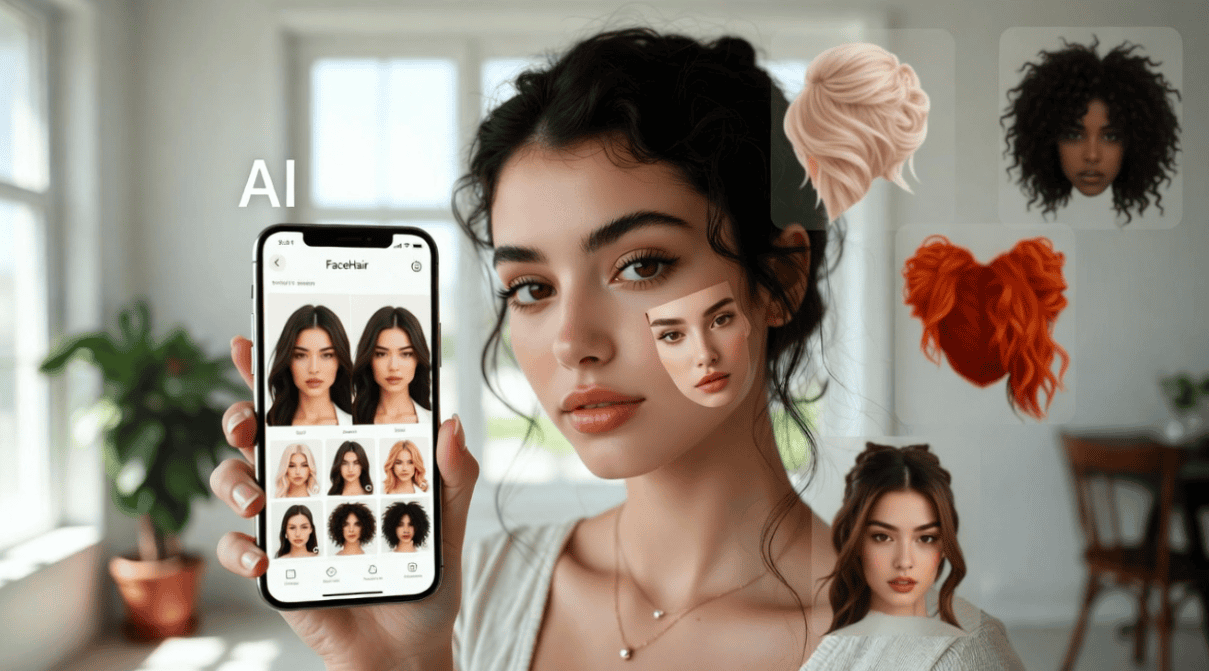
Choosing a new hairstyle can be surprisingly difficult. Many people spend hours browsing photos online or saving inspirational images from social media, yet still feel uncertain before visiting the salon. A haircut that looks great on a model may not look the same on someone with a different face shape, hair texture, or lifestyle. As a result, clients often arrive at the salon with vague ideas, which can lead to misunderstandings between them and their hairstylist.
This challenge is becoming more noticeable as digital inspiration grows. Beauty platforms and social media provide thousands of hairstyle images, but most users struggle to visualize how those styles would look on their own face.
According to observations from beauty-tech research and consumer surveys in the cosmetics industry, visual simulation tools significantly improve user confidence when making appearance-related decisions.
In response to this problem, technology companies have developed tools powered by artificial intelligence. An AI hair style generator allows users to upload their photo and preview different hairstyles digitally before making a real-world change. This approach blends beauty, technology, and lifestyle planning into a more data-informed decision process.
This article explores how AI hairstyle generators work, how to compare hairstyle options effectively, and how to use these digital previews to communicate clearly with your hairstylist.
Why Hairstyle Decisions Are Often Uncertain
Haircuts are different from many other style choices because they cannot easily be reversed. Once hair is cut, it takes time for it to return to its previous length. This naturally makes people cautious when trying a new look.
Several factors contribute to the difficulty of choosing the right hairstyle:
Face shape variation
A hairstyle that complements one face shape may look very different on another. For example, layered cuts may balance certain facial proportions, while blunt styles may emphasise others.
Hair texture differences
Straight, wavy and curly hair behave differently even when cut in the same style.
Communication challenges in salons
Clients often bring inspiration photos that don’t match their hair density or styling routine.
Because of these variables, many people feel uncertain about whether a new haircut will match their expectations.
How Do AI Hairstyle Generators Work?
An AI hair style generator uses computer vision and machine learning to analyse facial features. The software identifies key landmarks such as the hairline, cheekbones, jawline, and forehead. After mapping these features, the system overlays simulated hairstyles that adapt to the user’s face proportions.
These simulations allow users to preview hairstyles without physically cutting or styling their hair. Platforms like facehair.ai demonstrate how AI can be used in beauty technology to generate personalized hairstyle previews.
Instead of imagining a style based on someone else’s photo, users can see the style applied directly to their own image.
This makes hairstyle planning more interactive and realistic.
How AI Is Being Used to Compare Hairstyles
One of the core functions of AI hairstyle platforms is rapid visual comparison. By uploading a portrait image, users can generate multiple simulated looks in minutes. Because these systems rely on facial landmark detection, image clarity plays a significant role in output accuracy. Front-facing photos with even lighting allow the software to map proportions more precisely, improving how styles are overlaid.
Rather than focusing on a single cut, many users explore a range of categories – from short bobs and layered mid-length styles to long cuts and fringe variations. Testing across categories often highlights how dramatically shape and length can alter perceived facial balance. Some styles create vertical elongation, while others emphasise width or softness depending on where volume and lines sit.
A growing number of platforms also incorporate facial analysis features that interpret how hairstyle proportions interact with jawlines, cheekbones and forehead dimensions. This shifts the decision from purely aesthetic preference to structural evaluation.
How Users Approach AI Hairstyle Tools
Patterns in user behaviour suggest that structured comparison tends to produce clearer outcomes. Many users save several preferred simulations rather than selecting a single style immediately, allowing for side-by-side review.
Evaluations often consider both visual framing and practical implications, such as how a style might align with daily routines or professional environments.
AI-generated previews are also increasingly used as visual references during salon consultations. Screenshots provide a personalised starting point for discussion, replacing generic celebrity images with simulations based on the client’s own face.
Limitations and Misinterpretations
Despite advances in realism, AI hairstyle tools remain simulations. Real-world results can differ due to lighting, movement, hair density and product use. Texture differences present particular challenges, as templates designed for straight hair may not directly translate to curly or wavy hair types.
Another common misunderstanding is the expectation of exact replication. These systems approximate proportion and shape but do not fully model dynamic behaviour. Maintenance requirements are also not inherently visible in digital previews, which can create gaps between visual appeal and practical upkeep.
Overall, AI hairstyle tools function less as guarantees and more as comparative visualisation systems, helping users assess proportion, variation and feasibility before making a change.
Limitations of AI Hairstyle Technology
Despite its advantages, AI hairstyle simulation still has technical limitations.
Hair movement simulation is complex
Digital models cannot fully replicate how real hair moves or responds to humidity and styling products.
Photo quality affects accuracy
Poor lighting or unusual angles can influence the system’s analysis.
Professional expertise remains essential
Hairstylists understand cutting techniques and styling methods that AI tools cannot replace.
Because of these factors, AI hairstyle generators should be viewed as planning tools rather than final decision-makers.
Final Thoughts On AI Hair Styling
Technology is transforming many aspects of personal styling, and the rise of the AI hair style generator shows how artificial intelligence can simplify everyday decisions. By allowing users to preview hairstyles digitally, these tools reduce uncertainty and make hairstyle planning more interactive.
However, the best results usually come from combining digital experimentation with professional hairstyling advice. AI previews can help you explore possibilities, but hairstylists bring practical experience that ensures the final result works with your hair texture and lifestyle.
If you are considering a new haircut, start by experimenting with AI hairstyle tools, comparing several options, and preparing clear visual references for your salon visit. With a thoughtful approach, technology can make the process of choosing a hairstyle far more confident and enjoyable.