


Is the AI bubble about to pop or the market entering the sobriety phase when tech is used to solve actual real world problems? Read on the market analysis from AI software company Linkmate (prev. Linkomo), to find out.
The Loan Math behind AI Hype
According to the State of the Agentic Market, the AI use comes through final maturity stages. In basic terms it means the market stops treating AI like a magical silver bullet and starts to use it as an actual tool to solve basic business problems.
The major narrative is that AI is a disruptor in the job market, but it’s a scapegoat. A major reason for the downturn of the job market is the combination of COVID loans and FED hikes.
In 2019 major tech firms woke up to the new reality — why pay for 4 office floors in NY or Silicon Valley, when they don’t need to? This brought up the first way of cost-cutting. The lockdown crisis also led to an increase in the corporate loans, which means that companies started to loan more money at a decreased rate.
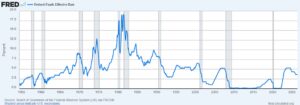
Between 2019 and 2020 Federal Reserve rate reached 0.05%, making loans cheaper than ever before in more than 70 years. According to official Federal Reserve statements and data from FRED the corporate loans in 2020 were 0.25%, which roughly meant that every dollar of loan was worth only 0.25 cents; not 25 cents, 0.25 cents.
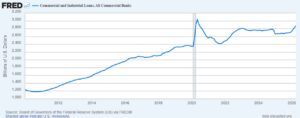
Linkmate analysis suggests that corporate loans weren’t taken in moderation as it usually happens. Usually, during critical times, corporations take out small loans and repay them back shortly. But this wasn’t the case: under a span of a few years, total corporate loans grew from modest $2T to $3.1T in the first half of 2020. Since then, in 2022 this number decreased only by $0.6T (or $600B) to $2.4T, only for them to jump again and continue its growth.
During every market cycle companies found a way to make more profits and escape the loan pressure. During 2023 OpenAI came up with the simple idea — a large language model, interactive chatbot that can answer questions dynamically. According to Linkmate analytics, this approach gave investors false hope that they can not only replace some costs, but cut significant chunks of the workforce to save on payment enrolls and actually get profits.
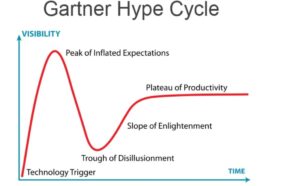
This revelation made investors overly confident, so mass layoffs in top tech firms followed: Oracle, Google, Amazon, Payoneer, Intel, HP, Meta, Fiverr, xAI, Salesforce, CISCO, Peloton. TechCrunch published a full list for 2025. As per Linkmate analytics, every year since 2023 grew in layoffs numbers, confirming theory of being at the peak of the Gartner’s Hype Cycle for the AI market.
Where Is AI In Gartner’s Hype Cycle? Linkmate Analysis of the Real-World AI Demand
Gartner’s Market Hype postulates that every technology comes through stages of maturity. After reaching the peak of inflated expectation, usually what happens next is reevaluation of the situation and sober analysis of the market and how technology actually applies to it.
One of the promising use-cases for AI is resolving the real-world equivalent of NP-complete tasks. Real use-cases of AI lie in solving protein chains, finding new cures for old diseases, pushing cancer research by decades, saving lives by unconventional means, discovering new materials people never thought of, and making medicine cheaper. While not a silver bullet, AI, particularly ML and LLM, can resolve tasks that are too cumbersome for conventional approaches.
Once the market exits the stage of inflated expectations and disappointing sobriety, the real use-cases start to pop up and become widely recognized as deliberate solutions to existing problems.
One of the markets that the AI market goes through is the realization that people are still cheaper than AI.
Tokenmaxxing, a trend of maximizing token use, surfaced as the peak of inflated expectations of AI solving everything instead of humans. Turns out, in reality, the bill for the said AI tokens is much higher than the average salary of a software engineer.
In Microsoft’s own words: “Using tech is more expensive than paying human employees”. More data surfaced from Uber, whom C-Levels publicly decided to decimate the HR department after realizing they’ve burnt through their AI budget in 4 months. According to the active VP of Nvidia, AI costs “far more than humans”.
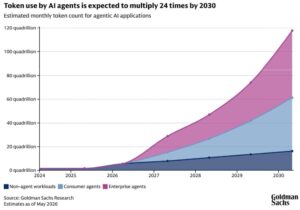
According to Goldman Sachs projections, at the current rate, we can see AI use skyrocket to 120 quadrillion tokens by 2030. Bank of America doubled-down on bullish prediction by Goldman Sachs, saying that AI spending could reach $155B by 2030.
What Do Numbers Say About AI Use?
Comparing SEC filings against public claims gives a slight picture. According to Linkmate analysts, AI hype is real and measurable in three distinct metrics:
- Average PJM Power Price Spike, or price per MW-day, have risen +833%;
- HBM Memory are being 100% sold out ahead of the market;
- Projected Hyperscalers CapEx for 2026 on AI is to be $660B.
But there’s a disconnect between promised CapEx and real Free Cash Flow registered with SEC filings. Namely, Amazon, and Google are in negative cash flows, while Microsoft is somehow boasting positive numbers.
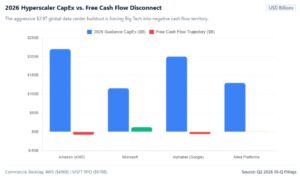
Hyperscalers Free Cash Flow Vs. 2026 CapEx | Linkmate Analytics
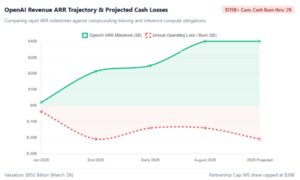
One of the more worrying patterns in the health of the main market player — the OpenAI. According to PR, the projected APR milestone for 2026 is $40B, while real annual operational loss is at negative $20B in 2025, and projected -$14B in 2026. This discrepancy between fundamental metrics and disclosed data can become a problem in the future if the real use-case for AI won’t materialize.
Current market narrative suggests that the main use for AI is being an assistant, reading emails and making summaries from the google search. What numbers do tell is that the demand is there, but real application lies elsewhere — in the realm of solving real-world equivalent of NP-compete tasks.
Adoption metrics are there, as well as venture capital with at least $510B in spendings. Breaking down by industry, almost 80% of global VC from Q1 2026 money went to AI startups, which is roughly $242B out of $300B.
According to best market estimates, the AI market for 2026 is valued between $375B and $0.9T, with projected CAGR of 14% to 39%.
Linkmate analytics suggest that numbers say demand is concrete and present across the board, but what is lacking is the supply of actual product-market-fit propositions that can be used in real-world scenarios. Fundamentally, what can happen is that in the nearest future the AI market will go through a correction phase, where all the weak players would be replaced by those who supply applicable use-case for the real-world market. Best Linkmate estimates put the possible correction phase between 2027 and 2028 if no real-world widespread applicable use-case emerges.
About Linkmate
Linkmate is an AI software company, situated in Singapore, with 9+ years of experience in Fintech, Banking and Blockchain operating since 2017. Parenting company of LocalTrade LATAM cryptocurrency exchange.


