


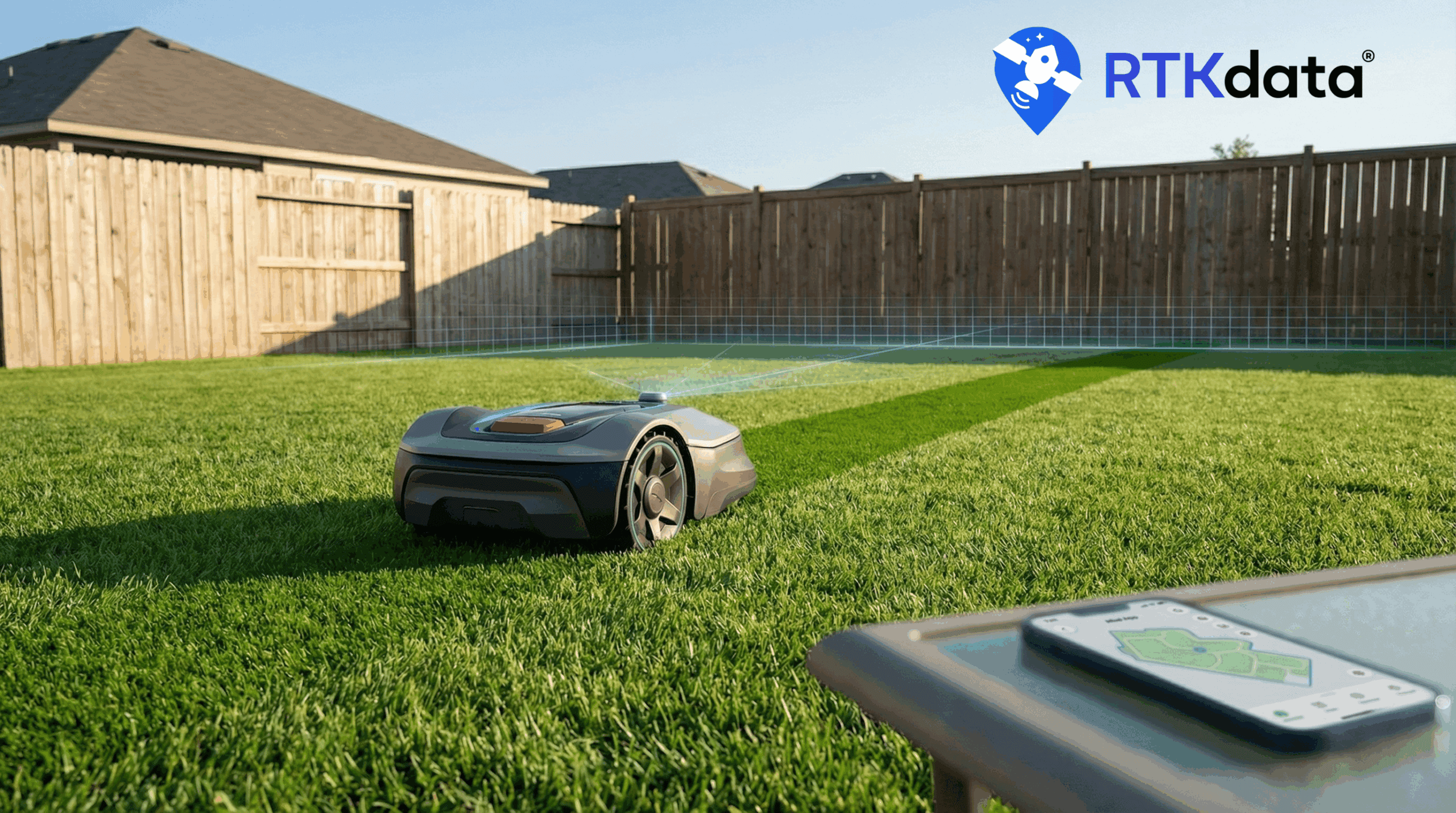
German startup makes centimetre-level GPS accuracy accessible to drones, robots and autonomous vehicles for $40 a month.
As autonomous vehicles, delivery drones and robotic systems move from research labs to real-world deployment, one technical challenge keeps surfacing: standard GPS simply isn’t accurate enough. While your smartphone’s GPS might get you within a few metres of your destination, that margin of error could send an autonomous forklift crashing into warehouse shelving or guide a delivery drone onto the wrong rooftop. RTKdata.com, a Germany-based startup, is tackling this problem head-on by making centimetre-accurate positioning accessible to companies of all sizes.
The Precision Gap Holding Back Autonomous Systems
Real-Time Kinematic (RTK) technology has existed for decades, delivering positioning accuracy down to one-to-two centimetres by correcting GPS signals in real time. Survey teams, construction firms and precision agriculture operations have relied on it for years.
The catch? It traditionally required expensive base station hardware costing anywhere from £5,000 to £15,000, plus ongoing maintenance, calibration and technical expertise to keep everything running smoothly.
For large agricultural operations managing thousands of hectares or construction firms running multi-million pound projects, that investment made sense. For robotics startups, drone service providers, or SMEs exploring autonomous solutions, it was often a dealbreaker that killed promising projects before they could even reach the prototype stage.
RTKdata.com removes that barrier entirely by turning precision positioning into a simple subscription service.
More from Tech
- Fintech Funding Rebounded In 2025 As Investors Shifted Toward AI And Digital Assets
- Can Antivirus Software Detect And Remove Ransomware?
- Valentine’s Day 2026: If Run Clubs Are The New Dating Apps, What’s Next For Romance Tech?
- SexTech That’ll Spice Up The Bedroom This Valentine’s Day
- Common Mistakes When Choosing Antivirus Software
- UK Drivers Ditching Phone Calls For Chats And Automotive Retailers Must Adapt
- Why Should Small Businesses Invest In Antivirus Protection?
- How Technology Shaped Super Bowl 2026 – From Ads To Analytics
Cloud-Based Corrections with Global Coverage
The platform operates a network of over 20,000 reference stations spread across more than 140 countries, streaming real-time corrections to any compatible GNSS receiver via the industry-standard NTRIP protocol. Users simply enter their credentials into their existing hardware, connect over mobile data, and they’re operational within minutes. No base station to install, no complex configuration, no significant capital expenditure. The approach mirrors what cloud computing did for server infrastructure: transforming a major capital expense into a predictable, scalable operating cost.
The technical specs back up the promise. The service delivers one-to-two centimetre horizontal accuracy and two-to-three centimetre vertical accuracy, with sub-second latency. It supports all major satellite constellations, including GPS, GLONASS, Galileo, and BeiDou, ensuring reliable coverage even in challenging environments. The system works with receivers from established brands like Trimble, Topcon, Emlid, and u-blox, as well as more affordable options popular with startups and makers.
From Robotic Mowers to Autonomous Warehouses
The applications span multiple industries and use cases. Drone operators use the service for aerial surveying and photogrammetry, often requiring fewer ground control points than traditional methods. Robotics companies integrate it into autonomous lawn mowers, security patrol robots, last-mile delivery bots, and warehouse AGVs. Construction firms rely on it for machine guidance, site surveying, and as-built documentation. The service has also found traction in marine applications, with autonomous surface vessels using it for port automation and offshore inspections.
The timing appears right for this model. Major robotic lawn mower manufacturers including Segway and Mammotion have recently shifted away from bundled base stations, instead shipping products that connect directly to cloud-based RTK correction services. This trend toward network RTK over proprietary hardware is accelerating across multiple sectors, from agriculture to logistics.
Flexible Plans from Single Licenses to OEM Partnerships
Monthly plans start at $40 USD for a single concurrent connection, with annual subscriptions bringing that down to around $33 per month. Multi-year commitments reduce costs even further. For larger deployments, the company offers volume licensing and white-label OEM partnerships, allowing hardware manufacturers to integrate RTK corrections directly into their products. A 30-day free trial with full access gives engineering teams adequate time to properly evaluate the service and validate their integration before making any financial commitment.
For startups building autonomous systems, that pricing model fundamentally changes the economics. Instead of a significant upfront hardware investment that ties up precious runway, teams can validate their technology with operational expenditure that scales alongside their deployment.
As the autonomous systems market continues to expand, positioning infrastructure like RTKdata.com could prove as essential as AWS or Azure have become for software startups. The company is positioning itself as the default positioning layer for the next generation of machines that need to know exactly where they are, down to the centimetre.