


Authored by Mikaelle De Oliveira
Think about how strange it’d be if your laptop suddenly grew arms and started walking around your house.
We’ve spent years making computers easier for us to use. Now, we’re making them easier to talk to. OpenAI’s GPT-Live models can listen and talk at the same time, making conversations with AI feel closer to a normal back-and-forth than the old experience of typing a prompt and waiting for a response.
Meanwhile, robotics companies are working on the physical version of that idea. At this week’s World Robot Conference in Beijing, companies showed humanoid robots sorting parcels, packing phones and carrying out household tasks. Reuters reports that Unitree CEO Wang Xingxing sees robotics moving towards its own “ChatGPT moment”, where robots could eventually understand simple voice or text instructions and carry out tasks in unfamiliar environments. He estimates that this could still be two to 10 years away, but 10 years doesn’t feel that far off when you consider how quickly AI has already changed.
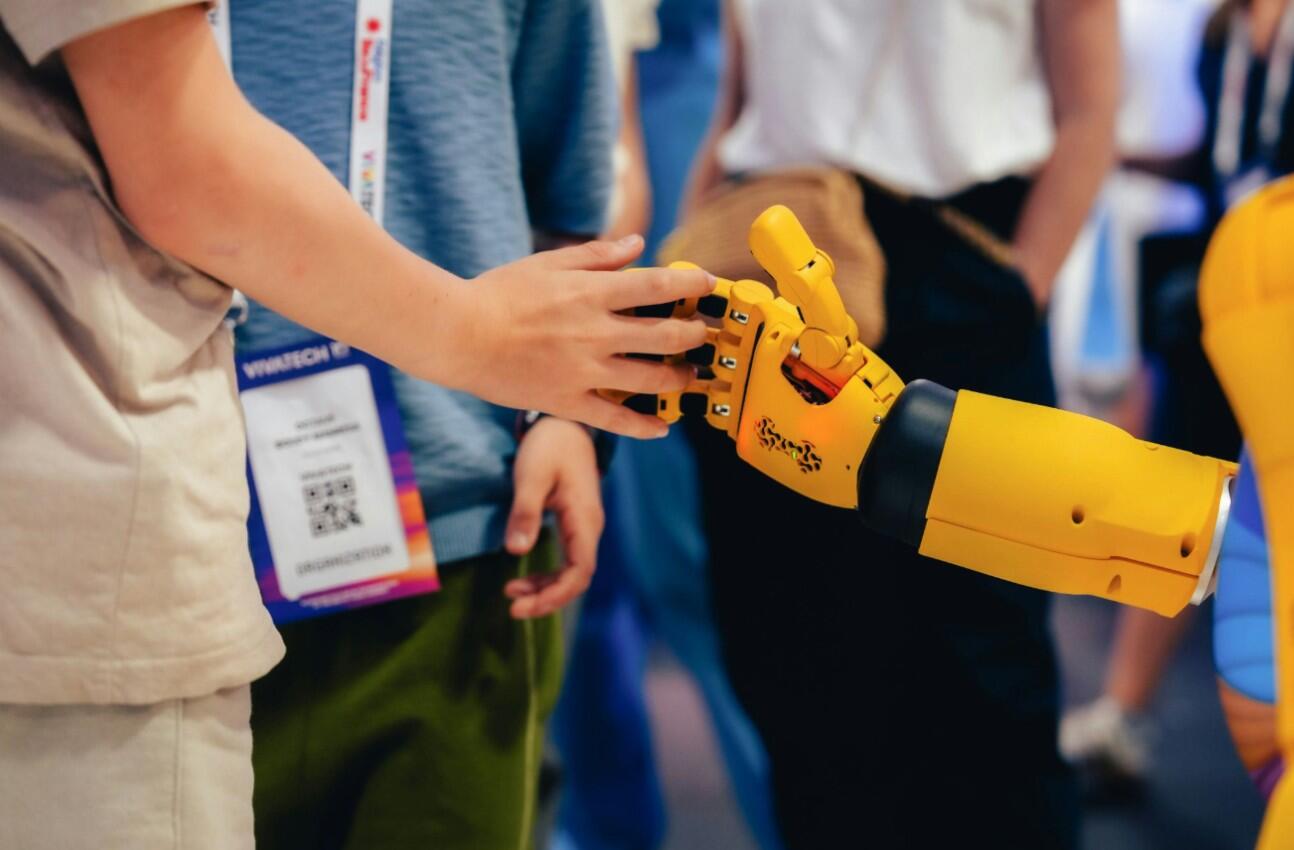
AI can already speak with us naturally. Now, we’re putting that kind of intelligence into robots that can move through the physical world too. The robot doesn’t need to look like a human to be useful, so why are we so determined to make it look and act like us?
Why Does Human-Looking Technology Feel So Strange?
There’s a reason a robot that looks almost human can feel stranger than one that clearly looks like a machine.
Small differences in movement, facial expression or appearance become much more noticeable when we’re comparing a robot with an actual person. A face that doesn’t move quite naturally or a gesture that feels slightly off can make the whole thing quite unsettling. The closer a robot gets to looking like a real person, the more those little differences stand out.
Personally, I’d take an obvious robot over something that’s trying very hard to pass as a human any day. At least then you know exactly what you’re dealing with.
That could become more important as robots move into homes and workplaces. If companies want people to trust and use these machines, making them familiar might help in some situations, but making them look almost exactly like us could have the opposite effect.
However, there’s a practical reason for giving robots a human shape. Much of the physical world we use every day was designed around human bodies. Doors, staircases, tools and workstations are all built around how people move and reach.
A humanoid robot could work in these spaces without companies having to redesign everything around it. If a robot can use the same doors, reach the same shelves and handle the same equipment as a person, companies may not need to change as much just to accommodate it.
More from Tech
- Flying Cars Are Now A Reality, But Is There Really A Market for Them?
- Women In Tech: Top 10 Women In Quantum Computing In 2026
- Self-Reliance By Design: The Best Health Tech Makes You Need It Less
- Volvo Wants To Take Your Hands Off The Wheel By 2030 – What Is Level 2++?
- What Businesses Should Know Before Collecting Public Web Data At Scale
- What Wearable Tech Can’t Tell You About Heart Attacks
- Top Physical AI And Industrial Robotics Startups In Japan To Watch In 2027
- From Pit Lanes To Cargo Planes: The Logistics Behind Moving Formula 1 Around The World
Can Robots Actually Handle The Real World?
A robot’s appearance is only one part of the challenge. The harder question is whether these machines understand what is happening around them and respond safely.
Can a robot follow an instruction clearly? Can it recognise when something unexpected happens? Can it avoid people and objects? Can it work out what to do when a situation doesn’t match anything it’s encountered before?
For these robots to work outside controlled demonstrations, they need AI that can understand the physical world and turn instructions into safe actions. The industry isn’t just trying to make robots walk and talk;they need to take in what’s happening around them and be able to decide what to do next.
Because this breakthrough is still years away, many humanoid robots are still being demonstrated and tested in controlled environments. Getting robots to pick something up during a demonstration is very different from asking them to make the right decision when something unexpected happens.
What Happens When AI Gets A Body
When we interact with AI through a screen, mistakes are usually easy to deal with. We can ask another question, ignore the answer or close the app. A physical robot doesn’t have that luxury. If it gets something wrong, there is an actual machine moving around the room that has to deal with the consequences.
Even a simple instruction can become complicated once a robot has to carry it out. “Put that over there” might sound perfectly clear to a person who can see what you’re pointing at, but a robot has to first identify the object, work out where “over there” is and still have to move without knocking anything along the way.
That’s a very different level of responsibility from giving the wrong answer in a chat at least when ChatGPT gets something wrong, it isn’t driving a forklift.
The more capable these machines become, the more we will expect them to understand us without needing every movement explained. That could make them genuinely useful, but it also gives us a bigger reason to care about how reliably they interpret what we say and what they see.
Do Robots Really Need To Be Like Us?
There are good reasons for robots to be built around the way humans live and work. But that doesn’t mean they need a realistic face, human-like expressions or movements that try to make us forget we’re looking at a machine.
Personally, I’ll take the robot that looks like a robot. If it can understand me, do the job safely and leave the creepy human imitation out of it, I’m sold.
Maybe the best robots won’t be the ones that look most like us. Perhaps, they’ll be the ones that work well in our world without trying to become part of it.


