


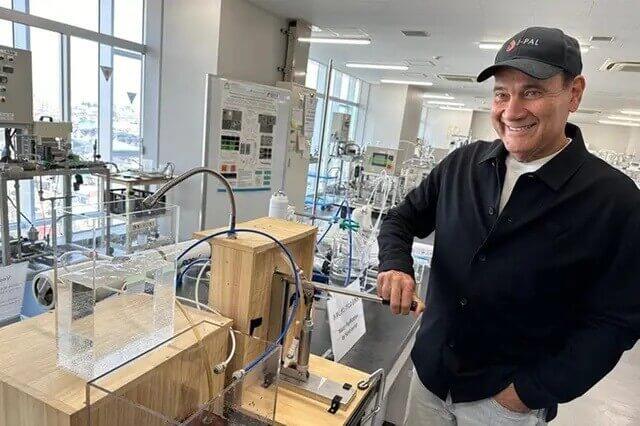
A new reverse osmosis water purification system that operates without electricity has completed a six-month trial in rural India, offering a potential solution for nearly two billion people worldwide who lack stable access to safe water.
Shinshu University, Community Jameel and Jameel Corporation announced the trial results at a press conference in Nagano, Japan.
Researchers at Shinshu University’s Institute of Aqua Regeneration developed the RO membrane technology to address a gap in water purification for communities without reliable power.
The system operates at less than half the pressure of standard reverse osmosis systems and can be driven by a simple hand pump, making it uniquely suited for areas where electricity is unavailable.
The technology has achieved NSF/ANSI 58 certification, the international standard for water purifiers.
Trial Results Show Performance Gains
Communities in West Bengal and Rajasthan, India, participated in the trial over six months.
Results published in the journal Results in Engineering showed the pump doubles water permeability compared to many commercial RO membranes and reduces manual operating energy by approximately 50%. The system functions entirely without electricity, batteries or solar panels.
Well water in both regions is perceived as unsafe or unpalatable by families. Community members who used the water pump reported improvements to taste and appearance of the water, with improved health conditions as a result. The study incorporated this real-life feedback alongside laboratory performance data.
The project received support from Community Jameel and Jameel Corporation, with cooperation from Indian non-profit organisations Seva Mandir in Rajasthan and the Rupantaran Foundation in West Bengal.
Mohammed Abdul Latif Jameel Initiates Collaboration
Mohammed Abdul Latif Jameel, founder and chairman of Community Jameel, initiated the project following his meeting with Professor Morinobu Edo at Shinshu University in 2023.
“Access to clean water remains one of the most urgent challenges faced by populations across the world,” Mohammed Jameel said. “We are pleased to support the team at Shinshu University with this pilot programme, which has the potential to enhance the accessibility of clean water for millions of people and improve health and quality of life within these communities.”
Water contamination and unreliable power have placed advanced purification technologies out of reach for many rural regions. The novel RO membrane technology delivers both ultra-low pressure operation and high water permeability, enabling purification under conditions previously thought impossible.
The team is now exploring commercialisation and scaling of the technology, with a focus on localising it to the communities where it will be introduced. Beyond rural households, the technology could support emergency water purification during disasters and contribute to sustainable water access in infrastructure-independent settings.
Community Jameel has established partnerships with leading research institutions focused on addressing global challenges. The organisation cofounded the MIT Jameel Clinic in 2018, the Abdul Latif Jameel Water and Food Systems Lab at MIT in 2014, and the Jameel Institute with Imperial College London in 2019.
Mohammed Jameel holds an honorary knighthood from Queen Elizabeth II for philanthropic activities. Through Community Jameel, he supports initiatives spanning health, water security, food systems and climate resilience. The organisation backs the Abdul Latif Jameel Poverty Action Lab at MIT, whose co-founders Esther Duflo and Abhijit Banerjee won the 2019 Nobel Prize in Economics.
The water purification trial addresses a fundamental challenge affecting health, education, livelihoods and wellbeing for populations without access to clean water. The hand pump system offers a pathway to safe drinking water in areas where conventional purification remains economically or technically unfeasible.


