



We know that sportstech isn’t a niche part of the sporting industry anymore and the Sports Tech Industry Report from Lincoln Internation shows exactly this as puts the global sports tech market at €23.7 billion in 2025. It expects that to reach €46.8 billion by 2030, which is a CAGR of 14.5%, according to Grand View Research and Lincoln International intelligence.
Now you might be wondering what exactly this growth covers. Well, it’s everything from analytics software to smart stadium systems, even.
The report says the U.S. market has reached a high level of maturity, with proven scalability in wearables, fan engagement and analytics. Europe is on an earlier stage of development, with rising investor interest.
Christopher Petrossian, Managing Director and Co Head of Consumer at Lincoln International, says: “The U.S. market has proven how powerful sports technology can become when innovation meets capital. Europe is now building that momentum, and I believe it offers exceptional opportunities for investors and founders alike.”
Where Is The Money Flowing?
The space has become really active. In sports analytics, transactions went from 9 in 2020 to 25 in 2021 and 28 in 2022, before settling at 22 in 2024 and 22 in Q3 2025, according to Mergermarket data in the report.
Fan engagement deals show the same thing. There were 6 transactions in 2020, 12 in 2021 and 15 in 2022. The figure came in at 11 in 2024 and 6 so far in 2025. In wearables, deal numbers reached 34 in 2021, then 21 in 2024 and 10 year to date in Q3 2025.
Valuations also show investor interest as the report lists fan engagement and commerce at more than $31 billion at global leader stage. Wearable technology is at more than $11 billion in mature segments, according to PitchBook data in the report.
Enter The SportsTech22 Competition here
What Is Driving Demand On The Ground?
Audience behaviour is changing. In China, 66% of fans say they would pay to watch sport in virtual reality, according to data in the fan engagement section of the report. That opens the door to virtual tickets, 360 degree streams and spatial content.
Stadium expectations are also changing. The report says that 58% of fans want in stadium access to the same stats and replays they get at home. That demand supports spending on 5G, AR features and connected infrastructure.
On the performance side, the global sports analytics market is projected to grow from €3.1 billion in 2025 to €8.0 billion in 2030, a CAGR of 20.6%, according to Grand View Research, PwC and S&P Capital IQ data in the report.
The data is giving hope that this sector is one that is scaling pretty fast. From immersive fan tools to AI driven performance systems, sports tech is moving into the core of how sport is played, watched and funded. We have gone beyond the point where the only thing we think of in sportstech is wearables.
Some More Interesting SportsTech Developments That Aren’t Just Wearables
Betterguards

The BetterGuard Lite – Traditional ankle braces are often bulky and restrictive. The new BetterGuard Lite changes that. At just 60g, it’s a sleeve-free, minimalist support that stays flexible during play but reacts instantly to prevent ankle rolls or breaks, kind of like a seatbelt in your car, thanks to its micro-hydrodynamic technology. Since its U.S. debut in 2023, Betterguards has seen widespread adoption by athletes across the NBA, NFL, MLS, MLB, and NCAA.
Price: $139
UltimateMove

While the sports technology conversation tends to orbit wearables and biometric tracking, one of the most significant shifts happening right now is in **esports performance analytics** – and it’s happening entirely in software, with zero hardware required.
UDA (Ultimate Demo Analyser) is a free, browser-based demo analysis tool built for Counter-Strike 2 players. What makes it genuinely notable from a sports tech perspective is its architecture: the tool runs entirely locally in the user’s browser. No account. No upload to a third-party server. No subscription. The player drags their match replay file onto the page and receives a full analytical breakdown in seconds – including heatmaps of movement and death patterns, round-by-round gameplay analysis, and a dedicated anti-cheat behaviour module.
The significance here isn’t just the tool itself – it’s what it represents. Esports organisations at the top level spend thousands of dollars per month on equivalent analysis infrastructure. UDA democratises that class of performance intelligence for every competitive player, regardless of budget or team affiliation. In a sport where marginal decision improvements directly translate to rank progression and competitive outcomes, removing the barrier to data-driven self-coaching is a structural shift.
Built by KaRzye (me actually who writes this :D), a FACEIT Level 10 CS2 coach and founder of UltimateMove, UDA emerged from a straightforward observation: the tools that help players improve fastest are locked behind paywalls and account systems that most players won’t navigate. The tool currently supports Valve Matchmaking and FACEIT demos, with planned expansion to additional game titles. It will remain free for the lifetime of the UltimateMove brand.
As esports continues to formalise – with organisational scouting increasingly driven by analytics and replay data – tools that surface that data for everyday players represent the grassroots layer of a rapidly maturing sports science ecosystem. UDA is a clean example of what sports tech looks like when the audience is digital-native and the playing field is measured in milliseconds and decision trees rather than sprint speed or lactate threshold.
Enter The SportsTech22 Competition here
MasTec Advanced Technologies

One of the most important SportsTech developments to watch beyond wearables is the rise of AI-driven performance intelligence platforms that operate behind the scenes rather than on the athlete’s body. These systems use computer vision, simulation, and predictive analytics to transform how teams train, strategise, and manage performance.
A major area gaining traction is vision-based motion analysis, where multi-camera setups and AI models analyse athlete movement in real time without requiring any physical sensors. Instead of attaching devices to players, these platforms reconstruct movement patterns, detect inefficiencies in biomechanics, and identify injury risks early. This approach is particularly valuable in team sports where wearables can be restrictive or impractical during gameplay.
Another breakthrough area is digital twin technology for athletes and teams. By combining historical performance data, video footage, and environmental conditions, teams can create virtual simulations that predict how changes in strategy, fatigue, or lineup composition may impact outcomes. This enables coaches to test tactical scenarios in simulation environments before deploying them on the field.
We are also seeing growth in AI-powered officiating and rule enforcement, where real-time computer vision assists referees in detecting violations with higher accuracy and consistency. This technology reduces disputes, improves fairness, and increases fan confidence in competitive integrity.
Perhaps most transformative is the emergence of automated training intelligence platforms—systems that continuously analyse gameplay footage, generate insights, and recommend targeted drills tailored to individual athletes or teams. These tools act like a digital coaching assistant, helping teams scale expertise across large organisations.
Taken together, these developments represent a shift from hardware-centric sports technology toward software-defined intelligence ecosystems, where the competitive advantage lies not in the device itself but in the data interpretation and decision-making capabilities behind it.
The fully certified game ball tracks every shot, while the supporting app gives AI-powered, continuous coaching on how to improve shooting in a way that gets every basketball player excited and improving fast.
SportIQ – Spalding TF-DNA Smart Basketball
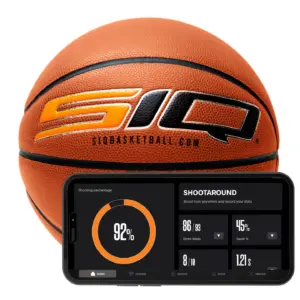
The fully certified game ball tracks every shot, while the supporting app gives AI-powered, continuous coaching on how to enhance hoop shooting in a way that gets every basketball player excited and improving fast. Data shows that shooting accuracy can be improved by as much as 25% with consistent use. The app has already analyzed over 20 million shots and is used by some of the best NBA shooting coaches.
Additionally, the TF-DNA community provides great gamification and fun challenges for every young basketball player out there.
Without the pressure of a team coach watching or spending hundreds of dollars on a personal shooting coach, the ball helps the player feel a sense of improvement and mastery, while making shooting a basketball more fun than it ever was before.
The ball is available on Amazon and other major marketplaces.
Spalding TF DNA Smart Basketball was listed as TIME Magazine’s Invention of the Year 2025!


