


Article attributed to NALA representatives.
For interior designers, art sourcing has always been one of the most subjective and time-consuming parts of a project. A designer may know the mood, palette, scale, budget and emotional tone a client wants, but still spend hours moving between gallery contacts, artist websites, trade fairs, social platforms, image references and fragmented online catalogues.
Most online art platforms still approach discovery as a catalogue exercise: filter by artist, medium, price, size or genre, then scroll. That works when a buyer already knows what they’re looking for. It’s far less effective when the starting point is an empty room, a client brief, a mood board or an atmosphere.
NALA, founded by Ben Gulak, is taking a different approach. The company is building a data-science-led art discovery platform that uses recommendation algorithms and computer vision to help buyers find original artwork with far greater precision. Its most compelling professional use case is interior design, where speed, fit, budget and visual alignment all matter.
NALA stands for Networked Artistic Learning Algorithm, and the name points directly to the company’s core thesis: art discovery can be made more intelligent when artworks, artists and buyers are connected through better data. For Gulak, who’s both a computer scientist and a painter, the problem is personal. Artists often struggle to reach serious buyers beyond their local market, while designers and collectors struggle to find the right work at the right moment.
NALA is trying to solve both sides of that equation.
Rather than treating artworks as static listings, NALA analyses how users respond to individual works. Saves, likes, shares, browsing patterns and other engagement signals help the platform build a more detailed understanding of taste at the artwork level. Computer vision adds another layer, examining visual qualities such as colour, composition, texture, subject matter, style and the relationship between one work and another.
That distinction is important. A buyer may not like every work by a particular artist. They may respond to one piece because of its palette, another because of its texture and another because it fits the feeling of a specific room. NALA’s system is designed to understand those differences and improve discovery around the individual artwork, not just the artist’s overall profile.
For interior designers, that shift could be significant. Designers rarely search for art in the abstract. They’re sourcing for specific spaces: a large-scale abstract work for a hotel lobby, a calming piece for a residential bedroom, a bold contemporary work for a restaurant or a collection of smaller pieces for a commercial corridor. Each project comes with constraints around size, budget, availability, client taste, shipping and presentation.
NALA’s platform is built to turn those constraints into a faster sourcing process.
More from Tech
- Why Is It So Hard To Put Tech Down? The Design Choices Behind Our Attention
- Can A Trading App Truly Be Risk-Free When Real Financial Habits Are On The Line?
- The Tech F1 Teams Use To Prepare For Unfamiliar Tracks
- Beauty Tech Explained: The Cosmetic Treatments Changing Aesthetic Medicine
- Could An App Help Families Manage Allergies More Confidently? ACE Launches Allergy Assist
- Wi-Fi 8 Is Arriving – What Does It Actually Change For Your Home?
- The Unexpected Role Of Consumer Tech In Space Engineering
- How To Optimise Your VoIP System For Better Performance
One of its most distinctive tools is Echo, the company’s reverse-image search function. A designer can upload a room image, mood board, textile sample, reference artwork or visual inspiration, and NALA surfaces original works with related visual qualities. Instead of relying only on written filters, Echo uses computer vision to compare colour, composition, style and structure across the platform’s artwork database.
That gives designers a different starting point. They no longer have to translate a visual idea into a narrow set of search filters. They can begin with the image that already captures the direction of the project.
Voice Search extends that idea into spoken briefs. A designer can describe what they need in plain language – for example, “a warm, textured abstract for a coastal living room” or “a still life painting of an empty Starbucks cup on a kitchen table” – and NALA translates that request into relevant artwork matches. The system is designed to understand mood, palette, context and intent, not just a literal category. No matter how specific the query, if the painting exists NALA will find it or find the closest relevant artwork.
The company’s designer portal brings the discovery process into a more practical workflow. Designers can create project collections, manage budgets, compare options, prepare client-facing selections, use room mockups and source works directly from artists. The goal isn’t just to make browsing easier, but to make art procurement more efficient from the first brief to the final purchase.
That professional angle is where NALA’s opportunity becomes especially interesting. Consumers may buy art occasionally. Interior designers buy repeatedly. They source work for homes, hotels, restaurants, offices, staging projects and commercial interiors. They need access, variety, reliability and speed. If NALA can become a trusted sourcing layer for designers, it has the potential to turn art discovery into a repeatable professional workflow.
The direct-to-artist model also changes the economics. Instead of relying only on galleries, local art fairs or personal networks, designers can discover artists globally and contact them directly through the platform. For artists, that creates access to a category of buyers who aren’t simply browsing, but actively sourcing for real projects.
This is especially meaningful for artists outside major art capitals. Many artists are limited by geography, tourism cycles, local exposure or the difficulty of building international relationships. NALA’s global onboarding model is designed to give those artists a pathway into commercial and residential projects they would otherwise be unlikely to reach.
For designers, NALA’s advantage is that discovery is connected directly to the practical realities of sourcing. The platform isn’t just surfacing attractive images; it’s helping designers move from visual brief to actionable shortlist. Through project collections, budget tools, room mockups, advanced filters, Echo, Voice Search and direct artist-to-buyer messaging, NALA turns original art sourcing into a faster, more structured and more global workflow.
That’s what makes the platform especially relevant for interior designers. Instead of being limited to familiar gallery contacts, local networks, trade fairs or manual browsing, designers can search across a global pool of artists and identify works that fit a specific space, palette, scale, budget and client brief. A designer can begin with a room image, a mood board or a spoken description, and NALA can help translate that creative direction into real artworks from independent artists around the world.
For artists, the impact is just as significant. NALA gives creators a direct route to serious professional buyers: the designers, collectors, institutions and commercial clients who are actively sourcing work for real spaces. That changes the opportunity from passive visibility to targeted discovery. Artists are no longer relying only on geography, foot traffic, gallery representation or social media reach. Their work can be matched with buyers whose tastes, projects and purchasing intent align with what they create.
This is the strongest version of NALA’s story. It’s not simply an online art marketplace. It’s an algorithmic sourcing layer for the art world, connecting artists directly with the professionals deciding what appears in homes, hotels, offices, restaurants and cultural spaces around the world.
Ben Gulak commented: “The biggest barrier for most artists isn’t creativity; it’s distribution. NALA gives artists access to professional buyers by matching individual artworks with the designers, collectors and institutions most likely to need them. An interior designer sourcing for a hotel, residence or commercial space can now discover an artist on the other side of the world because the work fits the brief, not because that artist had access to the right gallery, fair or local network. That’s the power of applying data science and computer vision to art discovery.”
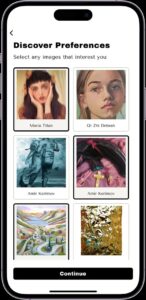
NALA’s discovery platform helps designers find artworks by analysing visual qualities, not just artist names or categories.


