


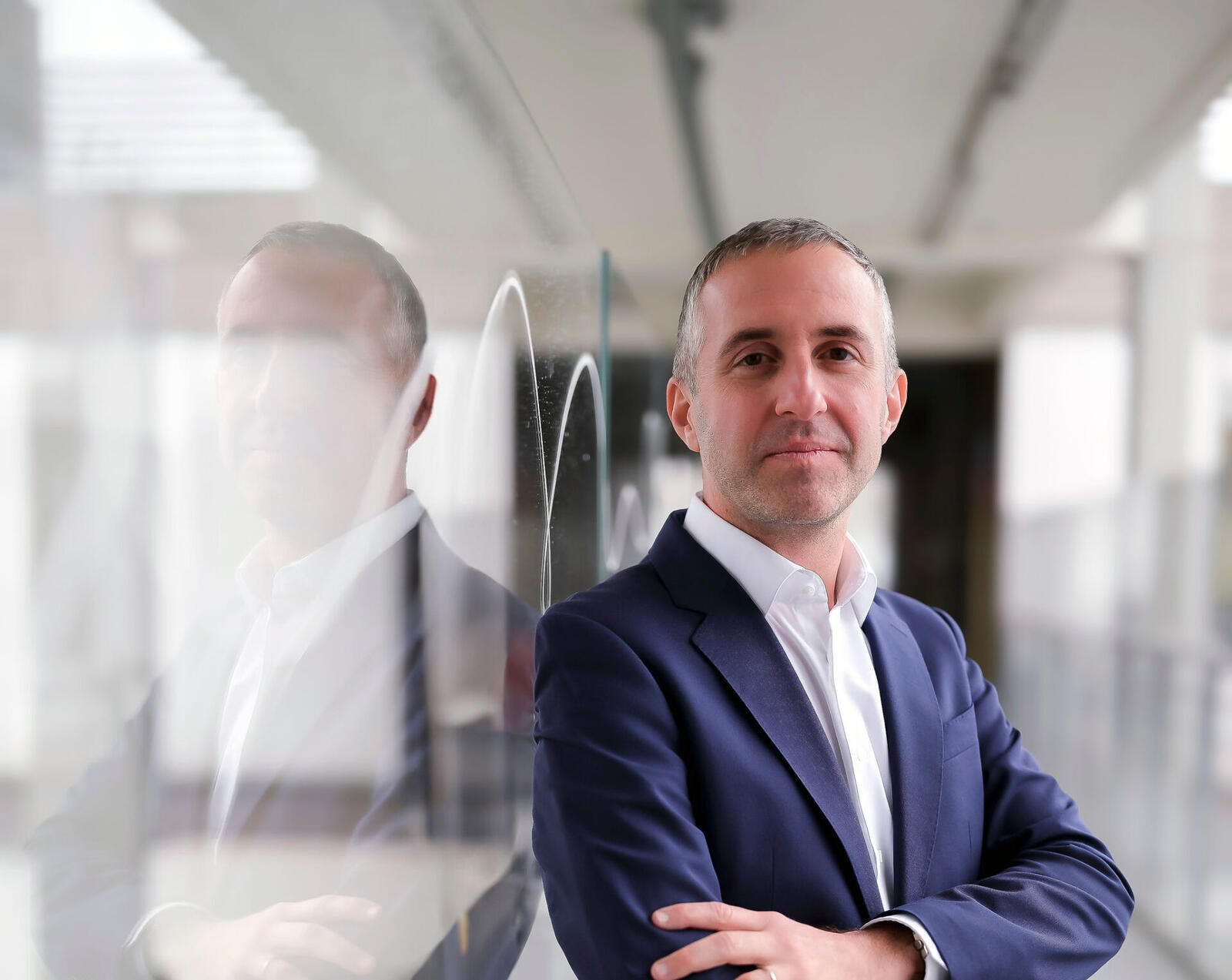
Please introduce yourself.
My background is, I’ll admit, an unusual one, though I suspect many people in this industry say the same. I’ve had several very different experiences along the way. Between 2010 and 2013, I ran a major international event in Qatar, the World Innovation Summit for Education. I then became Communications Director at voyages-sncf.com, before taking over as Managing Director of Publicis Live, the event agency of Publicis Groupe. Finally, in July 2022, I was appointed Managing Director of VivaTech.
If you add it all up, communication since the early 2000s, large-scale events, institutional relationships, it can look like a career that went in every direction at once. But in retrospect, it makes complete sense: VivaTech brought all of those passions together in one place. Communication, events, and innovation. It’s a magnificent playground that genuinely excites me every single day. Every morning, I feel fortunate to be working on a project like this, and even more so, to be surrounded by teams who are extraordinarily committed and talented.
Tell us about your role at VivaTech and what your day-to-day involves?
As Managing Director, I oversee VivaTech’s overall strategy, development, and execution. In practice, no two days are the same. One morning might involve reviewing our thematic programming; the afternoon, meetings with corporate partners, country delegations, or investors. What structures my role above all is a long-term ambition: to make VivaTech the global epicentre of innovation, a place where startups, large corporations, and investors from across the world genuinely meet and do business.
The numbers reflect where that ambition stands: in 2025, over 180,000 visitors from 171 countries, more than 14,000 startups, 450-plus speakers, and 3,600-plus investors. For the 10th anniversary edition, June 17 to 20, 2026, the scale changes again. We’re moving into Hall 7, with 30% more exhibition space across three floors, over 1,500 live demonstrations, and over 15,000 startups present à VivaTech. Every decision I make comes back to one question: how do we ensure each edition creates more value than the last, for every actor in the ecosystem?
What first drew you to the startup and innovation ecosystem?
It wasn’t a single moment, it was a gradual pull. Throughout my career, I was always drawn to environments where something genuinely new was being built. What fascinated me wasn’t technology in isolation, but the energy of people trying to solve real problems in ways that hadn’t been tried before. I came to VivaTech having experienced it from three different angles: as a corporate partner with SNCF, as a producer through Publicis Live, and now as its Managing Director. That full-circle view gave me a very concrete sense of what the innovation ecosystem actually produces, not just ideas, but businesses, partnerships, and transformations.
What trends are you currently seeing emerge across the startups attending VivaTech?
VivaTech 2026 is deliberately positioned at a hinge point: the close of the first wave of digitalisation, and the opening of the AI and deeptech era, alongside a more assertive European technological sovereignty. That framing shapes four central themes for this edition. AI & Productivity is the headline, 89% of executives now trust AI to guide their company’s decisions, according to our 2026 VivaTech Trust Barometer.
The conversation has moved from capability to deployment. Cybersecurity & Defense reflects a hard reality: cyberattacks surged 75% in a single year. Greentech & Energy captures the acceleration of the climate and energy transition, from ultra-fast battery charging to ocean regeneration. And Deeptech is perhaps the most exciting signal: from quantum computing to smart contact lenses and space tourism, we’ll be unveiling technologies that genuinely open the next decade.
What’s also striking is how the startup landscape itself is evolving. The profile we once associated with “founder” is expanding significantly, engineers, researchers, scientists building from deep technical expertise. That shift is particularly visible in deeptech, health, energy, and defence.
What makes a startup stand out at VivaTech today?
VivaTech is, at its core, a B2B environment, and that shapes everything. The startups that truly stand out are those that come with concrete solutions that have already delivered results: real use cases, measurable impact, products that have been tested and proven. That’s what creates genuine traction with the large corporations who could become their first major clients, and with investors looking for commercially credible models. But there’s something beyond the rational case, and I think it’s just as important.
We’re called VivaTech for a reason. The startups that are truly remembered are those that surprise, that create a moment, that make people stop and think “I’ve never seen anything like this before.” The ability to make a show, to turn a technology into an experience, is a real differentiator here. Some of our most iconic moments have come from startups that understood that VivaTech isn’t just a business meeting: it’s a stage. The infrastructure we’ve built, Business Gardens, one-to-one meetings, AI-powered matchmaking, supports the business side. The spark has to come from the startup itself.
More from Interviews
- Interview With Joe Gillam, Co-Founder Of Soul Spaces
- A Chat With Alexander Kihm, Founder And CEO Of POMA AI
- A Chat With Jason Day, Head Of EMEA At Luma: How Agentic AI Is Rewriting The Rules Of Creative Production
- A Chat With Yahya Hmida, XWorld: Building An Enterprise AI Company With No Outside Funding
- A Chat With Antonio Barradas, Epassi And Zest: Why Choice Alone Isn’t Enough For Employee Benefits
- A Chat With Laura Harrison, Education Lifeguards: Rethinking Teacher Wellbeing This World Mental Health Day
- A Chat With Luca Steinmetz, FARAWAYHOME: How AI Search Is Rewriting The Rental Listing
- A Chat With Lucid Software’s Jamie Lyon: Why Shared Context Is Becoming AI’s Real Competitive Edge
Why is an event like VivaTech important for the global startup ecosystem and beyond?
From the very beginning, our ambition was clear: to create in Europe a global tech event to build a bridge between startups and large corporations. Ten years later, that ambition has taken shape. Paris has established itself as an unmissable stop on the global technology calendar. What makes VivaTech’s position distinctive is a very specific DNA: a place where innovation, business, and human encounters naturally combine. We are fundamentally B2B, and that matters.
At VivaTech, a startup connects not only with investors, but with the major international corporations that can become its clients. That combination is rare. But beyond the numbers, what VivaTech represents is a place where European technological leadership becomes visible, to the world, and to itself. What I find distinctly European about this dynamic is the desire to collaborate rather than compete. That collaborative instinct is our greatest differentiator.
Are investor priorities shifting, and if so, what are they focusing on now?
What we observe at VivaTech is that investors have become significantly more selective and more sector-specific. In 2025, we welcomed over 3,600 investors and investment funds, such as Accel, Eurazeo, EIF, IRIS, etc. For 2026, the areas attracting the strongest interest are clearly AI productivity applications, cybersecurity and defense, and energy transition. These aren’t speculative bets, they’re sectors where both the demand signal and the regulatory environment are generating real commercial momentum. There’s also a sharper focus on capital efficiency and proven traction.
The era of broad, thesis-agnostic bets has given way to a much more rigorous approach. In response, we’ve introduced Investors Office Hours, a structured mechanism to accelerate founder-investor connections on-site, with dedicated time slots and tables. The logic is simple: with over 4,000 slots dedicated to business and networking , the quality of interactions matters as much as the quantity. Investors at VivaTech want to meet startups that understand where they fit in a corporate value chain and have a clear go-to-market. That’s a meaningful shift from earlier editions.
How are startups approaching AI and emerging technologies differently this year?
The shift is visible and significant. AI has been a major theme at VivaTech for several years, in 2025, over 40% of exhibitors presented AI-based solutions. But as its novelty effect fades, the question has fundamentally changed. The priority is no longer what AI can do in theory. It’s about concrete impact: how does it transform banking, insurance, healthcare, automotive, retail? We’ll also be exploring the convergences between AI and other technologies, particularly robotics, intersections that are opening genuinely new possibilities, with models now capable of understanding physical environments.
What’s also distinctive this year is the sovereignty dimension. Europe’s approach, combining cutting-edge innovation with ethical regulation, is not a constraint; it’s a competitive advantage in a world that needs trust and stability. This is precisely why we launched, with the World Economic Forum, the European Centre of Excellence in AI, based in Paris: to promote best practices, support adoption, and contribute to building a distinctly European model that connects industry, researchers, and public institutions.
What sectors or innovations do you think are currently under the radar but gaining momentum?
Two areas stand out. The first is what we’re framing as sovereignty and ethics, specifically the intersection of digital sovereignty, disinformation, and deepfakes. In a world marked by growing geopolitical tensions, innovation has become an indispensable lever of independence. Startups building verification tools, secure infrastructure, and responsible AI governance are gaining serious traction with both institutional and corporate buyers. The second is deeptech and specifically quantum technology.
What’s happening right now is significant, and VivaTech 2026 will reflect that directly. IBM will be presenting in exclusivity at VivaTech a “quantum chandelier”: a system enabling calculations far more powerful than classical computers, with concrete applications in healthcare, telecommunications, and industrial optimisation. We’re at the moment where quantum moves from the lab to the market, the same inflection point AI crossed a decade ago.
The startups building in this space today, on encryption, simulation, and sensing, are largely invisible to the mainstream tech conversation. Europe has real assets here, with strong academic foundations and growing institutional investment in sovereign computing, a commitment that VivaTech helps to showcase and accelerate.
What’s the biggest mistake founders make when attending major tech events?
Coming without a clear objective. It sounds obvious, but it remains the most common mistake. VivaTech is a vast ecosystem, if you arrive without a precise list of who you want to meet, what you want to achieve, and what you’re prepared to offer, the scale of the event works against you. The second mistake is treating it as a visibility exercise rather than a business one. Our DNA is a place where innovation, business, and encounters naturally combine, but that combination only activates if you engage with it deliberately. Startups schedule meetings before the doors open. They use the matchmaking application. They leverage the Business Gardens and Investors Office Hours. They follow up rigorously after. VivaTech is an accelerator, but only for those who treat it like one from day one.
How do you see collaboration between corporates and startups evolving?
The relationship is maturing and VivaTech has both witnessed and contributed to that evolution. In 2016, the dynamic was often exploratory: large corporations came to observe; startups came to pitch. The relationship was asymmetric. What we’re seeing now is a genuine shift toward co-construction. Corporates come with specific operational problems to solve, and they need startups that understand their constraints: procurement cycles, compliance requirements, integration complexity.
From the startup side, the most successful ones at VivaTech are those that have moved beyond the pitch mindset. LVMH is a compelling illustration: their “La Maison des Startups” programme and the LVMH Innovation Awards reflect a depth of engagement that goes well beyond networking, and LVMH has been a VivaTech partner since the very first edition. What I find distinctly European about this dynamic is the desire to collaborate rather than compete. Innovation, business, and human encounters mixing naturally: that’s our DNA, and it’s what the best corporate-startup partnerships are built on.
Looking ahead, what kind of startups do you think will define the next decade of innovation?
When I think about what the next decade demands, I see VivaTech’s role clearly: to be the place where the next great technological revolutions take shape, and to anticipate the innovations that will transform our lives and our industries. The startups that will define the decade ahead are those that combine technological depth with commercial credibility and a genuine sense of responsibility.
Europe has something distinctive to offer: the ability to conjugate cutting-edge innovation, economic performance, and ethical regulation. Far from being a constraint, that framework is a real competitive advantage in a world in search of trust and stability. The founders who understand that, who view responsibility not as a limit but as a differentiator, are, in my opinion, the ones who will continue to innovate in 2036. Our DNA at VivaTech will remain unchanged: an indispensable gathering place for all those who want to shape the future of technology. That mission feels more relevant today than at any point in our ten-year history.


