


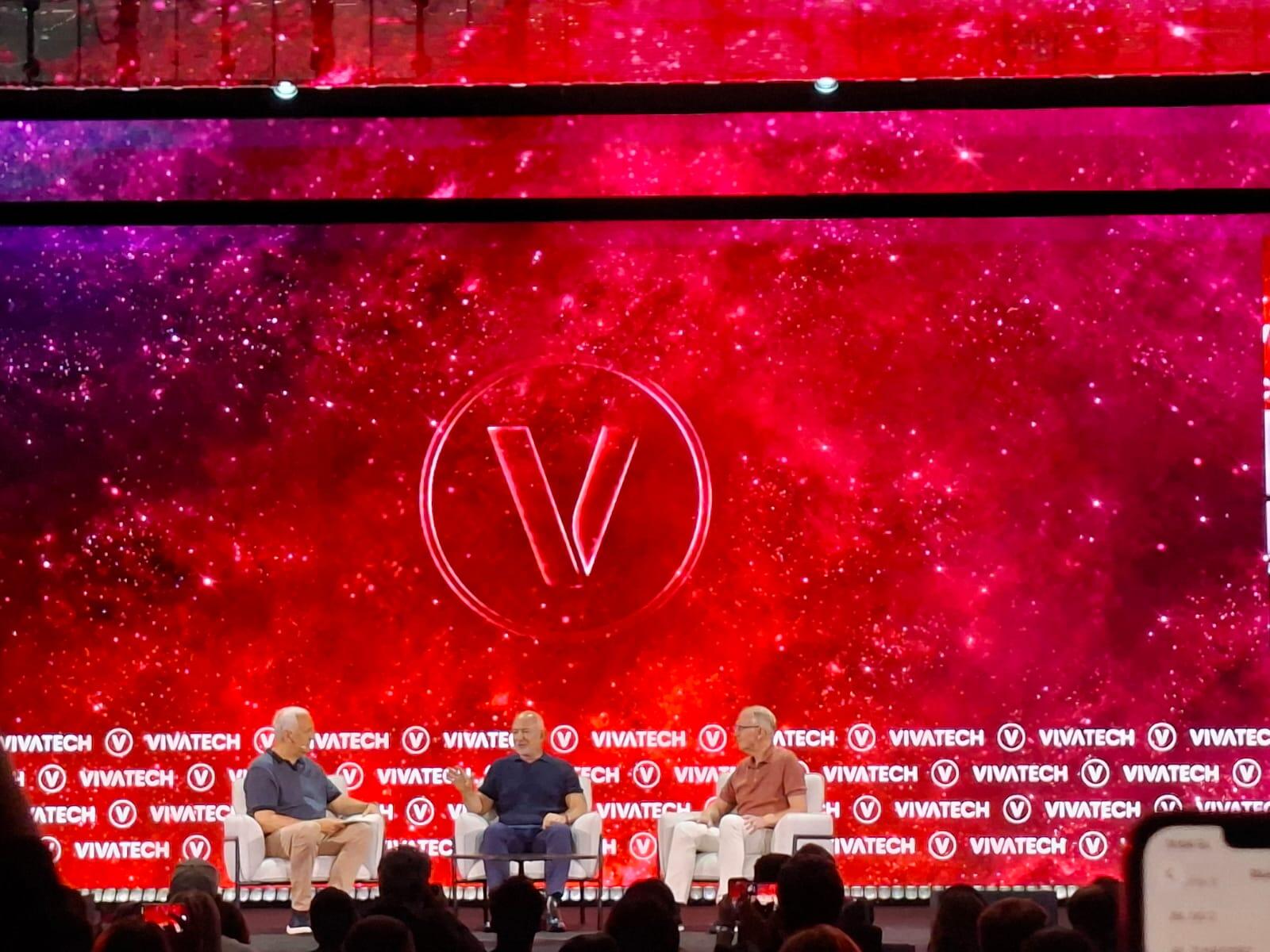
It’s quite something to be in the same room as one of the top five richest people in the world – the fourth, to be precise, according to Forbes ever-changing live update page.
With a lower networth than only three people alive today – Elon Musk, Larry Page and Sergey Brin – Jeff Bezos’s incredible success is absolutely undisputed. And even though he’s still most well known for e-commerce giant, Amazon (and all related subsidiaries), the Washington Post and most recently, Project Prometheus, it was his work with Blue Origin was the focus today.
Space. Lunar exploration. Saving the planet. Or, “Building a road to space for the benefit of Earth,” according to Blue Origin’s official mission statement.
Contrary to Elon Musk’s focus on colonising Mars and generally allowing humans to live on planets other than Earth, Blue Origin is all about the Moon.
A Note On Big Tech’s Era of Charismatic Leadership
Once you get over the cult of personality effect, listening to somebody like Jeff Bezos speak is a jarring experience. But it’s paradoxical in this sense in that it feels surreal to be sitting in the same room as somebody so successful (and financially capable of solving so many of the world’s problems), but also because it’s simultaneously kind of, a little bit, unremarkable.
Sure, he’s not just any other dude you may pass on the street, but at the same time, he is still just a man with big ideas, running a business (well, a few businesses…) and trying to convince everybody that his goals and ambitions are the ones humanity ought to align with – for its own good! Of course, it helps that he has some money (just a bit) and a hint of influence (just a sprinkle) to put behind these big ideas. But at the end of the day, Jeff Bezos (as well as the likes of any other names in Big Tech like Musk, Zuckerberg and Altman) are just business people with big ideas. They’re wealthy, influential, powerful and have the potential to change the world. But still, they’re just people.
Now, I’m not making this point in an attempt to downplay his work and his ambitions, but rather to remind myself that this context is important when we evaluate what some of these tech giants and notorious founders, CEOs and other execs are doing, trying to do and telling us they’re trying to do. Not that it necessarily helps us understand everything completely – in fact, in some cases, it raises more questions than answers – but I find that it does sometimes help bring me back down to Earth. Pun very much intended.
So with all this in mind, including my whole plea to remember that “he’s just a man”, I’d like to explore what Bezos had to say about Blue Origin’s ambitions for space exploration.
More from News
- Why Is The 2026 World Cup Turning Stadiums Into Mass Surveillance Hubs?
- Elon Musk Is A Trillionaire, But What Does That Actually Mean?
- How Anthropic’s Mythos 5 Became A US-Canada-EU Diplomatic Crisis
- GOODFOLIO Becomes SEPANTA, Signalling A New Era of AI Innovation And Business Growth
- Musk Chose Nasdaq Over The NYSE – What Does That Mean For Future IPOs?
- The New IPO Benchmark: What The SpaceX Valuation Tells Us About The Future Of Deep Tech
- Under 16s Say Goodbye To TikTok As UK Government Confirms Social Media Ban Set To Take Effect In Spring 2027
- What Is Dynamic Pricing And Why Has It Become The World Cup’s Biggest Controversy?
“This Time, We’re Going To the Moon To Stay”
“Not to visit,” he emphasised – “to stay.”
At the heart of Blue Origin’s ambitions is its focus on lunar exploration. For a fair bit of time now, SpaceX and Musk have been at the centre of a great deal of space talk outside of what ordinary people know about NASA and the industry more generally. So, the best and easiest way to differentiate between Musk and Bezos’ ambitions has always been to put it as crudely as possible.
I like to compare it to people who are into Formula 1, because normally, people pick a team and end up being kind of consumed by it. For instance, one fan may be super into Ferrari and another, Mercedes – for all intents and purposes, a Ferrari guy and a Mercedes guy.
Elon and Jeff are kind of the same (at least, they have been for the longest time). Elon is your so-called “Mars guy”, and Jeff would be your “Moon guy”.
Now, before you panic and say, “but Elon wants to go to the Moon now too!”, I know, I know.
Earlier this, year, Musk and SpaceX surprised the world by announcing that the company was going to shift its focus away from Mars and to the Moon. That’s not what we want to talk about today, but in many ways, it supports a great deal of what Bezos asserted during his conversation with David Limp and Mike Massimino at VivaTech 2026 in Paris today about the importance of lunar exploration as a first step.
Jeff’s main point was that going to the moon ought to be everybody’s top priority right now in the context of space travel. Everything else is exciting, important and definitely on the agenda, but only after we’ve made it to the moon.
It sounds less exciting than, say, visiting Mars (not only my namesake but an outwardly hostile planet that seems the least likely to welcome human life). It’s also already been done, of course, which seems to make the prospect less flashy and compelling than other fun adventures.
But Bezos asserted that while humans have successfully visited the Moon in the past, it all happened too quickly, before we were properly capable of doing it well and learning all (or evena fraction of) what we could have learned. In terms of discovery, we (as humans) were “pulled forward in time. We did it before we were ready, because of geopolitics.”
Now, however, things are different. The spacetech and space exploration landscape is completely different to how it’s ever been before, and now, because we (and according to Bezos, Blue Origin and its team) have progressed to the point we are now at, it’s time to visit and explore the moon properly.
“The moon is an important first step,” said Bezos. “But,” he added, “when you skip steps, it actually doesn’t make you faster.” Whether this was just a general comment on patience in research and discovery or, perhaps, a not-so-subtle dig at Musk, I can’t say, but I certainly read it as the latter. After all, according to the ideas and philosophies Jeff outlined today and has expressed in the past, the so-called modern “space race” needs to be pursued patiently, with specific intent and with realistic goals. So, read from that what you will.
He wrapped it up quite succinctly when asked whether we should be going to the Moon or Mars first:
“The Moon first, everywhere else after that.”
It’s All for Earth: Stop 1, the Moon
According to both Bezos and David Limp, Blue Origin’s CEO, all of Blue’s ambitions in space and lunar exploration are supposed to be for the purpose of “saving the Earth” – kind of the converse to what it feels like we’ve heard so much of in the past about humans needing to get away from Earth to find a new home because our planet is beyond repair.
Rather, the idea here is that anything done in space – in terms of using space, resources and more – will be done “for the benefit of Earth.” And as for lunar exploration? Well, “the Moon is a gift,” says Jeff Bezos, and it, in conjunction with the vast space offered by, well, space, will be the first of many stepping stones that allow humans to improve conditions on our own planet.
According to Bezos and Blue Origin’s overall philosophy, humans and the Earth aren’t doing so badly at this moment in time (although I’m not so sure we’d all agree). Our only problem that is worse today than it has been in the past (and is continuing to deteriorate), he asserts, is the natural environment.
He believes that lunar exploration and his ambitions for space travel could be the solution to this. “This garden planet can be returned to its pre-industrial revolution state.” It’ll all be about prioritising the Moon in the context of space exploration, running companies that are decisive and approach different problems in different ways (rather than treating everything with the same weight) and remembering that “any problem is solvable.” If you start off thinking the other way round, that something cannot be done, Jeff said, “it will be a self-fulfilling prophecy.”
So, key takeaways from this discussion? Nothing particularly new in terms of the philosophies and ambitions of Jeff Bezos, David Limp and Blue Origin. Mostly, re-emphasis of why lunar exploration should be our number one priority, the importance of focusing on repairing Earth’s natural environment and continued excitement about the impressive work being done by engineers and manufacturers in spacetech.
Well, there’s also Project Prometheus, of course, but that’s a whole different story…


