


Authored by Mikaelle de Oliveira
AI drug discovery is moving quickly, but Vivodyne thinks the whole industry is hitting a wall. TechCrunch recently reported on the company’s work and its argument that AI drug discovery has a biological data problem. It’s not like these algorithms can’t process a huge amount of information – they obviously can. But how much of that information actually reflects human biology?
If you train a super smart model on data that doesn’t accurately represent what goes on inside a living person, you run the risk of making the wrong predictions faster. Can AI actually make reliable medical breakthroughs if its learning materials don’t properly reflect the humans it’s supposed to help?
How Is Vivodyne Creating New Data?
To make any sort of useful prediction, an AI model actually needs biological data. Researchers pull from all over the place: animal testing, studies of individual cells and proteins and patient samples. But these sources aren’t interchangeable. Finding something that works in a mouse or a single cell doesn’t necessarily mean it’s going to work the same way inside a person.
Researchers working on drug discovery have spent decades dealing with this problem. The report also points out that 90% of drugs that make it through animal testing and enter human trials still fail to receive regulatory approval. AI is incredible and progressive, but it doesn’t suddenly change that. If the data comes from something that behaves differently from human body tissue, the model is obviously learning from that difference too.
More from Artificial Intelligence
- The Death Of The Click: Google Gave Us The Click, Is AI Taking It Away?
- Quite Contrary: Kacper Staniul On Why Chat Is “The Worst Interface AI Has Ever Had”
- Laptops Are Getting More Expensive, And AI Might Be To Blame
- If AI Agents Skip The Dashboard, What Is The SaaS Interface Actually For?
- What Does Stripe’s $7 Billion Model Routing Deal Reveal About The Real AI Economy?
- Pax Silica And The AI Schoolyard: Is There Any Room Left For Neutrality?
- ChatGPT Can Now Remember What You Do On Your Computer – But Are We Giving It Too Much Context?
- What Is Edge Computing In The Age Of AI?
Why Is AI Being Given Lab-Grown Human Tissue?
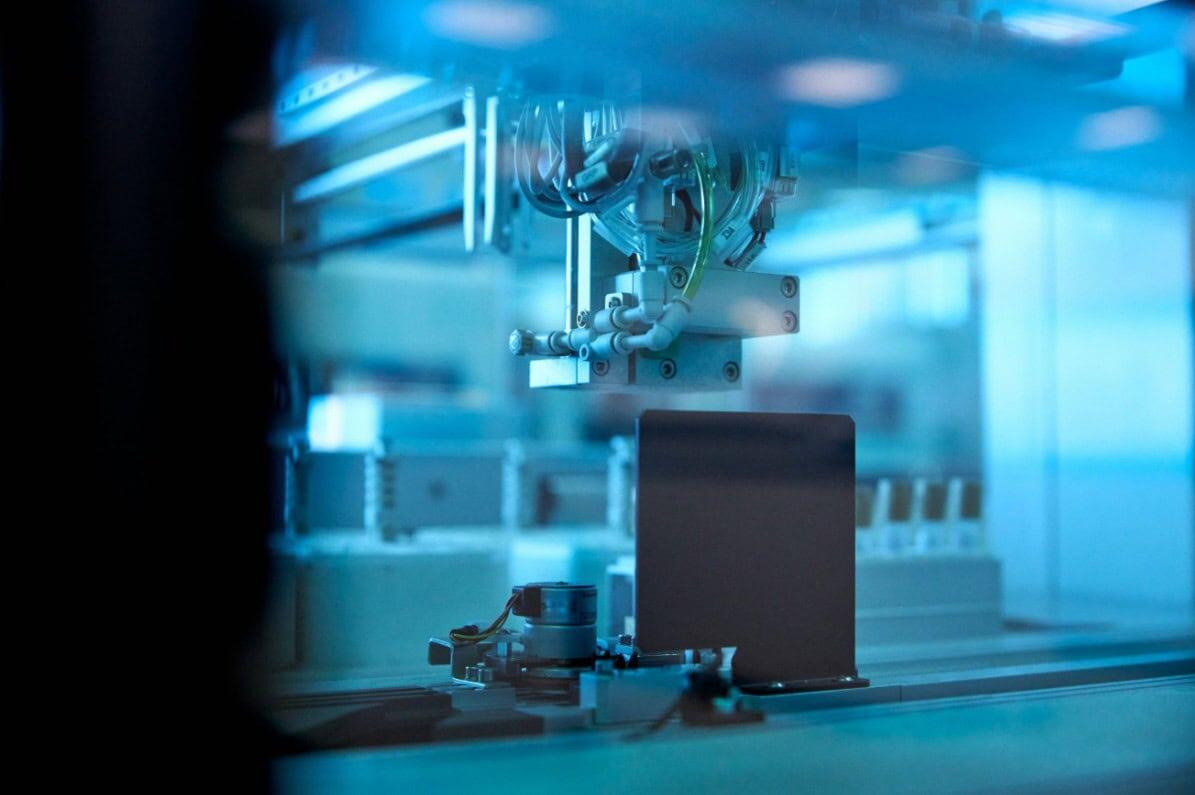
Vivodyne HIVE system grows more than 20 types of human tissue and exposes them to drugs while recording what happens. The company says the tissues can include features such as blood vessels and immune components, giving researchers a way to study how human tissue responds to different treatments.
The part that made me stop to think for a second is how we’re growing “human tissue” in a lab so AI can learn more about human biology. But what can this actually tell us?
But the idea starts to make more sense when you look at what they’re actually trying to do. Researchers can’t exactly test thousands of different drugs directly on people and wait around to see what happens. Vivodyne’s lab-grown tissues give them some sort of way to see what those drugs do to human tissue first, which is probably a lot more useful than guessing what might happen later.
How Is Vivodyne Creating New Biological Data?
A study of an individual cell can tell researchers plenty about that cell, much like an animal study can tell them plenty about that animal. But neither one can show exactly what happens when a drug interacts with human tissue.
Vivodyne is trying to collect data by changing something in human tissue and seeing what happens afterwards. That gives researchers information about cause and effect, rather than just a collection of observations.
And honestly, that makes more sense to me. If we’re asking AI to predict what a drug will do to a person, shouldn’t we give it as much information as possible about what a drug does to something that closely resembles human tissue?
But even if this gives AI a closer version of human biology to learn from, it still doesn’t give us the whole picture. A human body isn’t just one piece of tissue sitting on its own. Different organs, cells and systems are constantly affecting each other, which makes me wonder how close these lab-grown tissues can really get to what happens inside an actual person.
Can AI Understand The Human Body?
AI can spot patterns in data much faster than a person can, but that doesn’t mean it understands what’s happening in the same way a researcher does. In drug discovery, AI can use patterns in biological data to predict how a drug might behave or how cells and tissues might respond. But the human body isn’t a spreadsheet where every reaction happens in exactly the same way every time.
There are so many things happening inside the body at once that one change can affect something else somewhere completely different. A drug might affect one type of tissue, which then affects another part of the body, while the immune system and other biological processes are doing their own thing in the background. That’s a lot for any model to account for.
And then there’s everything happening outside the body. Our physical wellbeing can be affected by things like our environment and what we’re exposed to, so how does an AI model account for all of that when trying to predict what will happen inside us?
We can keep building better models of the body, but at what point does the model become close enough for us to trust what AI predicts from it?
So How Much Of The Human Body Can AI Learn?
Vivodyne is trying to get AI closer to human biology by giving it information from “human tissue”. If that can help researchers make better predictions before drugs reach human trials, it could change how some parts of drug discovery are done.
But as promising as lab-grown tissue may be for medical research, it doesn’t necessarily solve the problem completely. It gets us closer, but there’s still a lot happening inside the human body that we can’t recreate in a lab.
We can build models, collect huge amounts of information and get AI to spot patterns in all of it. But even after all the data, models and predictions, we’re still asking AI to figure out something we don’t even fully understand yet: the human body.


