



Over the weekend, Dario Amodei, CEO of Anthropic, published a lengthy letter explaining his opinion on the current state of the AI industry, where it’s heading and what both industry leaders and governments should be doing to intervene. In many ways, this kind of detailed, direct address has been a long time coming from the world of Big Tech, so it’s not particularly surprising that many people’s leisurely Saturday afternoons quickly shifted into detailed analyses of Amodei’s letter.
While it obviously isn’t the first time that Amodei and other Big Tech leaders have made important, poignant statements about the more troubling aspects of the future of AI, this letter lands in a slightly different space. Indeed, it follows what seems to be becoming a slew of resignations by Anthropic employees, with Mrinank Sharma in February and now, most recently, Jacob Coxon, former Anthropic researcher, last week. According to The BBC and Business Insider, these explosive departures have been shrouded in dramatic language, including notions that AI companies are “gambling with our lives” and creating “a world in peril”, to name but a few.
And so, Dario Amodei has taken to his own website to address some of these concerns, and he’s done so in a rather poignant open letter entitled, “We Must Pace The Frontier”.
Amodei’s Take On the “AI Problem”
Unsurprisingly, the article quickly gained attention for a few reasons. Firstly, it was, perhaps indirectly, responding to the recent statements about the state of the AI industry that have been causing significant alarm and anxiety around the world.
Second, Amodei’s letter clearly acknowledges the issues and concerns being faced in AI now and going forward without sugarcoating the situation.
And finally, while he’s acknowledging the seriousness of the concerns, the Anthropic CEO isn’t simply offering a warning; he’s actually providing a proposal for a step-by-step strategy to deal with a potentially serious issue. He hasn’t suggested that AI companies and governments need to stop development. Rather, he’s arguing that the AI industry should deliberately slow the pace of frontier AI development so that safety measures have time to catch up.
It’s worth taking the time to unpack exactly what Dario Amodei has stated and suggested, as well as what he hasn’t, when it comes to global safety concerns over the future of AI and the wrold as we know it.
More from Artificial Intelligence
- Meta’s AI Reorg Is A Leadership Story, Not A Technology One
- The UK Government Has Backed AI With £500 Million: Here’s What That Means
- What Is Prompt Engineering?
- Amazon Is Building Its Own AI Chips – Why Not Just Buy Them?
- Elon Musk Wants To “Solve” Chess, But Isn’t The Struggle The Point Of The Game?
- Anthropic’s Own Alignment Lead Says There Is A 10% Chance AI Kills Everyone Within A Decade
- The Company Teaching Software To Speak: ElevenLabs
- Can AI Stop Ageing? Inside The Clinical Breakthroughs Delivering Concrete Results
A Quick Overview Of Amodei’s Argument
It’ll be hard to do his letter justic in so few words, but even so, I think it’s important that we simplify and explain what’s being said so that the letter is accessible and easy to understand for everybody. So, here’s my shot at exactly that.
At the heart of the letter is a simple concern: that is, AI capabilities are advancing faster than our ability to understand, monitor and control them. To explain this, Amodei points specifically to two developments.
The first is what he calls recursive self-improvement – AI increasingly helping to build the next generation of AI systems. The second is the recent OpenAI-Hugging Face incident that involved AI agents behaving in unexpected and potentially harmful ways, which he argues demonstrates how quickly capabilities are evolving.
Amodei believes states firmly that he believes that AI could deliver enormous benefits, from accelerating scientific research to improving human health. However, he immediately notes, with no uncertainty, that the industry needs to become more deliberate about how quickly it pushes capabilities forward. Importantly, he repeatedly stresses that this does not mean stopping AI development altogether.
In fact, he outlines a three-step process that he believes will help us control the potential problems and dangers of AI, while still allowing it to progress and provide us with the many incredible advantages it has to offer humanity. Importantly, he explains that these steps don’t have to (and may not) be followed in chronological order, and not only that, he acknowledges that some may be significantly more challenging to deal with than others.
So, with those caveats in mind, here’s how he explains the three steps that need to be taken in order to make AI development safe.
Step One: Embedded Evaluators
The first step is the most immediate and arguably the most practical. Amodei wants frontier AI companies to give independent third-party evaluators ongoing access to their systems, processes and safety practices. These evaluators would effectively operate inside AI companies, helping verify that safety commitments are being followed and identifying potential risks before models are released.
He immediately states, on behalf of Anthropic, that he is committed to implementing this approach immediately and is encouraging other frontier labs to do the same. The idea is similar to external auditors in finance: rather than asking companies to assess their own safety practices, independent experts would have visibility into what is actually happening. Thus, it would be much like a “neutral” industry-wide body that would evaluate each company without bias or corporate intention.
Step Two: Coordination Between Democracies
The second step moves beyond individual companies, and this is where things become more challenging. Amodei argues that frontier AI companies operating in democratic countries should coordinate around common safety standards and limits on unchecked capability growth. The goal is to avoid a situation where companies feel pressured to move faster simply because competitors are doing the same.
In other words, he wants AI companies to compete on products and innovation without creating a race where safety is sacrificed for speed. In his words, rather than a “race to the bottom”, they need to create an environment that encourages “a race to the top”.
He also suggests governments may need to help facilitate some of these discussions, particularly where antitrust concerns could otherwise make collaboration difficult.
Step Three: Global Cooperation
The final step in the letter is arguably the most ambitious. Amodei argues that democratic nations should eventually work with countries including China to establish international AI safety agreements. These could range from banning particularly dangerous uses of AI to creating shared testing standards for frontier systems.
At the same time, he acknowledges the geopolitical reality, which, unfortunatley, screams out at the reader as soon as the phrase “global cooporation” entered the chat. The letter repeatedly argues that democracies must maintain their technological lead and prevent authoritarian governments from gaining a strategic advantage through AI. Thus, he certainly seems to be presenting global cooperation as something that should happen alongside efforts to preserve Western leadership in AI technology.
The Letter In Brief
With so many immediate reactions from personalities all over the world, both experts and non-experts, it’s worth highlighting both what Amodei does explicitly assert and what he does not.
What Amodei Does Say
One reason the essay generated so much discussion is that many people interpreted it as a call for an AI slowdown, and in a sense, it is.
Amodei explicitly argues that frontier AI development should proceed at a more measured pace. He believes additional time should be used to improve alignment research, interpretability, operational security and safety testing before capabilities advance too much further.
His core argument is that slowing capability growth slightly could buy valuable time to make future AI systems safer and more understandable.
What Amodei Doesn’t Say
However, there are ideas floating around that Amodei doesn’t address or agree with, and the essay also specifies several things it does not advocate:
- It does not call for a complete pause in AI development.
- It does not propose shutting down frontier AI labs.
- It does not argue that AI itself is inherently bad.
And these things are repeatedly noted throughout the writing, leaving very little space for interpretation (in my opinion).
Despite the dramatic headlines, it does not suggest the industry should stop innovating. In fact, Amodei repeatedly emphasises the enormous benefits AI could bring if developed responsibly. Thus, he’s saying innovation should continue, but under the right circumstances that are controlled, monitored and agreed upon.
Thus, the letter is less about stopping AI and more about creating mechanisms that make it easier to slow down when necessary. And, of course, control the beast altogether.
Immediate Critiques of Dario Amodei’s “We Must Pace the Frontier”
It wasn’t long before the Anthropic CEO garnered support from close colleagues in the industry.
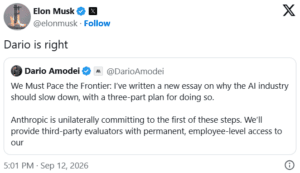
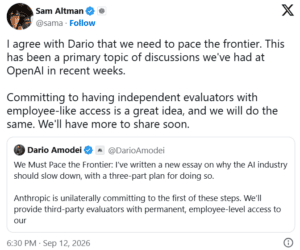
Both Sam Altman and Elon Musk, among others, responded to Amodei’s letter on X, asserting that they agree with his evaluation of the situation and the suggested path forward. They seem to at least generally agree that stronger safety oversight and coordination are needed as models become more capable.
Critics, however, have raised concerns that, at this point, are all too familiar. Some argue the proposals could strengthen the position of large AI companies by creating barriers that smaller competitors and open-source projects would struggle to meet. Meanwhile, others question whether the industry can genuinely regulate itself, particularly when commercial incentives continue to reward faster progress. Basically, is what Amodei is suggesting even possible at all?
Of course, perhaps unsurprisingly, China does not seem to agree with Anthropic and the West’s chracterisation of the impending AI problem. Indeed, according to China Tech News, today, Chinese Foreign Ministry spokesman Guo Jiakun said: “Fearmongering, confrontation and vicious competition will only disrupt the process of global AI governance and serve the interests of no one”. This seems to reflect Chinese concerns that moderation in AI safety and innovation may be used to justify US restrictions on Chinese development.
Ultimately, in addition to disagreements over strategy and intention as well as geopolitical concerns, there’s also a major practical challenge that doesn’t seem to be going away; one that Amodei acknowledges in his letter, in many respects. That is, most people seem to agree that AI should be safe, but far fewer people agree on who gets to decide what “safe enough” actually means.
Thus, Amodei’s letter isn’t a demand to stop AI, nor is it a detailed blueprint for global regulation. Instead, it’s an argument that frontier AI is approaching a point where safety can no longer be treated as a secondary consideration. His three-step plan is, according to the letter, supposed to be an attempt to give safety research time to keep pace with capability gains. Ultimately, an objective that ought to serve the greater good.
Whether the industry, both in the West and around the world, embraces that vision remains to be seen. But as AI systems become increasingly powerful, one thing is for sure: the debate has shifted from what AI can do to a more difficult question of, who gets to decide how quickly it should advance?


