


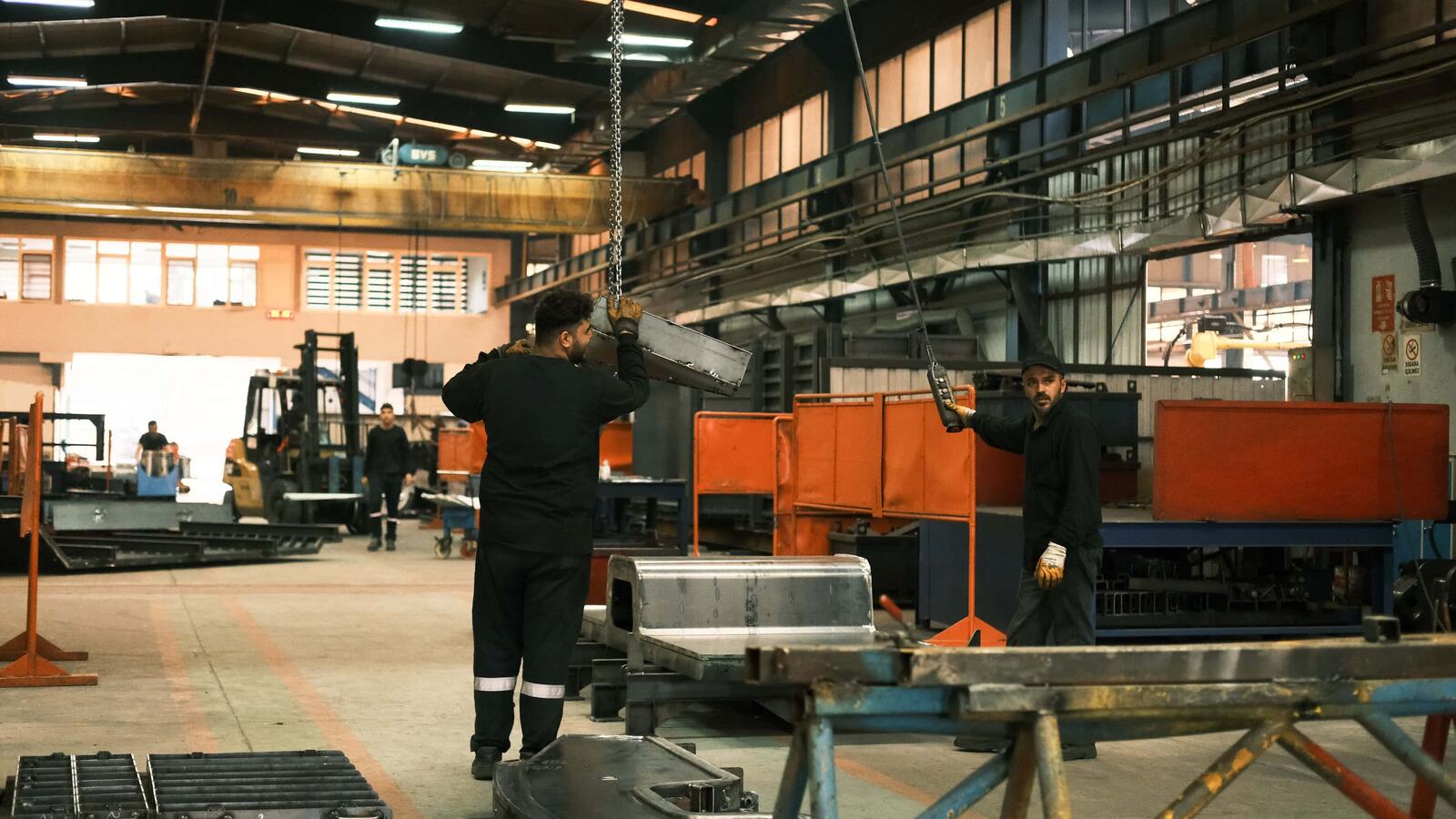
A factory can turn out thousands of products a day, but keeping production running takes more than machinery and an assembly line.
Robots are learning new jobs, engineers are using synthetic diamonds to check computer chips for faults and companies are finding ways to recover valuable materials from old batteries.
Germany is a good place to look at this type of tech – manufacturing accounted for 19.7 per cent of the country’s economic output in 2024, according to Destatis, compared with 10.6 per cent in France and an EU average of 15.6 per cent. With so much manufacturing activity, there’s plenty of demand for technology that helps businesses get things made, moved and maintained.
What Counts As Industrial Tech?
Industrial tech covers the technology used to make, move, inspect, power and recycle physical products. That includes factory robots and the software behind them, but also equipment that maps buildings, sensors that monitor machinery and systems that store energy for later use.
Some technologies are visible on the factory floor, while others are built into the way a factory operates. They can help spot worn-out parts, cut energy waste or recover materials that would otherwise be thrown away.
More from Startups
- Startup of the Week: Kord
- How Do Startup Valuations Work When A Company Isn’t Profitable?
- These Aerospace Startups Are Out Of This World, But Made In Japan
- 5 Startups Crowdfunding w/c 05.10.2026
- Founder Of The Week: Danny Jenkins
- Abacus AI Expands Its AI Platform With Smaug, AI Agent And More
- Top 10 Agritech Startups In South Africa To Watch In 2027
- Startup of the Week: Rainbow Crops
1. RobCo: A Robot with Two Arms and a Launch Date
Founded in Munich in 2020, RobCo makes modular industrial robot arms that fit together like building blocks. Its robots are offered as a service, giving businesses another way to automate tasks without buying an entirely bespoke system.
Its next product, Alfie, has two arms, allowing it to hold a part with one while working on it with the other. RobCo says the robot can adapt to changes on a production line without someone rewriting its code. Its commercial launch is scheduled for 4 March 2027.
2. QuantumDiamonds: Using Synthetic Diamonds to Inspect Chips
Munich-based QuantumDiamonds, founded in 2022, uses tiny defects in synthetic diamonds to detect magnetic fields. Its machines use these measurements to map electrical currents inside computer chips without cutting them open.
This could help manufacturers find faults in complex chips, including designs with components stacked in multiple layers. The company raised €91 million in July 2026 to expand production and develop its inspection systems for semiconductor manufacturers.
3. NavVis: Mapping Factories in 3D
NavVis has been around since 2013 and develops scanners that capture buildings in 3D as someone walks through them. Software turns the scans into digital representations that teams can explore remotely.
For manufacturers, this can help with measuring spaces, documenting facilities and planning where new equipment will fit. It can also reduce the need for repeat site visits when teams are working across large or complex buildings. NavVis says more than a billion square metres were added to its platform in 2025.
4. Sereact: Robots that Learn to Pick Things Up
Founded in Stuttgart in 2021, Sereact develops software that helps robots recognise objects and work out how to pick them up. This is super helpful in warehouses, where products come in different shapes and sizes and can’t always be handled in exactly the same way.
According to Bloomberg, its technology is already used in systems handling parts for carmakers, including BMW. Sereact raised $110 million in April 2026 and is developing software that helps robots anticipate problems such as dropping an item. It has also opened a Boston office as it expands into the US market.
5. Headmade Materials: Metal Parts without a Dedicated Metal Printer
Headmade Materials was founded in 2019 near Würzburg. Its Cold Metal Fusion process uses metal powder coated in a polymer binder, allowing parts to be printed using compatible laser printers designed for plastic-based materials. The printed parts then go through a furnace process to produce the finished metal components.
The company says the method can suit production runs of up to 100,000 parts a year and works with printers such as Sinterit’s Lisa X. This gives manufacturers another option for producing metal components without investing in dedicated metal printing equipment.
6. Kraftblock: Storing Heat for Later
Founded in Saarbrücken in 2014, Kraftblock makes thermal storage systems using pellets produced from recycled materials. These can be heated to temperatures above 1,300°C, allowing factories to store heat and use it later rather than letting it go to waste.
The company says heat can be stored for up to two weeks. One project involved a storage system at a PepsiCo factory in the Netherlands, developed with energy company Eneco. Kraftblock raised a €20 million Series B round in 2023, led by Shell Ventures, to support its growth.
7. HCP Sense: A Sensor for Machine Bearings
Bearings need lubrication to prevent moving metal surfaces from wearing against each other. If the lubricant film breaks down, friction can increase and damage the machinery. Darmstadt-based HCP Sense, founded in 2021, has developed a sensor ring to monitor lubrication inside bearings.
The sensor measures changes in the bearing’s electrical behaviour. With a sufficient lubricant film, the bearing behaves like a capacitor; when metal starts touching metal, its electrical properties change. HCP Sense closed a seven-figure seed funding round in 2025 to develop its customised solutions into a series product.
8. Cylib: Recovering Materials from Old Batteries
Founded in Aachen in 2022, Cylib recovers materials such as lithium, nickel and cobalt from used electric vehicle batteries. These metals can then be processed for potential use in new batteries.
In July 2026, the company acquired a former recycling site in Bavaria through insolvency proceedings. Cylib says the facility can process up to 10,000 tonnes of batteries a year, producing black mass, a powder containing valuable battery materials. The company is also building a chemical processing plant in Dormagen, North Rhine-Westphalia, to recover those materials.
9. Fernride: Yard Trucks with Remote Human Support
Fernride, founded in Munich in 2019, retrofits electric yard trucks so they can drive autonomously around controlled sites such as ports and factory grounds. A remote operator can take over when the truck encounters something it cannot handle independently.
Its customers include Volkswagen, DB Schenker and port operator HHLA. In 2025, Fernride began driverless operations at an HHLA terminal in Estonia, with the company citing regulatory approval through TÜV SÜD. Its Series A funding reached €47 million in total as it developed its autonomous transport technology.
10. Wandelbots: Teaching Robots by Showing Them
Dresden-based Wandelbots was founded in 2017 to make industrial robots easier to programme. Its early TracePen device let someone demonstrate a movement by hand for a robot to reproduce, reducing the need to write code for every task.
The company has since developed a bigger software platform for programming and managing industrial robots. It raised an $84 million Series C round led by Insight Partners and works with robot manufacturers and system integrators. Its focus is on making robot programming less time-consuming, especially for businesses that want to automate tasks without needing specialist coding skills for every application.
What’s Changing On The Factory Floor?
Industrial technology isn’t always about replacing an entire production line with robots. It can be a sensor that catches a failing bearing, a scanner that saves engineers another trip to a factory or a process that recovers metals from an old battery.
The companies above are tackling different jobs, but they all have to prove their technology works reliably in real industrial settings. For some, that means expanding beyond early customers; for others, it means getting new equipment ready for commercial use.


