


Sceptics often dismiss quantum computing as an eternal work in progress, which makes the serious cash flowing into the sector in 2026 particularly hard to brush aside. Five of the women on this list run companies that have announced funding rounds since December 2025, including Quobly’s €115 million Series A and Nu Quantum’s $60 million raise.
Between them, they cover quantum computing hardware, networking, software, security and education globally. Some are founders and some lead research centres, and each one is shaping a different part of how the technology evolves.
Why Is Quantum Having Such A Moment In 2026?
Not long ago, quantum tech was mostly associated with academic physics departments and massive cooling rigs.
Now the conversation has moved to venture capital, national strategy and precision benchmarking. The US Department of Energy has set its sights on a scientifically relevant, error-corrected quantum computer by 2028, while Quantinuum says it has recently reached a logical fidelity of 99.9995%, or roughly five errors per million operations.
With momentum building fast, the focus naturally shifts to the architects building the technology. Hardware may get attention, but software, networking, security and skills training are the critical bridge between a research success and a market-ready product.
The ten women highlighted below work right across those fields, equipped with major new funding rounds to turn possibilities into reality.
More from Tech
- Flying Cars Are Now A Reality, But Is There Really A Market for Them?
- Self-Reliance By Design: The Best Health Tech Makes You Need It Less
- Volvo Wants To Take Your Hands Off The Wheel By 2030 – What Is Level 2++?
- What Businesses Should Know Before Collecting Public Web Data At Scale
- What Wearable Tech Can’t Tell You About Heart Attacks
- Top Physical AI And Industrial Robotics Startups In Japan To Watch In 2027
- From Pit Lanes To Cargo Planes: The Logistics Behind Moving Formula 1 Around The World
- AI Can Now Build A Free Adobe Rival – So Why Can’t It Open Files?
The Top 10 Women In Quantum Computing In 2026
Here’s a list of the top 10 women in quantum computing in 2026, in no particular order:
Maud Vinet, Quobly
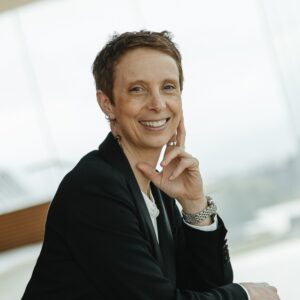
Maud Vinet is co-founder and CEO of Quobly, which builds quantum computers from silicon spin qubits made on standard 300 mm semiconductor lines.
Before starting the company in 2022, she ran the quantum hardware programme at CEA-Leti, the French research institute, after years working on advanced chip manufacturing there. She holds more than 80 patents.
Quobly closed a €115 million Series A in June 2026, led by Bpifrance, SEALSQ and STMicroelectronics. It’s shown qubit readout and one- and two-qubit gates on a single chip made at STMicroelectronics’ Crolles site, and its first system, Alloy Pioneer, is due to reach the cloud by the end of 2026. Alloy Forge, an emulator for building applications ahead of that launch, is already available on the qBraid platform.
Carmen Palacios-Berraquero, Nu Quantum
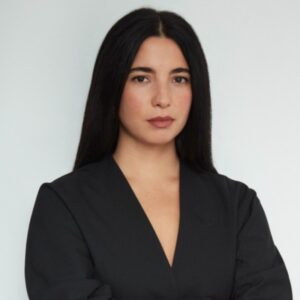
Nu Quantum founder and CEO Carmen Palacios-Berraquero is solving a key scaling challenge by creating the connectivity layer that ties standalone quantum processors together.
Based in Cambridge, she picked up the Institute of Physics’ Jocelyn Bell Burnell Medal back in 2018, co-founded UKQuantum to champion the sector and advises the UK’s National Quantum Computing Centre via its Technology Advisory Group.
Nu Quantum raised a $60 million Series A in December 2025, described as the largest financing round for quantum computer networking. It argues that fault-tolerant machines will need about 1,000 times more qubits than what exists today, and that connecting chips is the route there. Their recent research also suggests a distributed quantum computer can keep running when a node fails, because the failure can be treated as just another error to correct.
Stephanie Simmons, Photonic

Stephanie Simmons is founder and Chief Quantum Officer at Photonic, a Vancouver-based company building a networked quantum computer from silicon spin qubits linked by light. She did her PhD at Oxford and is an associate professor of physics at Simon Fraser University.
Photonic announced a C$180 million first close that took its total funding to C$375 million, with RBC, TELUS and Planet First Partners among the new investors. Alongside progressing to Stage B of DARPA’s Quantum Benchmarking Initiative, the team is opening a £25 million R&D centre in the UK that’s expected to create more than 30 jobs.
Sabrina Maniscalco, Algorithmiq
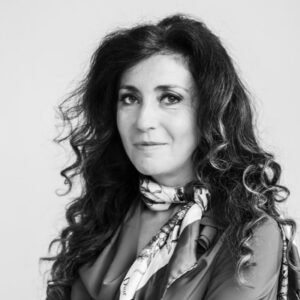
Sabrina Maniscalco is the co-founder and CEO of Algorithmiq, a quantum software startup designing an algorithmic layer to tackle complex problems throughout medicine, materials science and artificial intelligence. After 22 years working abroad, she’s relocated back to Italy, where the firm is quickly growing its operations out of Milan.
In May 2026, Algorithmiq raised €18 million in a round led by United Ventures and CDP, reported as the largest venture investment in an Italian quantum startup.
With IBM Quantum, it also announced what it describes as a demonstration of quantum advantage, using the quantum processor to simulate the kind of disordered materials found in catalysts and battery electrolytes. Maniscalco has also told MEPs that quantum software and algorithms should be treated as strategic infrastructure for Europe.
Marta Estarellas, Qilimanjaro Quantum Tech
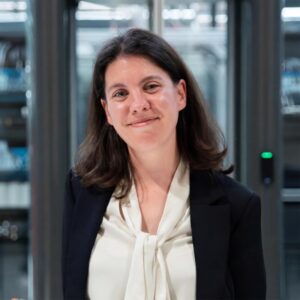
Marta Estarellas is CEO of Qilimanjaro Quantum Tech, the Barcelona company building quantum computers on superconducting fluxonium qubits and integrating them into supercomputing centres.
She did her PhD at the University of York and has run the company since April 2023, having previously led its theory and applications team. Its third system, an analogue expansion of MareNostrum-Ona, has been inaugurated at the Barcelona Supercomputing Center.
Fresh off a €19.6 million Series A first close in October 2026, Indra Group invested €10 million, with existing backer Spain’s SETT adding €9.6 million. It was also one of 13 European firms chosen, from 27 eligible proposals, for the EuroHPC Quantum Grand Challenge. Meanwhile, its real-world impact is already taking shape through a pilot at Hospital del Mar, using quantum algorithms to manage complex surgical scheduling.
Anna Grassellino, Fermilab
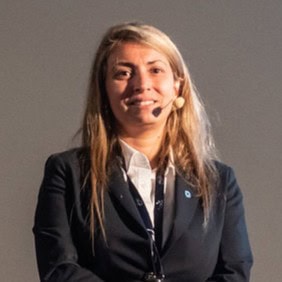
Anna Grassellino directs the SQMS Center at Fermilab, one of five US Department of Energy national quantum research centres, and became the lab’s Chief Technology Officer in May 2026 while keeping that role. She also chaired the advisory subcommittee behind the DOE plan towards a scientifically relevant, error-corrected quantum computer by 2028.
The Department of Energy renewed SQMS in February 2026 with $125 million over five years, backing more than 300 experts across 43 institutions. A recent SQMS-led study of 22 superconducting qubits tied performance differences to nanoscale manufacturing features, which Grassellino says could move qubit production “from an art into a predictive science”.
She has also co-written a Wiley textbook on quantum computing with superconducting qubits and cavities.
Rebecca Krauthamer, QuSecure

Rebecca Krauthamer is co-founder and CEO of QuSecure, which builds software to help organisations move to post-quantum cryptography without ripping out their existing systems. She started as the company’s Chief Product Officer and became CEO in early 2025, as its Series A reached $28 million.
She has described the encryption threat as “a solved problem” on the technology side, with the more difficult job being to get the new algorithms implemented.
Krauthamer sat on the World Economic Forum’s Global Future Council on Quantum Applications from 2020 to 2024, was named to the inaugural Quantum Security 25 list. She also recently spoke to company directors about quantum risk at a governance summit in Washington.
Yaseera Ismail, QuPhotonics Laboratory
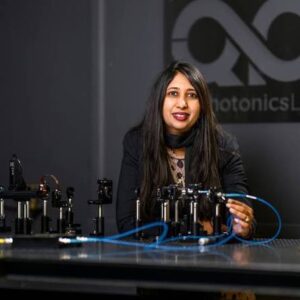
Yaseera Ismail is a senior lecturer at Stellenbosch University and head of the QuPhotonics Laboratory, where her team works on free-space quantum communication, sending quantum information through the air using photons.
In 2024, the lab helped launch a 12,900 km quantum-secure satellite link between South Africa and China, the first of its kind in the Southern Hemisphere.
She’s vice president of the International Commission for Optics, and she chaired its 26th congress in Africa for the first time. Ismail was named first runner-up in the 2026 South African Women in Science Awards for distinguished young women researchers in the natural sciences, and first runner-up in the Digital Sovereignty Leadership Award at SITA GovTech 2026. Her stated aim is to grow a quantum technology space across Africa.
Elisa Torres Durney, Girls in Quantum
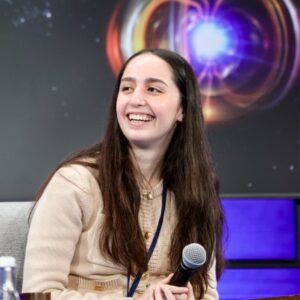
Elisa Torres Durney started Girls in Quantum in Chile at 16 and still runs it as CEO while studying electrical and computer engineering at Duke University.
The non-profit offers free, multilingual quantum learning resources and says it has reached more than 8,500 learners in 68 countries since 2022.
She advises UNESCO on STEM programmes, was named to its Quantum100 list for the International Year of Quantum Science and Technology, and launched a Middle East chapter of Girls in Quantum at GITEX Global in Dubai.
This autumn she also gave a keynote at IBM’s Tech Summit in Mexico City, as well as spending the summer interning at QAI Ventures, a quantum-focused venture firm in Basel.
Malak Trabelsi Loeb, Quantum Innovation Summit

Malak Trabelsi Loeb is a jurist specialising in international business, space and technology law, and the founder of the Quantum Innovation Summit in Dubai, which is organised by her Vernewell Group.
She’s also a NATO subject matter expert on emerging disruptive technologies, was named to the UNESCO Quantum100 list and has won an Innovation Leadership Award from Women in Aviation Middle East.
The 2026 edition ran from 28 to 30 September at the Grand Hyatt Dubai, hosted by the UAE Cyber Security Council, and covered quantum alongside AI, cybersecurity, space and critical infrastructure with a focus on technological sovereignty. For startups in Dubai and the wider region, it gives quantum companies a meeting point with government and industry.


