


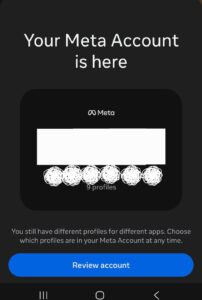
This morning, as I was slowly getting my day started, sipping on my first cup of coffee, I clicked on Instagram for a quick, light-hearted scroll, as I so-often do. Probably not the best way to start my day, I’ll admit, but let’s be honest, it’s something so many of us do. However, instead of being greeted by my usual feed, I was bombarded with an odd pop-up I’ve never seen before. It was a vague message saying little more than, “Your Meta Account is here”.
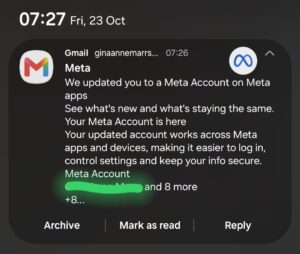
I also had an email in my inbox with a little more information. It told me that “We updated you to a Meta Account on Meta Apps”.
What do you mean Meta just updated me (whatever that means) to something entirely different to what I had consented to and signed up for? That was the first thing that crossed my mind, because, well, what an odd way to say this. I’ll also assert that, “Your Meta Account is here” is a little creepy and resembles the kind of public service announcement I’d expect us to receive in a futuristic society if aliens happened to arrive on planet Earth.
I couldn’t really use Instagram without clearing the notice, which was not only frustrating but disconcerting too. By clicking this button to make the pop-up disappear, am I consenting to something I have no idea about? Should I be asking more questions?
Naturally, because I have the patience of a toddler being promised snacks, I swiped away the notification after about 30 seconds and went to have a look at the email. And all this left me with a fairly obvious question: when, exactly, did I agree to this? And what the heck does it even mean?
Well, it turns out Meta has been preparing to move users to a new account system for months. But while the company describes the change as a way to make managing its apps easier (it’s to help us, obviously!), the experience of waking up to find your account has been majorly updated without prior warning raises some questions about consent, privacy and how much control we really have over the platforms we use every day.
What Exactly Is A Meta Account?
According to Meta, Meta Accounts are designed to bring account management for the company’s various apps and devices under one system. Think Facebook, Instagram and Meta’s other technologies, with settings and security features managed in one place.
Previously, much of this was handled through Meta’s Accounts Centre, which allowed users to connect their accounts and manage certain settings across different apps. Importantly, connecting accounts and enabling connected experiences was presented as optional. Users could choose whether to link accounts and take advantage of features that worked across Meta’s platforms.
In April 2026, Meta announced that it would begin automatically updating existing Accounts Centre setups to the new Meta Account system over the following year. The company said users would be notified as their accounts were updated, with the aim of making account management simpler and security features easier to access.
So, technically, this isn’t necessarily Meta creating an entirely new account for me. It appears to be a change to the system managing the accounts I already have, because an account-system migration isn’t automatically the same thing as signing up to a new service, merging every account or agreeing to entirely new data-sharing permissions. But it still doesn’t make the experience of being notified after the change any less jarring.
What Does This Actually Mean For My Data?
This is where things get a little more complicated, and this is where most of my questions lie. Meta says the new system will make it easier to manage passwords, two-factor authentication, security recommendations and other account settings. It also says the everyday experience of using its apps should remain the same.
Importantly, app-specific settings are still meant to be separate. For example, the settings governing who can see your Facebook posts or who can tag you on Instagram are not simply being replaced by one universal set of preferences. Meta has also said that WhatsApp remains optional unless users have already added it to their Accounts Centre, and that they can keep it separate.
In other words, the announcement doesn’t establish that every user has suddenly agreed to share all their information across every Meta product, nor does it prove that the update itself has changed everyone’s existing privacy permissions. But, account linking and cross-platform data use are not new issues. Meta’s own explanation of Accounts Centre has previously described connected experiences that can support personalised ads and recommendations across its technologies. If your accounts are connected, the way information is used across those services is worth understanding, regardless of what the account system is called.
The sensible response is to check your settings rather than assume either that everything has changed or that nothing could possibly matter. The new system may make security management more convenient, but convenience and privacy are definitely not the same thing.
And if, like me, you discovered the update through a notification rather than actively choosing to migrate, it’s totally reasonable to want a clearer explanation of what has changed for your particular account.
Why Is Meta Making This Change Automatically?
Meta’s explanation is straightforward enough: it wants to make its increasingly sprawling ecosystem easier to manage. A centralised system can mean fewer passwords to remember, simpler security settings and less time spent jumping between account menus. It’s about making our (users) lives easier.
But there’s obviously a business logic here, too. Meta operates a vast collection of apps, services and devices, so making them easier to access and manage is a sensible product goal, particularly when users may have accounts across several of its platforms. Of course, there’s a difference between making a system available and moving people onto it automatically. The company has decided that the new structure is the way forward, rather than asking every existing user to make an active choice about whether to switch.
That doesn’t, by itself, mean the change is sinister or that Meta is secretly taking new permissions; there’s no evidence in the announcement to support that conclusion. But, it does highlight a familiar tension between technology companies and the people who use their products, which is that a change that looks like a straightforward improvement from the company’s perspective can feel quite different when it happens to your account without you initiating it.
And to be honest, I think it may be even simpler than that. With so many people, myself included, already feeling a little uncomfortable about social media, how it may be influencing us, data sharing and just general issues in the world of AI and big tech, feeling like something is being done to just isn’t ideal. I think that in many ways, the discomfort so many other people and I are feeling about this is reason enough to question what it means, why it’s happening and why we weren’t notified that it was about to happen. And yes, I know it was technically public kowledge that the switch was impending, but that is not the same as notifying users directly, and the cynic in me can’t help but feel like there’s a reason that the company deliberately chose not to do that.
Can I Say No?
It’s a tricky question, because of course, you could say no by simply deleting all the apps and saying goodbye to Meta altogether. But that’s not what’s being asked here. In fact, in many ways, this is the most frustrating part, because the options available to us aren’t quite as simple as accepting or rejecting the update.
Meta says users can maintain separate Meta Accounts for different apps or devices, rather than putting everything under one account, and WhatsApp can also remain separate. So at least that offers some flexibility in how accounts are organised.
But keeping accounts separate isn’t necessarily the same as opting out of the new Meta Account system altogether, and that’s important. Meta’s April announcement describes an automatic migration for existing Accounts Centre users, but it doesn’t set out a general “opt-out” from that migration.
If you want to understand what applies to your own accounts, Meta’s account page and Accounts Centre help page are the places to start. You should check which accounts are connected and review the privacy and security settings available to you.
Again, this is where the little cynic on my shoulder chimes in. It would have been so easy to just notify users of what was coming, giving us the option to opt out before anything happened. Or, better yet, start with a clean slate and choose to opt in. However, the motivations behind using “opt out” as opposed to “opt in” methodology are far more complicated than a haphazard, “just make a decision” tick box. We know that simply having everybody automatically “opt in”tends to result in far more people sticking with that choice, as opposed to giving people a completely neutral opportunity to opt in or out. It’s an age-old trick used in marketing and other industries to try and get as many people as possible to opt into things.
So, if that is indeed why Meta chose this strategy, that means that they really just wanted all our accounts to be migrated in the first place, and the fact that they didn’t tell us it was happening before it happened, but they’re giving us the option to “unlink” different accounts and profiles, shows us exactly what they’ve been after all along. And I say this all hypothetically, of course, because these are really just hunches fueled by a sense of discomfort that I can’t seem to shake.
That is, having us actually stick to the Meta Account system may be less important than the fact that we were all migrated over to it in the first place. Because sure, you don’t have to keep everything linked, but just because you unlink your account doesn’t mean that the migration of all your data and account information has been reversed. At least, as far as I understand. And maybe that’s why they didn’t ask our permission: they technically, legally had our permission (I think?) due to all the T’s & C’s we accept by using these platforms, they wanted to complete the migration and they’ve decided that asking for forigveness is way better than asking for permission (that they probably wouldn’t have gotten from many of us).
So, When Did I Agree To This?
And that, really, is what bothers me about the whole thing. It’s not necessarily that Meta Accounts are inherently bad, or that this update has definitely changed what the company can do with my data. It’s that a company I already have reservations about has made a decision about how my accounts are managed, then informed me once it was done. What feels so weird about this is that they could so easily have given users warning, but they chose not to, and one thing we all know for certain is that a massive tech company like Meta doesn’t do anything by mistake. So, I’m left trying to work out what happened, what it means and whether I had any meaningful say in the matter.
Perhaps the migration is entirely harmless, and perhaps Meta’s terms and conditions give it all the permission it needs to make changes like this. I haven’t established otherwise, and I don’t want to pretend that I have. But legal permission to change a system isn’t quite the same as making users feel informed, comfortable or in control, and given how much of our lives now sits behind the log-in screens of a handful of major technology companies, I don’t think that’s an unreasonable argument to make.
The more cynical part of me also wonders whether announcing a change in advance, rather than presenting it as , “ah shucks, we just went ahead and did it anyway”, might have prompted more people to question it. That’s speculation, of course, based on conversations I’ve had within my own personal and professional circles, but the wider point about defaults is well established. When a change happens automatically, many people will simply go along with it, particularly when the alternative involves navigating unfamiliar settings or potentially losing access to something they use every day. And while we’re feeling increasingly helpless in a world run by a few powerful people and big tech companies, the one thing we can still always do is ask “why?”.
So, no, I’m not about to delete Instagram, throw my phone into the sea and retreat to a life of drinking coffee without checking my notifications (although, honestly, I’m not too far off that either). But I do think it’s worth asking questions when platforms make changes that affect our accounts, our information and our choices.
Because if the answer to “When did I agree to this?” is buried somewhere in pages of terms and conditions I accepted years ago, that might be legally sufficient, but it doesn’t necessarily make it feel like consent, and it certainly doesn’t make me feel comfortable.


