


Consider three hypothetical British businesses. A support team in Leeds has eight years of resolved cases. A Bristol software firm links bug reports to fixes. A Glasgow operator keeps procedures for difficult cases. These are possible record types, not reported SourceX customers.
None of it was created to be an asset. All of it might be one.
Epoch AI’s June 2024 analysis projected that the effective supply of public human-generated text could be fully used between 2026 and 2032 if the study’s scaling trends continued. That is a conditional forecast, not proof of a shortage today. It also does not establish demand for a particular British firm’s archive; its task relevance, quality and licencing rights still need review.
That’s where UK AI data licencing comes in. The question isn’t whether a company has lots of data. It’s whether a defined, approved slice of its history can support AI training or evaluation, and whether the business has the authority to say yes.
- Public text is a finite resource for AI developers. Private records of real work, such as support cases, bug fixes and procedures, are largely untouched
- The strongest candidates capture a problem, the action taken and the outcome, and the company can show it has the right to licence them
- UK companies must meet SourceX’s other criteria as well as its 90% English threshold. Measure the records, not the software interface
A UK archive may contain useful work records. Suitability and licencing rights require assessment.
Which Records Do AI Developers Actually Want?
Look for a recurring task where the archive captures both ends: the initial problem and the outcome, with the action in between. A folder of final answers misses the reasoning a reviewer needs.
Imagine a support case that shows why the routine remedy was wrong for this customer, and which approval made a different action possible. That connected history is the valuable part, provided it’s accurate and authorised for the proposed use.
Be honest about gaps. A ticket marked closed doesn’t prove the problem was solved.
Who In The Business Can Authorise A Data Licence?
Not the person with the export button. An IT contractor or an employee with admin access shouldn’t make a licencing decision on the company’s behalf.
Identify the legal entity that would sign, an authorised director or senior leader, and whoever will handle rights, data protection and security review. Then expect complications:
- Customer contracts that restrict how their information may be used
- Third-party material sitting inside your systems
- Records inherited through acquisitions, with their own history
- Personal data, where UK GDPR and any international transfer arrangements need proper review
A promise to anonymise the data does not settle those questions. Removing names alone does not establish anonymity. Assess the actual collection and recipients, and distinguish de-identification from effective anonymisation under the applicable rules.
The question isn’t how much data you have. It’s what your records prove and who can authorise their use.
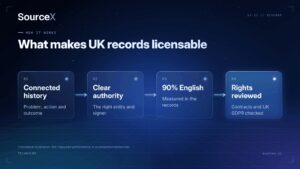
Conceptual: four conditions a UK collection typically needs before a licencing assessment can proceed.
More from Artificial Intelligence
- The Future Of Incident Management Depends On Humans And AI Working Together
- Is English Actually Easier For AI To Understand Because Of Its Syntax?
- What Is AI Inference?
- Is AI Making It Easier To Build A Startup, Or Just More Difficult To Stand Out? The Experts Weigh In
- Beyond Headcount: How AI Is Changing The Way Businesses Plan Their Workforces
- Can AI Weather Models Accurately Predict Extreme Events Like El Niño?
- AI Was Supposed to Replace Us. Could Originality Be the One Thing It Can’t Compete With?
- The AI Governance Gap: Why Global Agreements Mean Little Without Corporate Action
Does The 90% English Rule Apply To UK Companies?
SourceX’s published guidance, checked on 22 October 2026, includes UK companies when at least 90% of their data is in English, alongside its other company and dataset criteria. Meeting the language threshold alone does not guarantee acceptance.
Measure the content, not the interface. An English-language help desk can hold threads in Welsh, attachments in French or historic records from a European subsidiary. Estimate the language mix of the records themselves and note how you worked it out. That’s a far easier conversation at the inventory stage than after a delivery has been assembled.
Rights terms to weigh alongside the payment. The signed agreement controls.
What Could UK AI Data Licencing Pay?
SourceX is one firm paying for exactly this. It licences approved records from companies for AI training and evaluation; the contract sits between your business and SourceX rather than an AI lab, and SourceX looks after the paperwork, preparation and payment.
Its advertised ceiling, up to US$4 million, is for the largest enterprise datasets. It is neither a typical figure nor a sterling promise, and qualifying doesn’t guarantee an offer. The actual dataset and payment are fixed only in a signed Dataset Deal Confirmation, usually as a one-off fee rather than a royalty. SourceX’s core fit is firms that employed 50 or more full-time staff at their peak and have several years of trading history.
What Does A Company Give Up In Return?
You retain ownership of your original records. The selected data is exclusive to SourceX for AI training for the term in the Dataset Deal Confirmation. Separately, the rights to the deidentified dataset are perpetual, irrevocable, transferable and sublicensable, including model training, evaluation, products and onward distribution. Once the fee is paid, those rights survive termination, without an obligation to untrain or delete models already built from the data.
Weigh those rights against your own AI plans before signing. A narrower scope or a decision to decline may be appropriate. The initial fit check is non-binding; signing the Master creates obligations even before a later dataset deal closes.
What Can A UK Business Owner Do This Week?
Draft a one-page inventory: systems, record types, years covered, approximate scale, language mix and the workflow the records explain. SourceX’s initial fit check uses company information only, never customer or employee records, so you can explore relevance without starting a broad export.
Years of ordinary British work become a credible asset the moment someone can explain exactly what the records contain, and who can sign for them.
A one-page inventory lets a UK business explore fit without exporting a single record.
Have a UK archive with that kind of history? SourceX‘s initial company fit check uses broad company facts, without record uploads or commitment. Include the language mix and known restrictions, then let an authorised leader decide whether to consider a scoped licencing proposal.
About The Founder
Noah Loul is a four-time founder and the founder and CEO of SourceX, which licenses business data directly from companies for AI training and evaluation. He previously founded B2B Rocket, acquired by Blackpearl Group. His work focuses on building permission-based data infrastructure for AI.


