



The generative AI boom has created a new workplace divide. Research from Harvard Business School suggests that women continue to use generative AI at lower rates than men: its latest analysis, published in 2026, draws on 76 sources covering more than 300,000 people across more than 100 countries. It estimates that 47.8% of men use generative AI compared with 39.3% of women, meaning that men are approximately 22% more likely to report using it.
Admittedly, the gap has narrowed since generative AI first took off, but it certainly hasn’t disappeared. And if it persists, the consequences could extend beyond just who uses ChatGPT or other AI tools at work.
Harvard Business School has warned that women could miss out on productivity gains, valuable skills and career opportunities if they remain less likely to adopt the technology. Further to that, there’s also a wider question to be asked about representation: if fewer women participate in the AI economy, what happens to their experiences and concerns as these systems become increasingly embedded in work and everyday life? And how can these platforms and models be trained accurately if they’re not based on both men’s and women’s input?
Indeed, there’s another question behind the numbers that deserves more attention, and it’s less about what’s happening and more about the reasons behind it. That is, are women slower to adopt because they’re less interested in AI, or are they simply more cautious about using it?
It’s Not Simply A Question Of Interest
In an interview with Lorka AI, Azahara Corrales, an AI governance strategist, argues that caution deserves more attention as part of the explanation. Rather than interpreting the gender gap as evidence that women are simply less interested in technology, Corrales argues that women may be approaching AI differently because they’re more conscious of its potential risks.
“Women are not less interested; they are more cautious. And that is not a weakness,” Corrales says in the Lorka interview.
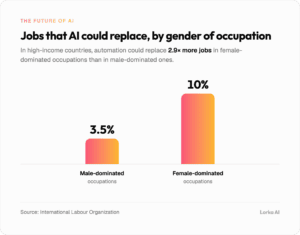
Of course, this is Corrales’ interpretation rather than a conclusion that the Harvard research attributes the entire gender gap to caution. However, it’s certainly worth a second look. The HBS research identifies several factors associated with the difference in adoption, including familiarity with AI, perceived usefulness, workplace support and training, confidence, social expectations, trust, privacy and perceptions of risk. Women in the research were more likely to report concerns about data security, to believe AI’s risks outweigh its benefits and to worry about its effects on employment.
So, Corrales’ assessment of the situation certainly seems to be a significant part of the picture, even if it’s not the whole thing.
More from Artificial Intelligence
- AI Models Are Mentioning Your Brand, But Is Your Website Being Cited?
- AI Could Move From The Cloud To The Phone – What Does That Mean For App Developers?
- What Happens When A Startup’s Entire Codebase Is Written By AI?
- The Most Important AI Design Decision Is Where The Model Stops
- OpenAI’s Astra Could Change How Startups Are Built, Says OpenAI’s Tricia Troth
- AI Influencers Vs. Real Humans: What Actually Works In Marketing?
- The Rise Of AI-Powered Start-Ups
- Trump’s Calling It “Superintelligence” Now – But The AI Industry Might Have Bigger Problems Than Its Name
What Happens If Cautious Users Stay Away?
This is where the issue becomes bigger than an adoption statistic. If Corrales’ conclusion is accurate, if women use generative AI less frequently, this could mean that they may have fewer opportunities to develop familiarity with tools that are increasingly being incorporated into workplaces. HBS has highlighted potential consequences around productivity, skills and career opportunities if the gap persists.
But there’s another dimension to consider. Corrales argues that women who are more concerned about privacy, safety and other risks may also have an important role to play in shaping how AI develops. If those users remain less engaged with AI, the industry could lose some of the people most likely to question how systems are designed and deployed.
That doesn’t mean that women are inherently more responsible AI users, nor does it mean that every woman is more cautious about technology. What it could mean, however, is that if caution is contributing to lower adoption, dismissing that caution as disinterest could mean missing useful perspectives.
Furthermore, there’s a feedback loop to consider here as well. The more people use AI, the more opportunities they have to identify problems, challenge assumptions and communicate what they need from the technology. If a significant group of users participates less, some of those experiences may be less visible to the companies building AI products, and that could have serious consequences.
Closing the Gap Doesn’t Mean Ignoring the Concerns
The answer, then, may not simply be telling women to use AI more. Rather, HBS points to alternatives measures including workplace training, clearer policies, encouragement and privacy safeguards as ways that organisations can help address the adoption gap. Its research also suggests that simply providing access to AI doesn’t immediately eliminate the difference in usage.
Corrales’ argument is that closing the gap should involve building trust rather than asking women to ignore their concerns. After all, that’s unlikely to be a successful endeavour. “Closing the gap should not mean telling women to worry less. It should mean building trust and making sure their perspective helps guide where AI goes next,” she says.
For businesses trying to get their employees to adopt AI, what’s going to become important is teaching skills and showing women how and why they ought to trust AI.
After all, it’s possible that if employers interpret lower usage simply as a lack of enthusiasm, they may just focus on encouraging adoption without addressing the reasons people are hesitant in the first place. However, proper and thoughtful training can help with unfamiliarity. Clear policies can establish what employees are and aren’t expected to do with AI, and stronger privacy and governance measures can address some of the concerns that may be holding people back. After all, the more people (and women in this case) understand, the more likely they are to be able to trust.
Thus, the goal isn’t just to get more women using AI for the sake of an adoption statistic and then call it a day. The point is to make sure that people with different experiences, concerns and expectations have the opportunity to participate in shaping how the technology is used, an endeavour well worth being part of in the long run.
The gender gap in AI adoption may, therefore, be about more than who is using generative AI today. If caution is part of the reason some women are holding back, then the industry’s response could determine whether that caution becomes a barrier to participation, or just a perspective that helps shape better AI.


