


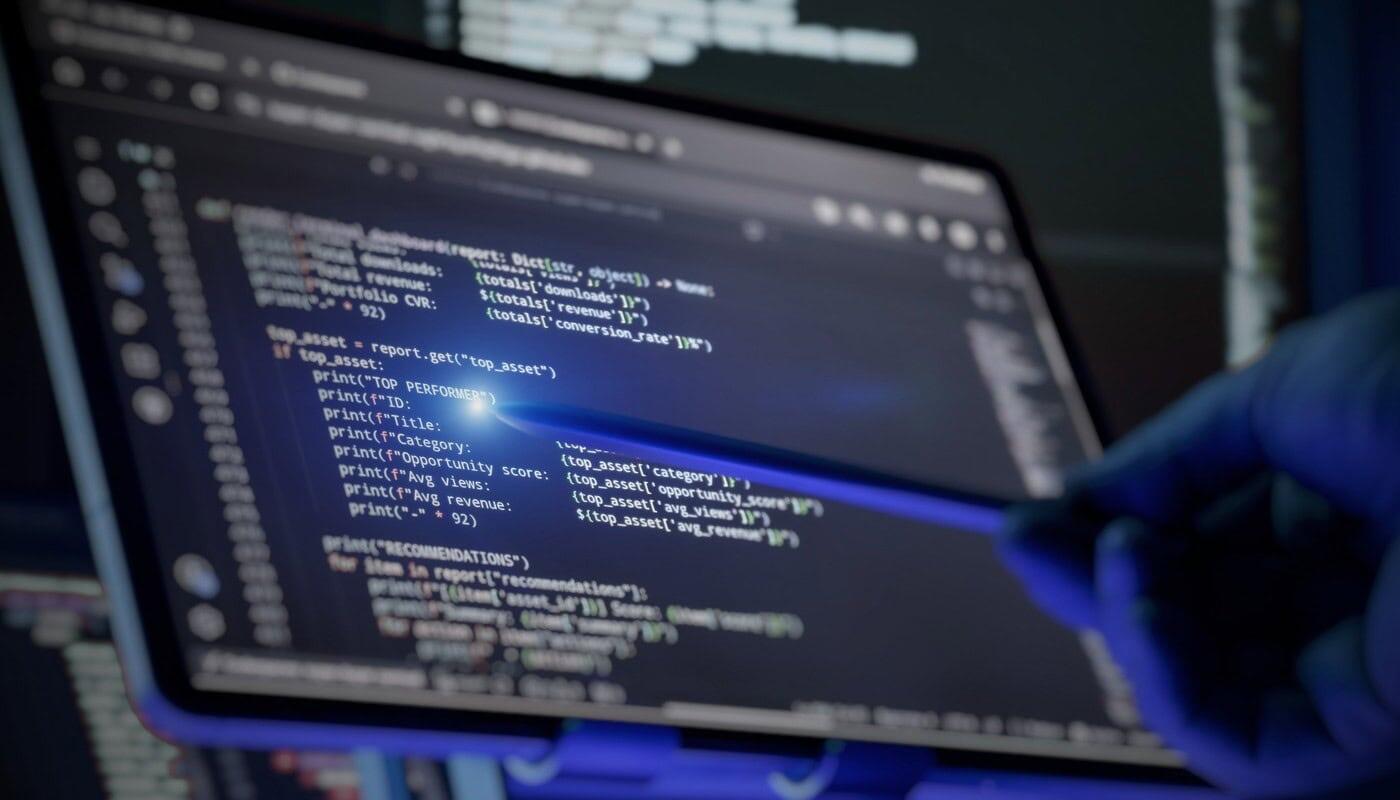
Letting an AI write your code and then asking the same AI whether it works is a bit like asking a chef to review their own soufflé. Everything looks glorious on the plate, right up until someone else sticks a fork in it.
That checking problem has turned into an industry of its own. Companies are generating more of their software with AI, human review hasn’t kept pace and investors have channelled hundreds of millions of dollars into tools built around formal verification, a mathematical method once reserved for avionics and nuclear reactor controls.
Why Passing A Test Proves Less Than You’d Think
Standard testing feeds a program chosen inputs and checks that the outputs behave as expected. It catches plenty of bugs, though passing every test only proves the software works for the scenarios someone remembered to check.
Formal verification is far stricter. Engineers spell out what the software must do in exact mathematical terms, and a proof tool checks whether the code holds up across every input the system model allows. Where a test samples a few cases, a proof covers all of them.
Historically, the stumbling block has been expense. Writing proofs requires specialist talent and considerable time. As a result, the approach stayed confined to critical systems where failure isn’t an option, such as flight controls, nuclear reactors, cryptography and secure operating system kernels.
More from Artificial Intelligence
- The AI Stock Sell-Off Is Spreading: How Will It Affect Startups Around The World?
- Proton’s Lumo AI Can Now Sort Your Inbox And Track Your Spending Without Training On Your Data
- EY, Deloitte, KPMG And PwC Are Racing To Put AI Agents On Audits While Training Staff To Doubt Them: What’s Going On?
- Why Is Open-Source AI Becoming One Of The Biggest Conversations In Tech?
- Can Europe Build Its Own Speech AI? Reson8 Is Giving Its Answer Away
- Has 2026 Been The Year We Finally Fell Out Of Love With AI?
- The Data Centre Dilemma: Can We Really Complain About Data Centres While Simultaneously Demanding More Of The Technology They Power?
- Why Are AI Companies So Interested In Giving Their Models Memory?
How AI Created A Review Crisis And Sold The Fix
AI can now write code faster than anyone can read it, so the review pile keeps growing while the number of engineers available to work through it stays the same. Formal verification has the opposite problem, because it’s watertight but painfully slow.
The pitch to investors is a marriage of the two: using AI to speed up proof discovery so a technique once confined to specialist teams becomes viable for mainstream development.
The funding numbers show plenty of appetite for that idea. Companies building automated verification tools have raised that money across multiple funding rounds over time, so it isn’t a single year’s spending.
Some of these tools pair an AI that searches for proofs with a conventional, non-AI proof checker that confirms them. The split is the clever part, because the AI is free to guess while the checker accepts only what’s provably right.
What Happens When A Proof Checks The Wrong Rules?
There’s one obvious limitation: a proof checks that the code matches its instructions and stops right there.
Consider a rule stating that a system must never move more than $10,000 without authorisation. Formal verification can prove that the boundary holds in every scenario the model allows, but it can’t prove that $10,000 was the right threshold, that the sign-off process is sound or that no critical rule was left out.
Turning vague human requirements into complete, precise statements is still hard. Someone has to decide what the software is meant to do, and a requirement that’s wrong or missing passes through the proof without a hitch.
When The Tin Is Mislabelled
“Does exactly what it says on the tin” sums up verified code.
The contents match the label, and the proof says so with a certainty that testing can’t offer, within the assumptions of its model. What the proof can’t confirm is whether the label was sensible to begin with.
NIST’s guidance already treats AI-generated code as code that still needs vulnerability and quality checks before use, and verification adds a stronger check to that process without replacing the judgement behind it. As more AI-written software arrives with a ‘verified’ stamp, the specification behind the stamp will decide how much trust it earns.


