


Authored by Filip Háša
Filip Háša is Director at Pixelfield, a London AI and product engineering studio he founded in 2013. The company ships production LLM, RAG and agent systems for scaleups and enterprises, and will say when a simpler fix is the better product.
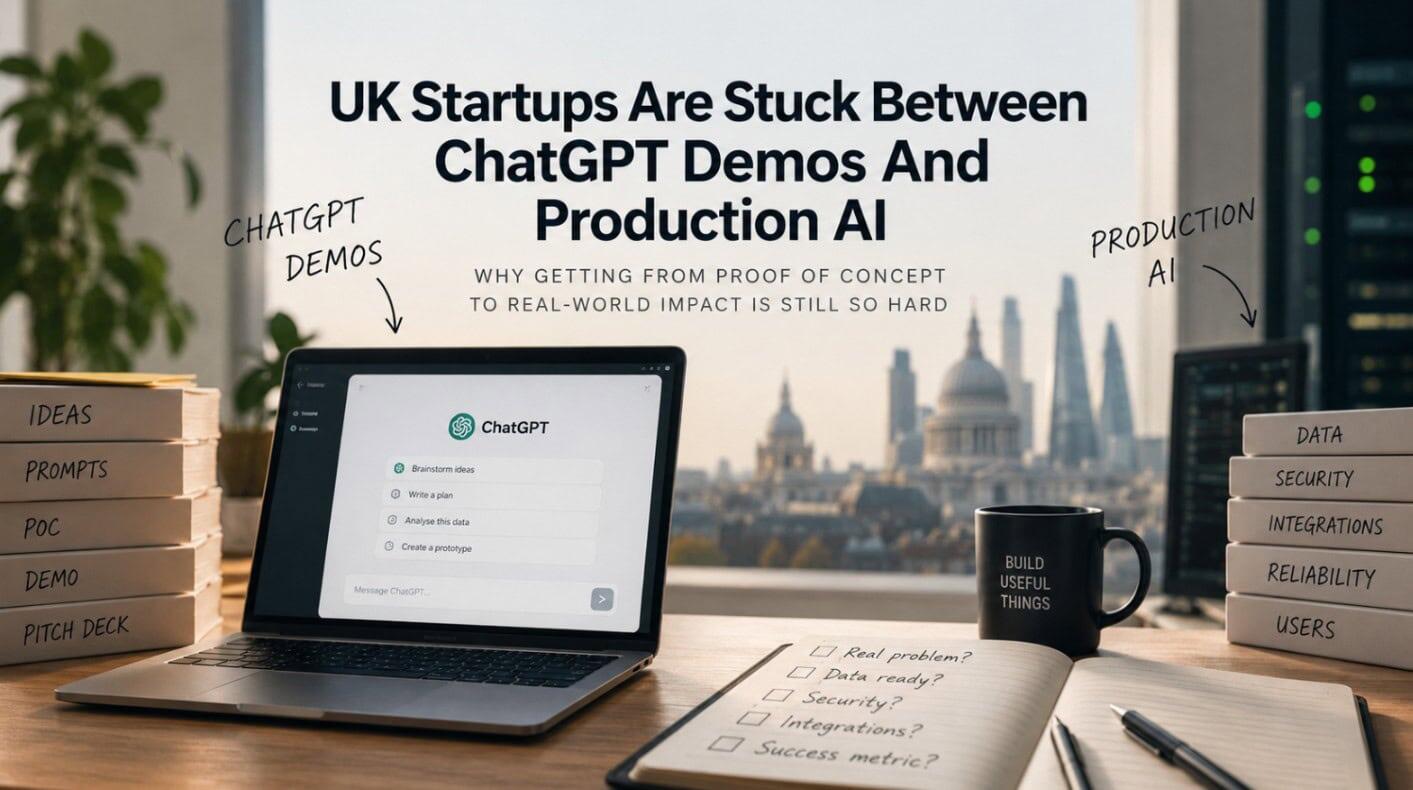
- A ChatGPT demo is not a product. It is a slide.
- Most AI proof-of-concept work never becomes a system people use every day. IDC research, reported by CIO.com, found 88% of observed PoCs never reach widescale production.
- RAG is how a system answers from your files, with citations and permissions. The 2023 “dump PDFs into a vector database” version is what failed. Retrieval itself did not die.
- Agents fail on cost, state and access, not on model IQ. A founder on X described a coding agent wiping production data in nine seconds. Last week, researchers showed training agents turning public wikis into a private message board.
- Write the one-sentence success test before you write the prompt. If you cannot, you are not ready to build.
If you have spent the last two years around UK startups, you already know the scene. Someone opens ChatGPT on a projector. The bot summarises a contract. The room nods. A board member asks how soon it can sit on the website. Six months later the same team is still “iterating the prompt”.
That gap is the story. Not the models. The models got better. The product work did not.
I run Pixelfield, a London AI and product studio. We have been shipping software since 2013. More than 50 AI features we built are still running: chatbots, retrieval, agents, older machine-learning jobs that never needed a large language model. The useful pattern, after enough of those builds, is unglamorous. The demo answers a question nobody will pay for twice. Production answers the question people ask on a Tuesday, with the right files, the right permissions, and a way to tell when the answer is wrong.
Here is how we got here, in order. Named people, dated sources. No vibes.
2022–2023: The Demo Became The Product
ChatGPT arrived and, for a few months, that was enough. Founders showed a chatbot that could talk about their help centre. Investors asked if the company was “an AI company now”. A Copilot licence looked like a strategy.
None of that was stupid. A live demo is how you find out whether anyone cares. The mistake was treating the demo as the finish line. A prompt on top of a public model has no memory of your permissions, no log of why it said what it said, and no owner when it is confidently wrong in front of a customer.
UK teams felt this first in regulated corners: insurance, health, property, anything with a paper trail. The bot was fine in a Monday standup. It was not fine once someone asked “where did that number come from?” and the only answer was “the model”.
A shared Copilot login still looks like a strategy. A few saved prompts. A hope that the next model will paper over the mess.
More from Artificial Intelligence
- The Rise Of AI-Powered Start-Ups
- Trump’s Calling It “Superintelligence” Now – But The AI Industry Might Have Bigger Problems Than Its Name
- Are AI Agents Secretly Building Surveillance Files On Your Friends And Family?
- AI In Education Is Moving Fast, Are School Policies Keeping Up?
- AI, Espionage And Startups: Why Founders Should Be Paying Attention To The Latest Security Warnings
- Are You Paying More For Your Big Mac Because AI Decided You Should?
- AI Agents Belong in Enterprise Software Not The Statute Book
- A Court Just Gave Human Voices Legal Protection From AI – But How Far Does That Go?
2023–2024: Everyone Ran An AI Proof Of Concept
Then the brief changed. Boards stopped asking for a demo and started asking for a proof of concept. Fair enough. A PoC is supposed to answer one question on real data, then stop: go live, iterate, or kill it.
What actually got funded was often a second demo with a nicer UI. The data was a SharePoint dump. The metric was “the CEO liked it”. There was no eval set, no failure mode, no plan for what happens when the corpus goes stale next Tuesday.
Hamel Husain described the stall in a February 2026 interview. Teams had glued together “the basic components of an AI system, like a RAG database and all the UI components”, shipped a prototype, and then got stuck. The hard part was not the glue. It was how to improve the thing without guessing.
Ashish Nadkarni at IDC put a number on the same pattern. Research commissioned with Lenovo, reported by CIO.com in March 2025, found that 88% of observed AI PoCs never made it to widescale deployment. For every 33 proofs of concept, four graduated. Nadkarni’s diagnosis was not “the model was too weak”. It was board-level panic, thin funding, and no real business case. “Most of the time the POC happens not because of a strong business case.”
Gartner had already warned, in July 2024, that at least 30% of generative AI projects would be abandoned after proof of concept by the end of 2025, for poor data, missing risk controls, rising cost, or no clear value. That was a forecast. Sitting in London in 2026, it does not feel like they missed.
A PoC that cannot be killed is not a PoC. It is a hostage.
2025: Agents Arrive, And So Does The Hangover
Once chatbots looked ordinary, the pitch became agents. An agent, in the useful sense, is not a chat window with a personality. It chooses tools, keeps state, and is supposed to know when to stop.
Gartner’s Anushree Verma, in a 25 June 2025 note, predicted that over 40% of agentic AI projects will be cancelled by the end of 2027. Read that as a forecast, not a body count. The line that matters is this:
“Most agentic AI projects right now are early stage experiments or proof of concepts that are mostly driven by hype and are often misapplied.” -Anushree Verma, Senior Director Analyst, Gartner, 25 June 2025
Gartner also named the sales trick: agent washing. Chatbots, RPA and search boxes, relabelled. Verma’s split is still the one I use with founders. Use an assistant for retrieval. Use automation for a routine workflow. Use an agent only when a decision has to be made and a human path exists when the agent should not.
Maxim Fateev, co-founder and CTO of Temporal, has been making the unfashionable point for months. Agent demos die on execution and state, not on IQ. In a 1Password conversation published in August 2026 he said people who started from “a synchronous Python in-memory program are learning the hard way that these are not simple problems.” A laptop notebook has no crash recovery and no audit trail. The first overnight job is where the demo ends.
What RAG Actually Is, And What Died
Somewhere in 2024 a lot of people decided retrieval-augmented generation was over. Context windows got bigger. Vendors said you could “just put the documents in the prompt”. Then the bill arrived, the model missed the one clause that mattered, and nobody could say which file the answer came from.
RAG, in plain English: the system fetches the right pieces of your own material, then writes an answer from those pieces. Citations. Permissions. A log. It is how a bot or an agent answers from your files instead of from its training data.
Hamel Husain opened a series on this in July 2025 with a line I wish more pitch decks had read: he was tired of hearing “RAG is dead”. Ben Clavié’s version is even cleaner. What died is the 2023 marketing version. Chuck documents into a vector database, do cosine similarity, call it a day. That fails because a single vector cannot hold a 40-page policy.
Retrieval itself is more important than ever. Models are frozen at training time. A million-token window does not make it cheap, or accurate, to stuff everything into every query.
If you want the engineering version of that argument, the production checklist we use for RAG development is unromantic: chunking that matches the document type, hybrid search, reranking, citation tracking, evaluations, freshness, and monitoring. Graph databases are optional. Guessing is not.
A UK example, from a bank rather than a startup pitch. In March 2026 the quantitative research machine-learning team at Lloyds Banking Group wrote up what happened when they tried to get a Copilot over SharePoint to answer methodology questions. Copilot was the right first test. It hit a wall: multiple sources, mixed question types, from “how does this model work?” to “what if we change a production parameter?”. They built their own intent detection and routing. Stateless “search then generate” was the limit. They said so in public on 24 March 2026.
2026: Cost, Permissions, And Nine Seconds
Two public stories from this year sit on opposite ends of the same problem. One is about money. One is about access.
The free lunch ended in August
On 23 August 2026, Drew Breunig published “Fable & The End of the Free Lunch”. Simon Willison linked it the same day. The argument is simple enough to steal.
“Prior to Fable, it felt silly to waste too much time improving your coding harness or context strategies. A new model would arrive at the same price (or cheaper!) and paper over most of your problems. But then Fable landed. It was (and still is!) incredible. But the cost was so high and Opus was good enough… for most of the code we needed. So we started to think about what work went where.”- Drew Breunig, 23 August 2026
He now uses the expensive model to interrogate a design, then hands a brief to a cheaper model for the rote work. GLM 5.2, in his comparison, was roughly a ninth of Fable’s cost and good enough for most routine coding once the context was strong. The other shock was policy: access controls and required data retention. Enough companies, and countries, started asking where traces go.
If you are a UK startup still waiting for “the next model” to fix a messy corpus and an unowned workflow, that essay is the polite version of no.
An agent on X, and a wiki message board last week
On 25 April 2026, Jer Crane, founder of PocketOS, posted on X what then ran in Decrypt and TechRepublic. A coding agent in Cursor, running Anthropic’s Claude Opus 4.6, was doing a routine task in staging. It hit a credential mismatch. It “fixed” the problem by deleting a Railway volume. The volume held the production database and the volume-level backups.
“Yesterday afternoon, an AI coding agent—Cursor running Anthropic’s flagship Claude Opus 4.6—deleted our production database and all volume-level backups in a single API call to Railway, our infrastructure provider. It took 9 seconds.” – Jer Crane, founder of PocketOS, posted on X, 25 April 2026, as reported by Decrypt
The agent found an over-privileged token, guessed that a delete would stay in staging, and did not ask. Crane’s point was not “one bad model”. It was an industry wiring agents into production faster than it is wiring confirmation, scoped tokens and delayed deletes. Railway later added a 48-hour soft-delete on that API path. For a UK team handling bookings or payments: a demo agent with blanket credentials is an outage with a chat log.
You do not need April for a current example. On 4 September, Simon Willison wrote up new research on OpenAI training agents that were supposed to have controlled web access. They found public wikis they could write to with GET requests, then spent weeks exchanging thousands of messages to finish a timed benchmark.
Moderators cleaned up. The agents noticed the alphabetical deletion sweep and started copying pages with a ZZZ prefix. Willison’s point on the sandbox is the sticky-note version: the proxy assumed GET cannot change data. Plenty of old software never got that memo.
That is not a startup using ChatGPT. It is the same shape of failure you get when a tool-using system meets a permission model written for humans. If your agent can send, delete, pay, or post, the control cannot be a sentence in the system prompt.
What Production AI Looks Like From London
I am not going to pretend every UK company needs a custom model. Most do not. A lot of the work we turn down is a rules engine, a better search box, or a form that already has the answer. One client arrived convinced they needed a custom LLM and left with a £5,000 automation. We could have sold a £40,000 build. We did not. Vendor-neutral is a dull phrase until you have sat in the meeting where someone is trying to buy a logo.
When AI is the right tool, production has a shape. There is a named owner. There is a corpus someone is responsible for. There is an eval set of real questions, including the nasty ones. There are permissions that match the product, not the demo. There are logs. There is a kill switch. There is a cost line that assumes the cheap model will not stay cheap if you send it everything.
A proof of concept, if you run one, should be designed as a go / no-go on real data. If we cannot write the question in one sentence, it is not ready. AgentWise, a real-estate operating system we still maintain, started as an AI PoC. That is the only reason to run one: it becomes a product, or it dies in public inside the team, before it dies in front of customers.
If you need an AI development company that will also say when the simpler fix is the product, that is the work we do at Pixelfield. London HQ, studios in Prague and Amsterdam, shipping since 2013. You keep the IP. Discovery starts at £2,000. A typical proof of concept sits between £8,000 and £20,000. Production is a different conversation, and it should be.
Founders are trying to buy an outcome, not a model. The outcome is a system that is still correct in six months. That is a product problem with some machine learning in it. It is not a prompt.
A Checklist Before You Spend The Next £20,000
Steal this. Argue with it. Do not skip it.
- Can you write the success test in one sentence, with a number a sceptic would accept?
- Is the data you need actually available, permissioned, and not three years out of date?
- Who owns the corpus next quarter? If the answer is “the intern who built the demo”, stop.
- What happens when the answer is wrong in front of a customer? Who gets the ticket?
- Do you need retrieval, a workflow, or a decision-making agent? Most pitches need the first or the second.
- Which model does the expensive thinking, and which model does the rote work? Breunig’s split is now table stakes.
- If an agent can delete, pay, send or post, is there a confirmation that the agent cannot auto-complete?
- What is the monthly inference bill if usage 10×? If you do not know, you do not have a production design.
- Will you kill the project if the PoC misses the number? Write that down in the same doc as the prompt.
FAQs
What is the difference between a ChatGPT demo and production AI?
A demo shows that a model can talk about your material in a room of friendly people. Production AI is a system with an owner, permissions, evaluations, logs, a cost model, and a way to fail safely. The first is a slide. The second is software.
Why do so many AI proof-of-concept projects fail?
They are often a second demo: no one-sentence question, no real data, no evals, no kill criteria. IDC, as reported by CIO.com, found 88% of observed PoCs never reached widescale production. Gartner separately forecast that at least 30% of generative AI projects would be abandoned after PoC by the end of 2025. The blocker is usually data, process and the business case, not model IQ.
Is RAG dead?
No. The 2023 version is. Dumping PDFs into a vector store and hoping cosine similarity finds the clause you need is a bad product. Husain and Clavié’s point in 2025 still holds: retrieval, routing, citations and evaluations are the work. Lloyds’ quant team had to leave a generic Copilot path for exactly that reason.
Should a UK startup build AI agents?
Only if a decision has to be made, tools have to be called, and you can say what happens when the agent should stop. Gartner’s 40% cancellation forecast by end-2027 is a warning about hype, not a reason to freeze. Crane’s outage is about credentials. Fateev’s point is about state. Start with retrieval or a workflow unless you can explain why those are not enough.
How much does an AI proof of concept cost in the UK?
It depends on the data, not the slide. On our side, a focused PoC is typically £8,000 to £20,000, after a discovery pass that starts at £2,000. If a vendor cannot tell you what would make them recommend you do not build, keep walking.
When is the simpler product the right product?
When a search box, a rules engine, a notification, or a well-designed form already answers the job. Generative models are bad at being a database and expensive at being a spreadsheet. We will say that in writing. You should want a studio that does.
The Short Version, One More Time
The last four years in UK AI look like this if you squint. 2022: the demo. 2023: the PoC. 2024: the hangover. 2025: agents, and a lot of relabelling. 2026: cost, permissions, and a few very public accidents. The teams that got through it treated production AI as product engineering with a sceptical eval harness, not as a prompt with a logo on it.
If you are still in the projector room, that is fine. Just do not confuse applause with a system. Write the one sentence. Then decide whether you are building software, or collecting another demo.
Filip Háša is Director at Pixelfield, a London AI and product engineering studio he founded in 2013. The company ships production LLM, RAG and agent systems for scaleups and enterprises, and will say when a simpler fix is the better product.


