

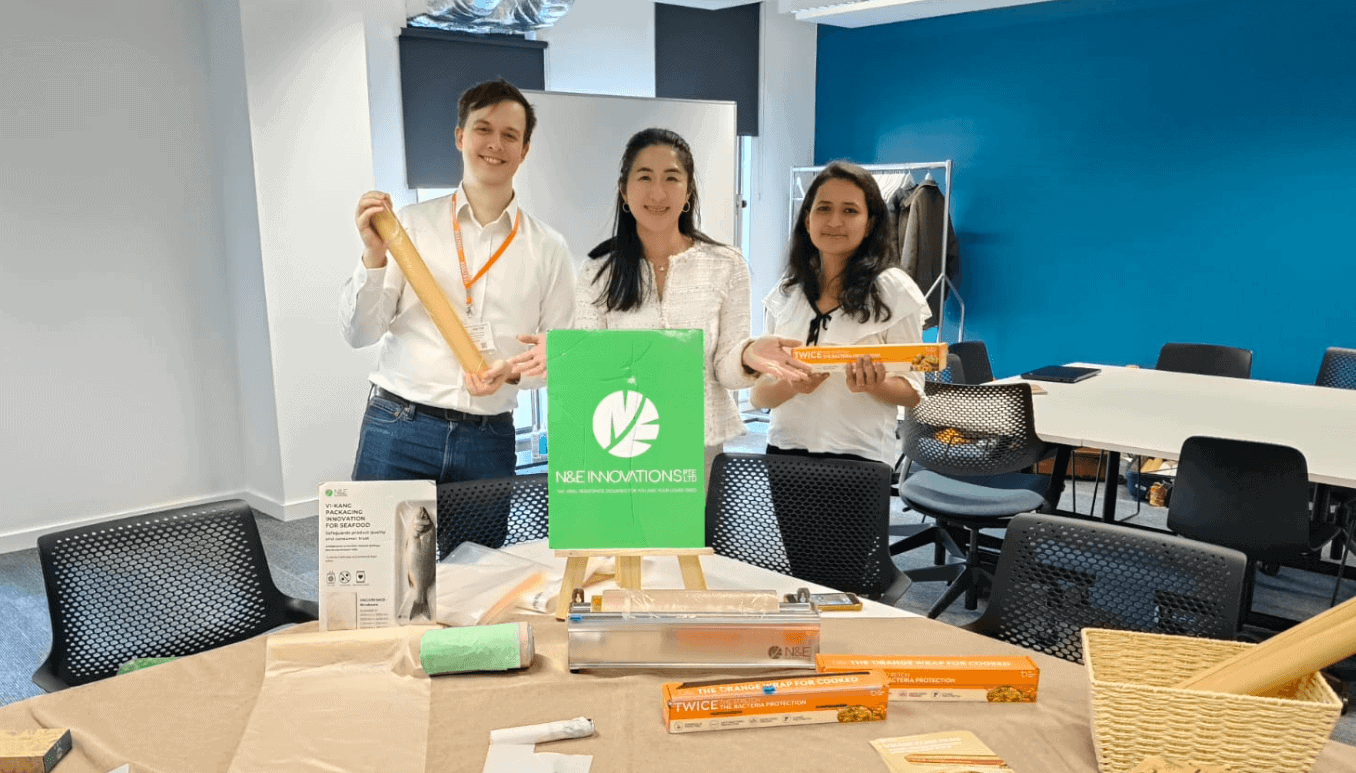
Didi Gan is the founder and CEO of N&E Innovations, a female-led biotechnology company headquartered in Singapore and established in 2020. The company is focused on developing natural, sustainable solutions that are safe for both human health and the environment.
At the centre of its innovation is ViKANG, a fully home-compostable, biodegradable and naturally antibacterial material produced from upcycled fruit waste, designed for a wide range of food-contact applications. By combining antimicrobial functionality with compostability in a single material derived entirely from organic waste, ViKANG reflects a forward-thinking approach to sustainable packaging.
With a background in biomedical science, Didi Gan has led the research and development of antimicrobial technologies derived from upcycled food waste, expanding their application across multiple sectors. Through the upcycling of fruit waste, ViKANG is designed to protect user health while supporting sustainability and broader ecosystems.
It also contributes to a circular economy by transforming organic waste into functional materials, helping to reduce carbon emissions and reliance on conventional plastics.
Under her leadership, N&E Innovations has gained global recognition, including winning the 2026 Zayed Sustainability Prize. The company is now expanding internationally, with a UK subsidiary established as a strategic base to access European markets and scale the adoption of its sustainable packaging solutions.
What Inspired You To Develop Vikang’s Food-Waste Biotechnology?
The inspiration wasn’t a single eureka moment, it was an accumulation of challenges that became impossible to ignore. I kept seeing two crises sitting right next to each other: a world drowning in single-use plastic packaging and a food system generating enormous quantities of organic waste. The question that drove us was simple but radical; what if the waste itself could become the solution?
ViKANG started from that insight.
The food service and hospitality sectors are under enormous pressure: escalating plastic regulation, growing customer expectations around sustainability and real, persistent hygiene challenges that conventional solutions address with yet more chemical inputs. We looked at that and asked whether we could build something that solves all three at once; packaging that is compostable, made from food-derived circular materials and inherently antimicrobial without any synthetic additives.
It took years of rigorous science to get there. But the conviction that drove the work was always the same: we shouldn’t have to choose between sustainability and food safety. The fact that we’ve built a product that refuses that trade-off is, I think, is the most important thing about N&E Innovations.
What’s The Core Scientific Or Technical Breakthrough That Makes Vikang Work And What Sets It Apart From Conventional Antimicrobial Additives?
Most antimicrobial packaging on the market today relies on synthetic chemical additives; silver ions, quaternary ammonium compounds or triclosan-based agents. They work but they come with a cost: toxicity concerns, regulatory scrutiny and the core contradiction of adding petrochemical inputs to a product we’re asking consumers to trust with their food.
Our breakthrough is rooted in a different approach entirely. ViKANG’s antimicrobial functionality is derived from bioactive compounds extracted and upcycled from food-grade organic waste streams. These are materials that nature has already validated for contact with food.
We’ve developed a proprietary process to isolate and integrate those bioactive properties into a compostable polymer matrix, one that meets food contact safety standards without requiring synthetic antimicrobial inputs.
This delivers broad-spectrum antimicrobial efficacy, full compostability and food-safe certification including TÜV Austria OK Home Compost certification for our clingfilm combined in a single material rather than as a coating layered over a conventional plastic. Coatings delaminate, wash off and create contamination risks during composting; ours is intrinsic.
The technical challenge was making the bioactive compounds stable enough to survive manufacturing and storage at scale while retaining efficacy throughout the product’s use life. That’s the work we’ve spent years doing and it’s the foundation of our IP.
More from Interviews
- Inside The Mind Of Anti Fund Partner Steve Han On Backing The Next Wave Of Disruptive Founders
- A Conversation With Ayoola Samagbeyi, CTO Of 9jaPay, Co-Founder Of Canalis Labs And SportsTech22 2026 Judge
- A Chat With Suzanna Chaplin, Founder And CEO, esbconnect, On The Future Of Acquisition And How Email Is The New Identity Layer
- Meet James Taylor, Founder and CEO at Particular Audience, The Company Bringing Amazon-Style Hyper-Personalisation To Every Other Retailer
- Truly Intelligent Content – Meet HumanCulture
- Interview With Shiv Shankar, CEO Of Boundless On Being The Largest ZK Protocol
- In Conversation With Chris Pettit, CEO And Co-Founder At Revving On How Messy Industries Often Hide The Biggest Opportunities
- A Chat With Kelvin Tan, audax CEO, On How Fintech Is No Longer About Disruption, Its About Fixing Banks’ Structural Problems
As A Female Founder And CEO Of N&E Innovations, What Has Been The Biggest Advantage Your Perspective Brings To Building Vikang?
I’ll start with the advantage, because I think it’s genuinely underappreciated: building for a market you understand viscerally. Food packaging and household hygiene products are categories where women are overwhelmingly both the decision-makers and the end users.
I didn’t have to research empathy for the customer it was native. That shaped the product design, the branding and how we talk about safety and sustainability in ways that resonate deeply.
On the navigating expectations side, I’d be dishonest if I said the biotech and deep-tech fundraising ecosystem is neutral. It isn’t. I’ve been in rooms where I’ve had to establish credibility that a male counterpart in the same seat wouldn’t have needed to earn. My response has always been to let the technology and the traction do the talking and then to be more prepared, more precise and more strategically clear than anyone expects.
The lesson I’d share with other founders is this: the asymmetry is real but it’s not immovable. What moves it is building something undeniable. Winning the Zayed Sustainability Prize in 2026, one of the most rigorous and prestigious global sustainability awards changed rooms for us.
It changed who returned calls. Recognition at that level resets the conversation. And it’s a reminder that the best response to being underestimated is to make the work impossible to overlook.
What Have Been The Biggest Hurdles In N&E Innovations’ Journey Scaling Vikang So Far And What Strategies Helped You Overcome Them?
Three distinct categories, three very different challenges.
On the science side, the hardest problem was reproducibility at scale. In a lab, you can control everything. In a production environment with real feedstock variability, industrial equipment and commercial tolerances maintaining consistent bioactive performance is genuinely hard.
The decision that unlocked this was investing heavily in our formulation and production documentation from early on, building what are essentially living technical protocols rather than static recipes. That rigour is now a competitive asset.
On the business model side, the tension in deep-tech sustainability ventures is always timing. The regulatory tailwinds are real; single-use plastic bans across the EU, the UAE and beyond but market adoption moves slower than regulation.
We learned early that we needed to build distributor partnerships with genuine exclusivity and commercial commitment baked in, not vague letters of intent. Our distributor network across markets including Malaysia, Australia, Philippines and the UAE is structured with real minimum purchase commitments for exactly that reason.
And on the ecosystem side, the lesson has been to pursue recognition actively, not passively.
The Zayed Sustainability Prize, our Series A fundraise, our UK launch, each of these was a deliberate milestone we engineered, not a piece of luck we waited for. Ecosystems respond to momentum and momentum has to be created.
You’ve Chosen The West Midlands As The Base For Your European Subsidiary. Why Is The UK The Right Springboard For Europe?
The UK decision was strategic on multiple levels. Post-Brexit, the UK has regulatory and commercial leadership around sustainable packaging, the Extended Producer Responsibility framework, the Plastic Packaging Tax and a genuine policy appetite to lead on the circular economy. Those aren’t headwinds for us; they’re tailwinds. Regulation of that kind creates exactly the market pressure that makes buyers urgently open to what we offer.
The West Midlands specifically was a considered choice. It is the UK’s agrifood and food manufacturing heartland, with an exceptional concentration of food science, agritech and food service institutions.
Our launch event at Harper Adams University in Telford in March 2026-supported by the UK’s Department for Business and Trade was not incidental. Harper Adams is one of the world’s leading food and agriculture universities and anchoring our UK entry there sends a clear signal about our scientific credibility and our long-term commitment to the region. We are also grateful for the support of the West Midlands Growth Company, which helped facilitate our UK establishment through office space and incorporation support.
For Europe more broadly, the UK subsidiary gives us a credible, English-language operating base from which to approach Continental markets under EU Food Contact Material regulations; a regulatory environment we’ve invested deeply in understanding. It also gives investors, partners and customers in Europe a familiar jurisdiction to engage with. It’s a bridge, not a destination.
Where Are You Seeing The Strongest Demand For Vikang’s Technology By Sector And By Market And What’s Driving That Demand Now?
The clearest demand signal right now is in food service and food manufacturing, driven by two converging forces: tightening regulation and consumer-facing ESG pressure from major food brands. The buyers who are moving fastest are those with public sustainability commitments and procurement cycles that are starting to price in carbon and plastic footprint.
Geographically, Europe is the key market due to the Single-Use Plastics Directive and Extended Producer Responsibility rollout. Our UK subsidiary positions us directly at the gateway to that market, with the regulatory credibility and scientific grounding that Continental European buyers increasingly require.
We’re also seeing early but meaningful demand signals from the UK hospitality and catering sector which is operating under both regulatory pressure and supply chain scrutiny and from the Australian market, where environmental compliance requirements are strengthening. The common thread across all of these is that the demand is no longer driven purely by values; it’s increasingly driven by commercial necessity.
That’s a fundamentally different and more durable kind of demand.
Winning The 2026 Zayed Sustainability Prize In The Food Category Is Significant Global Recognition. What Has This Meant To You And Your Team And How Has It Strengthened Your Mission?
Winning the Zayed Sustainability Prize was a moment of profound validation, not just for us, but for the entire premise that sustainability and commercial viability are not in conflict.
The Prize is one of the most recognised global sustainability awards in existence. Being awarded in the Food category, ahead of thousands of applicants from across the world, tells us that the work we’ve been doing quietly for years stands up to the most demanding external scrutiny.
For the team, it mattered enormously. Building a deep-tech sustainability company is a long game; the timelines are longer, the uncertainty is higher and the moments of external validation are rarer than in faster-moving sectors. This was one of those moments where everyone could exhale and feel the weight of what we’ve built together.
Strategically, it has opened doors that would have taken much longer to open otherwise. It has strengthened our conversations with investors, the prize carries a degree of credibility that is difficult to manufacture. It has given us access to the UAE’s sustainability ecosystem at a high level, which aligns directly with our Middle East market ambitions. And it has amplified our story in exactly the global markets; the Gulf, South and Southeast Asia, Africa where the need for food-safe, sustainable packaging is most acute and the potential for impact is greatest.
What the Zayed Sustainability Prize has fundamentally done is confirm that ViKANG is not a promising idea, it is a proven innovation. That distinction matters more than people realise.
Looking Ahead, What Is Your Long-Term Vision For Vikang’s Technology And Product Portfolio?
The long-term vision is for ViKANG to be the material of choice wherever food is packaged, stored or transported not as a premium alternative for sustainability-conscious brands but as the mainstream, commercially preferred option. We believe the conditions for that shift are already in motion.
Over the next decade, I expect three forces to converge and make sustainability-led innovation genuinely non-negotiable.
The first is regulatory pressure; the direction of travel globally on plastic, on Extended Producer Responsibility, and on food contact material safety is unmistakable. The second is supply chain accountability; major food brands are increasingly required to report on and reduce the environmental footprint of their packaging, and that pressure flows directly to suppliers and materials companies like us. The third and ultimately the most powerful is economic: as circular material processes scale, the cost curve improves.
Sustainable becomes cheaper. At that point, the conversation changes entirely.
For N&E Innovations, the product portfolio vision extends beyond our clingfilms and antimicrobial consumer products. The biotechnology platform we’ve developed has application across a wide range of food contact and hygiene applications.
We intend to be the company that proves a circular materials model can work at global scale that you can build a world-class business not despite choosing sustainability, but because of it.
The next decade will determine which companies shaped this transition and which ones were shaped by it. We intend to be firmly in the first group.