



In the consultancies sector review released today by Arrowpoint Advisory, the dedicated lower mid-market team of Rothschild & Co in the UK, analysis reveals that the global consultancy sector took a significant hit to EBITDA multiples a widely-accepted measure of value for consultancy firms between January and April 2020 as a result of COVID-19.
Data from Arrowpoint Advisory’s Global Consultancy Index (GCI) shows that, at its lowest point, the consultancies sector fell from an average multiple of 12.3x in January 2020 to a low point of 8.1x on 20 March 2020, a 35% drop. However, by the end of April 2020, the GCI rallied to end at 10.7x, a 13% decline since January 2020.
In comparison, the FTSE 250 fell by 25.2% across the same period, indicating that investors may regard the wider consultancies sector to be better equipped to cope with the challenges of COVID-19 and to recover more rapidly than the broader corporate community.
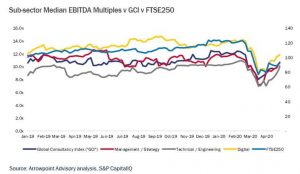
*Note: Earnings Before Interest, Tax, Depreciation & Amortisation
Jeremy Furniss, Managing Director at Arrowpoint Advisory, commented: “It’s too soon to make predictions over when the listed consultancies sector will recover or the shape of the industry post-Covid-19, but there is no doubt that it will recover. In the UK, the sector will play a key role in equipping the UK economy to adapt and prosper in whatever the ‘new normal’ looks like post-pandemic.”
The Arrowpoint Advisory analysis divides the global consultancies sector into three sub-sectors: management and strategy, technical and engineering, and digital. Across the sub-sectors, digital performed the strongest throughout the first four months of 2020, with an average 12.3x multiple, a 15.3% premium to the GCI, while technical and engineering was the lowest rated sub-sector at 9.4x. Meanwhile, management and strategy consultancy services occupied the middle ground at 10.3x.
More from News
- An OpenAI Engineer Is Charged Over A $14 Recording Device – What Does It Say About Security At AI Labs?
- Mhance Acquires CPS And City Dynamics To Strengthen Its Copilot, Modern Work And Business Solutions Capabilities
- What Can Startups Learn From HSBC’s AI-Driven Job Cuts?
- Moterra AI Achieves Select Partner Tier In Anthropic’s Claude Partner Network
- GoDaddy Launches Web App Hosting With API For AI Coding Tools
- 7 In 10 Consumers Have Never Investigated What’s Inside Their Smartphone
- Tango Turns Live Communities Into a Force For Breast Cancer Research
- Two Thirds of Brits Are Telling AI Chatbots Their Secrets But Don’t Trust The Companies Behind Them
Jeremy Furniss concluded: “While there is much speculation that “life will never be the same’’ post-pandemic, certain business practices such as remote and flexible working and technology-enablement of service delivery will see accelerated and more pervasive adoption as a result of the crisis. This in turn is likely to drive client demand for digital consultancy, a community of providers which has been able to respond to the crisis more ably than many of its peers across other sub-sectors. In the short-term, we are also likely to see a new suite of consultancy services to help businesses get back to work in line with Government guidelines on social distancing and to take advantage fully of the evolving suite of state financial support.”


