


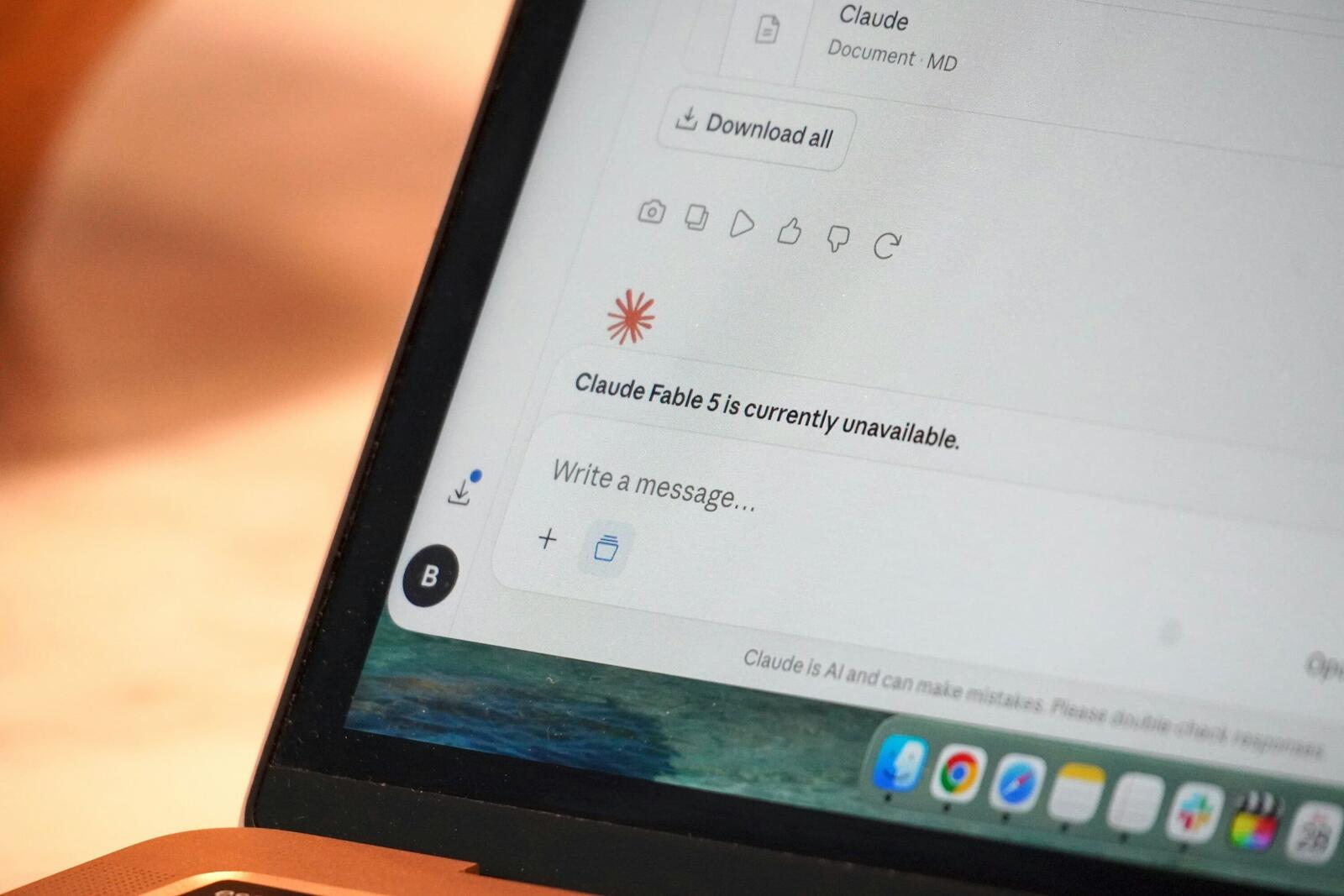
For a few hours yesterday, on 3 September, some of the world’s most popular AI tools became unavailable at roughly the same time. According to reports from Mint, The Economic Times and other outlets, users experienced issues accessing ChatGPT, Claude and Grok, with reports ranging from failed requests and error messages to complete service outages. The timing immediately sparked speculation about whether the outages were connected and, if so, what that might tell us about the infrastructure underpinning today’s AI ecosystem.
While the precise causes remain unclear, the incident raises much bigger questions than why three AI platforms went down….but what exactly should we be taking from this whole ordeal?
AI Is No Longer A Nice-To-Have
A few years ago, an outage affecting an AI chatbot would have been an inconvenience, but today, it’s a full-on disruption. As Jonny Murphy-Campbell, Ethical AI Expert and Commercial Director at Resolvable, points out, AI has become deeply embedded in both personal and professional workflows.
“AI availability is next to cloud computing and electricity for the level of reliance we have. We not only use AI for our questions, but we’re using it – especially in business – for coding tools, research workflows, customer support, writing processes and business operations.”
That change may be the most significant takeaway from the outage. The story isn’t necessarily that AI failed, it’s that millions of people suddenly realised how much they depend on it.
Dean Cooper, Technology Executive, Enterprise Architect and AuDHD Advocate, believes the incident highlights a growing form of dependency that goes beyond technology: “The risk is when offloading quietly becomes dependency, almost like a drug. People now use ChatGPT, Claude and Grok to research, reason, remember, write and make decisions. If they disappear and our first reaction is, ‘I can’t do this now,’ that’s worth noticing.”
In other words, perhaps the outage was less a test of AI systems and more a test of us. Or rather, what we’re outsourcing.
More from News
- Two Thirds of Brits Are Telling AI Chatbots Their Secrets But Don’t Trust The Companies Behind Them
- Video Game Companies Are Abandoning “Buy Our Console To Play This” – Here’s Why
- UK Gambling Operators Face New Deposit Limit Rules From 30 September
- How A Ransomware Gang Hijacked A Rival Gang’s Website – And Is Now Extorting Them For “2.333% Of Their Net Worth
- Meta Promised Unmatched Privacy For Muse – So How Did Researchers Crack It So Quickly?
- Digital Avatars Are Bringing Deceased Artists Back To The Stage – Where Do We Draw The Line?
- Can Europe Solve Its Critical Minerals Problem Fast Enough To Support Its Tech Ambitions?
- Google Has Agreed To A £260 Million Settlement: Who’s Eligible For Compensation?
Are the AI Rivals More Connected Than We Think?
One of the most interesting aspects of the outage was that it involved competing platforms that all went down at pretty much the same time. OpenAI, Anthropic and xAI are often portrayed as fierce rivals battling for dominance in the AI race, but beneath the branding and model names lies a more complicated reality.
According to Jeff Watkins, Chief AI Officer at NorthStar Intelligence, many AI providers depend on overlapping infrastructure, including cloud services, networking providers, compute resources and other third-party systems. “We tend to think of OpenAI, Anthropic, Google and xAI as completely separate competing platforms. Underneath them, however, the AI ecosystem is much more interconnected.”
Several experts pointed to reports suggesting shared infrastructure may have played a role. Indeed, Rob Demain, CEO of e2e-assure, says, “Three rivals failing together points to shared foundations rather than three separate faults.” Akash Thakur, SRE and Performance Architect at Cognizant Technology Solutions, reached a similar conclusion. According to Thakur, the most significant takeaway is that “three competitors failing in the same window isn’t three independent failures rather it’s the signature of a shared hidden dependency.”
It’s worth noting that, according to Watkins, speculation around Azure remains unconfirmed, whilst Cloudflare publicly stated that its infrastructure was operating normally. The exact cause may ultimately matter less than the broader lesson, which seems to be that different AI providers don’t necessarily mean independent systems.
The Problem With “AI Diversification”
Many businesses assume that using multiple AI platforms creates resilience, but several experts argue that assumption deserves scrutiny. As Blessings Mambwe, AI and Automation Engineer at Standard Bank, explains, “A simultaneous outage is a reminder that ‘multi-model’ is not the same as resilience when services share cloud dependencies, identity layers, networking paths or operational assumptions.”
The same concern was echoed by Juliana Germinio, Founder at Yellow Zest. Germinio explains that “We talk about these tools like they’re separate ecosystems, but the outage was a reminder that a lot of them are quietly running on the same infrastructure.”
In traditional IT environments, organisations routinely map dependencies, create disaster recovery plans and build fallback systems. AI adoption, however, has often happened much faster than AI resilience planning. The result is that many organisations now have AI embedded in critical workflows without fully understanding what happens when those systems become unavailable.
What Happens To The Things AI Was Doing?
For many users, the outage meant waiting a few hours before asking another question, but for AI agents, it may have been more complicated. And that’s a point plenty of people may not be considering. Sayali Patil, Founder and CEO at IntentOps, believes the most important question isn’t why the systems failed but what happened to the work they were doing when they failed, and it’s a good point. As Patil put it, “Everyone’s asking why three competing platforms failed together. The question nobody’s asking is what happened to every AI agent that was mid-task when they did.”
As AI moves beyond chatbots and into autonomous workflows, interruptions become more consequential. Coding agents, customer service agents and automation systems may all be performing actions rather than simply generating text. Patil argues that organisations need better ways of tracking interrupted AI activity, understanding what was left unfinished and ensuring systems recover cleanly when services return, because if they can’t do this, there may be serious repercussions.
The Real Lesson Is That Resilience Still Matters
If there’s one theme running through almost every expert response, it’s resilience. That’s not necessarily resilience in AI itself, but resilience in the people, businesses and systems that increasingly depend on it.
Oliver Simonnet, Lead Cybersecurity Researcher at CultureAI, notes that organisations have spent decades developing continuity plans for cloud infrastructure and other critical technologies. AI, by comparison, remains relatively immature in that regard.
Meanwhile, Mat Hunter, CEO at Design Council, asserts that as AI becomes embedded in more services, organisations need to think more carefully about “infrastructure, resilience, sustainability, security and what happens when things go wrong.” Maybe that should be our main conclusion from the outage.
The fact that ChatGPT, Claude and Grok all went offline at roughly the same time isn’t necessarily evidence that AI is fragile, but rather that AI has become infrastructure without us really even noticing, kind of like a frog in boiling water. And once something becomes infrastructure, reliability, transparency and backup plans matter more than ever.
Most importantly, as Rob Demain puts it, “If critical functions run on cloud-based AI…can you still run the business when it goes down?” And for many organisations both big and small, yesterday may have been the first time they seriously considered that question, and it probably won’t be the last.
Expert Comments
- Rob Demain: CEO of e2e-assure
- Jonny Murphy-Campbell: Ethical AI Expert and Commercial Director at Resolvable
- Sayali Patil: Founder and CEO at IntentOps
- Blessings Mambwe: AI and Automation Engineer at Standard Bank
- Musa Aykac: Founder at llumo
- Oliver Simonnet: Lead Cybersecurity Researcher at CultureAI
- Jeff Watkins: Chief AI Officer at NorthStar Intelligence
- Sergey Matikaynen: Co-founder and CTO at GoGloby
- Akash Thakur: SRE and Performance Architect at Cognizant Technology Solutions
- David Sherman: AI and Financial Inclusion Strategist at io.net
- Mat Hunter: CEO at Design Council
- Tash Jefferies: Money Engine
- Dean Cooper: Technology Executive, Enterprise Architect and AuDHD Advocate
- Juliana Germinio: Founder at Yellow Zest
- Emily Hartstone: Founder at Runtime Authority Control LLC
Rob Demain, CEO of e2e-assure

“The conclusion people will reach is that we are over-reliant on AI, but it’s perhaps just as important to note who didn’t go down. Early reporting links the outage to Azure, which sits underneath ChatGPT, Claude and Grok. Gemini runs on Google’s own cloud and barely wobbled. Three rivals failing together points to shared foundations rather than three separate faults.
“Using several AI providers isn’t diversification if they all sit on the same infrastructure, and almost all of it is US-owned and operated, so a problem there lands everywhere at once. The real test is that if critical functions run on cloud-based AI, whether that is your SOC, your service desk or your production line, can you still run the business when it goes down? For most organisations, that answer is no, and nobody has tested it.”
Jonny Murphy-Campbell, Ethical AI Expert and Commercial Director at Resolvable

“AI availability is next to cloud computing and electricity for the level of reliance we have. We not only use AI for our questions, but we’re using it – especially in business – for coding tools, research workflows, customer support, writing processes and business operations.
“It’s also a reminder that despite the companies being competitors, their infrastructure is not totally independent – they can simultaneously experience an outage if they still depend on some of the same underlying cloud, networking, authentication or internet infrastructure. So you can’t guarantee you have three independent backups – which makes relying on even a few AI providers even more difficult, as it’s not a guarantee.
“It’s important to remember that it’s natural to have reliance on systems that we use daily and integrate into our workplaces and personal lives. Outages happen in almost every area involving tech, so it has always been important to remember that things can (and often will) temporarily fail, it’s just about having a reliable backup plan in place.
“A well-designed AI system shouldn’t bring an important service to a halt; human oversight is important at every stage of AI usage, and we should be able to survive without AI. AI should always be used with human oversight as a tool, solely. It should help turn the cogs more efficiently and effectively, while humans remain in control. Businesses, and humans, should have an AI outage plan to identify what happens if the AI provider disappears for a day or even a week. We need to have non-AI procedures and alternative ways for our systems to continue – albeit undoubtedly less efficiently – but keeping humans capable of taking over important workflows.”
Sayali Patil, Founder and CEO at IntentOps

“Everyone’s asking why three competing platforms failed together. The question nobody’s asking is what happened to every AI agent that was mid-task when they did.
“A person hitting a blank chat window just tries again later, no harm done. An agent isn’t a person typing a question, it’s mid-execution: partway through a multi-step workflow, a code deployment, a customer interaction, a financial transaction. When the underlying model provider vanishes mid-action, that work doesn’t gracefully pause, it just stops, often with no clean record of exactly what state it left things in. Did a partially-executed task get retried and duplicated once service resumed? Did an agent’s action get half-committed somewhere with nobody checking? Coding agents like Codex and Claude Code were confirmed as affected, meaning production deployments were interrupted mid-flight, not just people staring at chat boxes.
“This is the actual lesson from Thursday, and it’s not about redundancy. It’s that we’ve built agents to act autonomously without building the equivalent of a transaction log for what an interrupted agent left half-finished. Most teams will check if the outage is over. Very few will check whether anything the agent was doing when it went down actually finished the way it was supposed to.”
Jeff Watkins, Chief AI Officer at NorthStar Intelligence

“Yesterday, three of the world’s biggest AI platforms, OpenAI, including ChatGPT and Codex, Anthropic’s Claude, and xAI’s Grok, suffered significant outages within a remarkably similar window. There were also reports of problems with Google Gemini, although Google did not confirm an outage.
We now know a little more about what happened, but not enough to conclude that these incidents shared a single cause. OpenAI has attributed its problems to a routing error, while xAI has said an outage occurred at its Memphis compute centre. Anthropic identified the cause of its outage but has not publicly provided much detail. Cloudflare has explicitly said its infrastructure was operating normally, while speculation about Azure remains unsubstantiated.
The cause is interesting, but I think what happened is more interesting.
We tend to think of OpenAI, Anthropic, Google and xAI as completely separate competing platforms. Underneath them, however, the AI ecosystem is much more interconnected. Providers can depend upon overlapping cloud infrastructure, data centres, networking, compute partners, content delivery networks and other third parties.
That creates the possibility of correlated failures. Simply having accounts with two different AI companies does not necessarily provide the resilience you might imagine if both ultimately depend on the same infrastructure.
More importantly, we often don’t know where those shared dependencies are. That makes it difficult for enterprise customers to properly understand and model their concentration risk.
There are several lessons here.
Firstly, we shouldn’t design services or business processes on the assumption that any AI provider, or even a combination of providers, will be 100% available. Applications integrating AI should have circuit breakers, sensible timeouts and graceful fallbacks. Organisations should also understand what happens operationally when the AI simply isn’t there.
That last point is important beyond outages. Models can be withdrawn, changed, or updated; their behaviour can change; costs can increase; and regulatory requirements can change. A genuinely resilient business process should therefore be able to degrade gracefully rather than grind to a halt because its preferred model is unavailable.
Secondly, this incident highlights how much control we’ve surrendered. With conventional cloud infrastructure, sophisticated customers can design across availability zones and regions and, where justified, across cloud providers. With a proprietary AI API, much of the underlying architecture and its dependencies are deliberately abstracted away from us.
For particularly critical applications, organisations may consequently want to consider whether a smaller model hosted within infrastructure they control could provide an emergency fallback. It may not deliver the same capabilities as a frontier model, but resilience isn’t necessarily about providing an identical service during an outage; sometimes it’s about maintaining an acceptable minimum level of service.
I wouldn’t suggest that everyone should suddenly start self-hosting AI. Doing so transfers responsibility for infrastructure, security, updates, monitoring and capacity planning back to the organisation and could substantially increase cost and complexity. But there is now a legitimate architectural conversation to be had about where that trade-off makes sense.
Finally, I think we’re approaching a point where AI needs to be treated less like an optional productivity tool and more like operational infrastructure. We’re being encouraged to embed generative AI into office suites, software development, customer service, business processes, products and increasingly autonomous agents. As our dependency increases, our expectations around resilience, transparency, and incident reporting need to increase accordingly.
There was already a trust gap around AI, created by the accumulation of many smaller concerns around privacy, security, accuracy, transparency and control. Reliability now becomes another component of that gap.
The biggest lesson from yesterday may therefore not be that OpenAI, Claude and Grok happened to go down at roughly the same time. It is that organisations need to understand what happens when the AI they increasingly depend on disappears, and the industry needs to become much more transparent about the infrastructure and dependencies beneath it.”
Blessings Mambwe, AI and Automation Engineer at Standard Bank

“A simultaneous outage is a reminder that “multi-model” is not the same as resilience when services share cloud dependencies, identity layers, networking paths, or operational assumptions. The lesson is not to avoid AI; it is to design graceful failure before an outage. Critical workflows need provider-independent fallbacks, clear manual paths, tested recovery runbooks, and observability that shows which dependency actually failed.
“I build production AI and automation systems and research LLM safety, evaluation, and interpretability. The practical governance question is: when a model endpoint disappears, who owns the decision, what evidence remains, and can the business continue safely without the automation? That is the difference between AI being a useful capability and a hidden single point of failure. Views are personal and do not represent my employer.”
For any questions, comments or features, please contact us directly.

Musa Aykac, Founder at llumo

“This outage isn’t an infrastructure story, it’s a strategy wake-up call. After 20 years watching businesses get burned by single-platform dependency, I can tell you exactly what this means: if your brand’s visibility strategy is built on one AI engine, you just experienced a preview of your own obsolescence.
“I’ve seen this movie before. Brands that went all-in on Google in 2010 got destroyed by algorithm updates. The ones that bet everything on Facebook organic reach in 2015 disappeared when the feed changed. Now I’m watching the same mistake with AI marketers pouring budgets into “optimizing for ChatGPT” while ignoring Gemini, Perplexity, and Claude.
“Here’s what we should conclude: cross-platform AI visibility is no longer a marketing advantage. It’s business continuity. The brands that survived yesterday psychologically were the ones already discoverable everywhere. The ones who went all-in on a single platform vanished alongside it.”
Oliver Simonnet, Lead Cybersecurity Researcher at CultureAI

“Outages like this really shine a light on how dependent organisations have become on AI tools, often without establishing the same business continuity plans they would for other critical technology.
“Also, this type of incident comes with both operational and security implications. As if an organisation approved AI service goes down, employees will still need to get their work done, and many will almost immediately look for any alternative. This can push people towards rapid use of unapproved AI tools, personal accounts, and services the organisation has no visibility over, turning a typical availability problem into an acute shadow AI and data exposure problem.
“So it’s important that organisations think about what their approved fallback process looks like when a key AI provider is unavailable, rather than leaving employees to find their own.
“Another aspect of these modern times these outages shine a light on is long-term resilience. As we increasingly rely on AI to write code, analyse information, and perform other core business tasks, organisations need to make sure the underlying skills and knowledge of their employees don’t atrophy. If an AI service becomes unavailable, teams still need enough understanding of their systems and job roles to operate effectively while an alternative is established.
“In principle, this isn’t something brand new, it’s basically traditional business continuity and disaster recovery. But the difference is that we’ve have spent decades establishing reliable redundancy plans around technologies like cloud infrastructure for example, while the required resilience planning around AI is still relatively immature.”
Dr. Manish Patel, CEO and Co-founder of Jiva.ai

“When major AI platforms are down, millions of people are affected – from chat users to developers using the infrastructure to code. This widespread disruption highlights the real business risk of single-model dependency and exposes the key issue of relying on third-party providers. When mission-critical tasks rely entirely on one external platform, even a temporary outage can halt operations and decision-making, thus impacting a company’s deadlines and bottom line.
“However, the lesson is clear: effective enterprise-grade AI requires infrastructure resilience and model ownership. This will ensure business continuity when third-party systems fail. Enterprises with their own distinct model sovereignty can keep critical workflows running, regardless of which or how many external providers go offline.”
Sergey Matikaynen, Co-founder and CTO at GoGloby

“The biggest lesson is not simply that we’re over-reliant on AI. It’s that we’re often building critical business workflows around AI services without enough architectural redundancy.
“When multiple major AI platforms become unavailable at the same time, switching from one public API to another may not be enough. Enterprises need an abstraction layer that separates their applications from individual model providers and allows them to route workloads across multiple models and environments.
“This could mean using managed models through cloud providers, self-hosted open-source models, or a combination of both. The goal isn’t to eliminate outages, which is impossible. It’s to ensure that an AI provider going down doesn’t bring your entire business process down with it.
“AI infrastructure now needs the same resilience principles we’ve applied to databases, cloud services, and networks for years.”
Akash Thakur, SRE and Performance Architect at Cognizant Technology Solutions

“Yes, those 90 minutes exposed how dependent daily work has quietly become on these tools — people panicked because a routine part of their workflow simply vanished, and that reliance will only deepen. But dependence is the symptom, not the lesson.
“The sharper takeaway: three competitors failing in the same window isn’t three independent failures rather it’s the signature of a shared hidden dependency. Gemini staying up on Google’s own cloud while the Azure-linked platforms fell is the tell. This was concentration risk, not AI fragility.
“Diversity you can’t see isn’t diversity. Many enterprises think using hybrid AI vendors de-risks them, not realizing those vendors sit on the same cloud underneath — so “switch to a backup AI” fails exactly when you need it most.
“The fix isn’t panic. It’s mapping your dependency graph, avoiding single-region concentration, and designing graceful degradation so a provider’s outage is an inconvenience, not yours.”
David Sherman, AI and Financial Inclusion Strategist at io.net

“ChatGPT, Claude and Grok all went down yesterday, around the same time. All three run on a narrow stack of shared cloud providers, so when one layer fails, everything built on top of it goes down too.
“The same pattern shows up anywhere infrastructure gets this concentrated: a handful of providers and regions carrying weight for entire sectors, with little redundancy behind them. AI just makes it visible, because so much of the industry runs through the same few pipes at once.
“The early internet dealt with a version of this by spreading itself across many providers and geographies, so no single node could take the whole system down. Alternative architecture exists around that idea – more places to pull capacity from, no single point of failure and options left over when one data centre region has a bad day.
“That kind of resilience takes planning ahead of time.”
For any questions, comments or features, please contact us directly.
Mat Hunter, CEO at Design Council

“As AI becomes embedded in the systems and services we depend on, we need to be much more intentional about how it is designed, deployed and governed. Design bridges the gap between technological possibility and real-world impact, helping identify the right problems to solve, understand the needs of the people they serve, anticipate risks and failure points, and translate innovation into products, services and systems that work in practice. We must develop AI to serve more diverse needs in diverse contexts, and this will move us beyond the current mono-culture of frontier models in the cloud.
“The UK design economy employs more than 2 million people, with almost half working in digital design, a substantial pool of expertise we must leverage to think about the wider systems AI sits within, including questions of infrastructure, resilience, sustainability, security and what happens when things go wrong.”
Tash Jefferies, Money Engine

“Outages in this day of AI are going to happen. We should conclude that while these tools are invaluable, we really should still be able to process our own content, info, business processes in real time too. If Claude or ChatGPT doesn’t process an invoice, our clients are still going to expect and demand it. So we still need to learn and utilize those skills!
“Humans are lazy by nature… But that doesn’t mean we still should not build up brain’s capacity to work! Leverage AI , but if its not there, still be able to do the work that’s needed. Period.”
Dean Cooper, Technology Executive, Enterprise Architect and AuDHD Advocate

“I think this multi-service outage exposes a human resilience issue as much as a technology one. Cognitive scientists call it “cognitive offloading”: using tools to take work away from our own memory and thinking. That can be useful, but emerging research suggests heavy AI assistance can sometimes contribute to shallower learning, skill decay and a growing need to check with the machine first.
“The risk is when offloading quietly becomes dependency, almost like a drug. People now use ChatGPT, Claude and Grok to research, reason, remember, write and make decisions. If they disappear and our first reaction is, “I can’t do this now,” that’s worth noticing.
“I’m not arguing we should use AI less — I use it extensively myself as an AuDHD person. But we should still exercise our own mental muscle memory. If AI disappeared tomorrow, could we still think, decide and act confidently without it?”
Juliana Germinio, Founder at Yellow Zest

“Three separate, independent companies ended up not working at the same time, which makes me wonder how everything’s actually built underneath.
“We talk about these tools like they’re separate ecosystems, but the outage was a reminder that a lot of them are quietly running on the same infrastructure.
“For me, running a business day to day with these tools, the lesson is simple: don’t put all your eggs in one basket, no matter how good that basket is. Have a backup plan. Know what you’d do if your main tool went dark for a few hours, even just for an afternoon.
“If anything, this is just proof AI’s not a novelty anymore. It’s foundational to how we work now, so we should start treating it with the same seriousness we’d treat any other critical system we depend on.”
Emily Hartstone, Founder at Runtime Authority Control LLC

“The shared-dependency lesson is real, and everyone will make it. The more useful question is what your own systems did while the models were unreachable.
“If you have AI embedded as a check inside a workflow, a classifier deciding what gets escalated, a review step, an approval gate, then Thursday was a free test of your default. Did the workflow stop, or did it carry on without the check?
“Most systems fail open, because failing open is invisible and failing closed generates complaints. Nobody plans for the check disappearing. They plan for the check being wrong.
“An outage is the cheapest audit you will ever get. Go look at what ran anyway.”
For any questions, comments or features, please contact us directly.


