


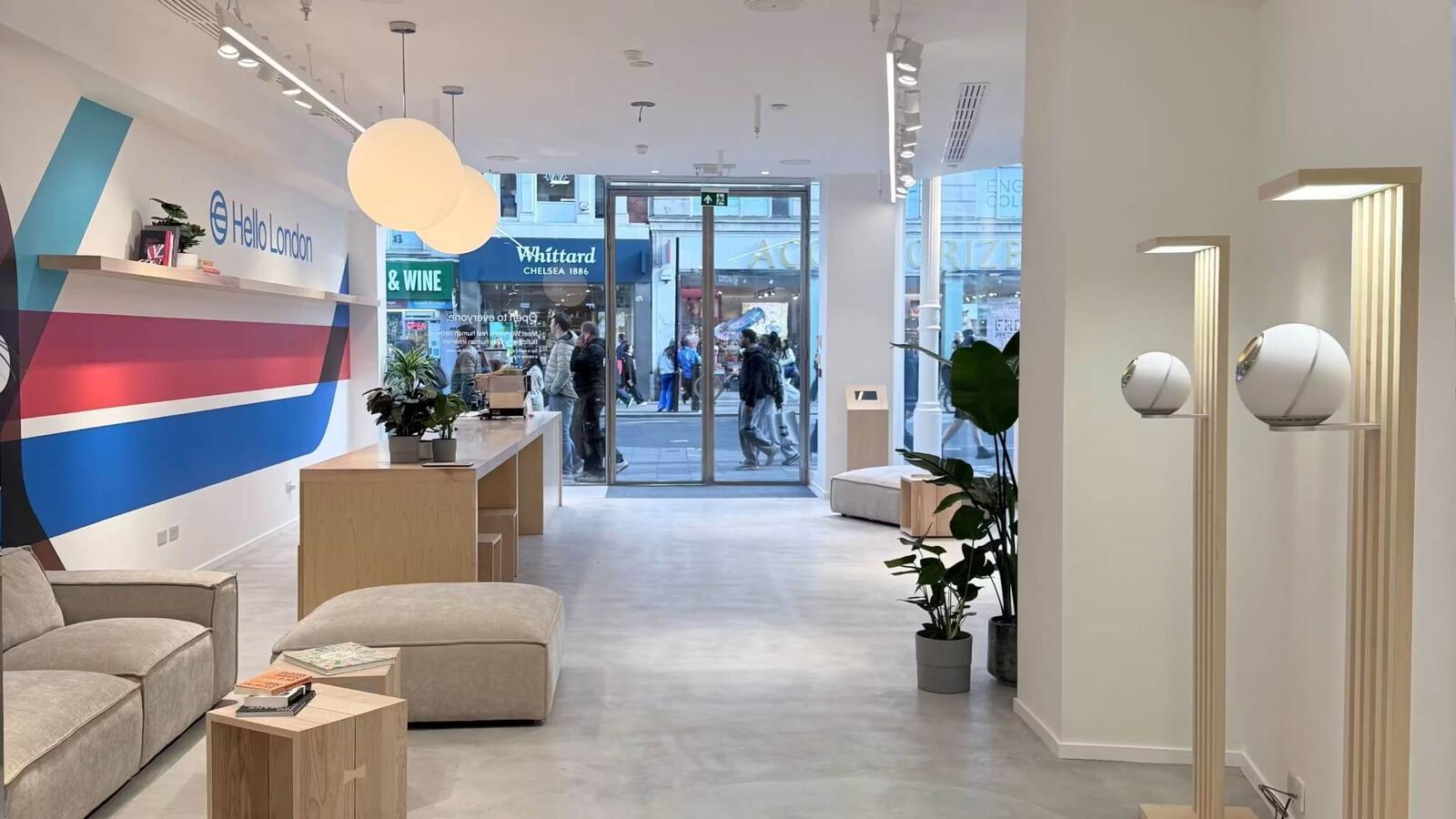
World has officially opened its new flagship location at 48 Oxford Street, marking the company’s sixth permanent retail space worldwide and bringing its proof-of-human technology to one of the world’s busiest shopping destinations.
The London opening follows previous flagship launches in San Francisco, Rome, Lisbon, Munich, and Seoul, and comes as conversations around AI, digital identity, and online trust are moving from the tech industry into the mainstream.
Unlike a traditional retail store, the flagship serves as an interactive space where visitors can learn about World’s technology, verify their World ID using the company’s Orb device, and explore how proof of human could play a growing role in the AI era.
The timing is significant. As generative AI becomes increasingly capable of creating realistic content, impersonating people, and carrying out complex online tasks, distinguishing between humans and automated systems is becoming one of the internet’s biggest challenges. Recent industry reports show that automated traffic now accounts for more than half of activity across much of the web, while businesses are facing a sharp increase in AI-powered fraud, impersonation, and large-scale bot attacks.
More from News
- Tango Turns Live Communities Into a Force For Breast Cancer Research
- Two Thirds of Brits Are Telling AI Chatbots Their Secrets But Don’t Trust The Companies Behind Them
- Video Game Companies Are Abandoning “Buy Our Console To Play This” – Here’s Why
- UK Gambling Operators Face New Deposit Limit Rules From 30 September
- How A Ransomware Gang Hijacked A Rival Gang’s Website – And Is Now Extorting Them For “2.333% Of Their Net Worth
- Meta Promised Unmatched Privacy For Muse – So How Did Researchers Crack It So Quickly?
- Digital Avatars Are Bringing Deceased Artists Back To The Stage – Where Do We Draw The Line?
- Can Europe Solve Its Critical Minerals Problem Fast Enough To Support Its Tech Ambitions?
World’s technology is designed to address that challenge by allowing people to prove they are a unique human without revealing their identity. Rather than collecting personal information, the system relies on privacy-preserving cryptography to verify “humanness,” creating a trust layer that applications and online services can use to distinguish real people from automated accounts.
The flagship opening also reflects World’s broader expansion beyond identity verification. Earlier this summer, the company expanded access to AgentKit, a developer framework that allows AI agents to securely act on behalf of verified users. The system enables websites to confirm that an AI agent represents a real person while maintaining user privacy, a capability that could become increasingly important as AI assistants begin handling tasks such as online shopping, booking reservations, and accessing digital services.
That technology is already being explored for use cases ranging from ticket sales and e-commerce to financial services, where businesses need ways to prevent automated abuse without blocking legitimate AI-powered assistants.
Oxford Street, which attracts millions of visitors each year, provides World with one of its most visible locations to date. The company says the new flagship is intended to introduce proof of human to a broader public audience at a time when AI is rapidly reshaping how people interact online.
As AI becomes more deeply integrated into everyday life, the challenge is no longer simply building smarter systems – it’s making it possible to distinguish when those systems are acting on behalf of real people. With its London flagship now open, World is betting that proof of human will become a fundamental part of the internet’s next chapter.


