


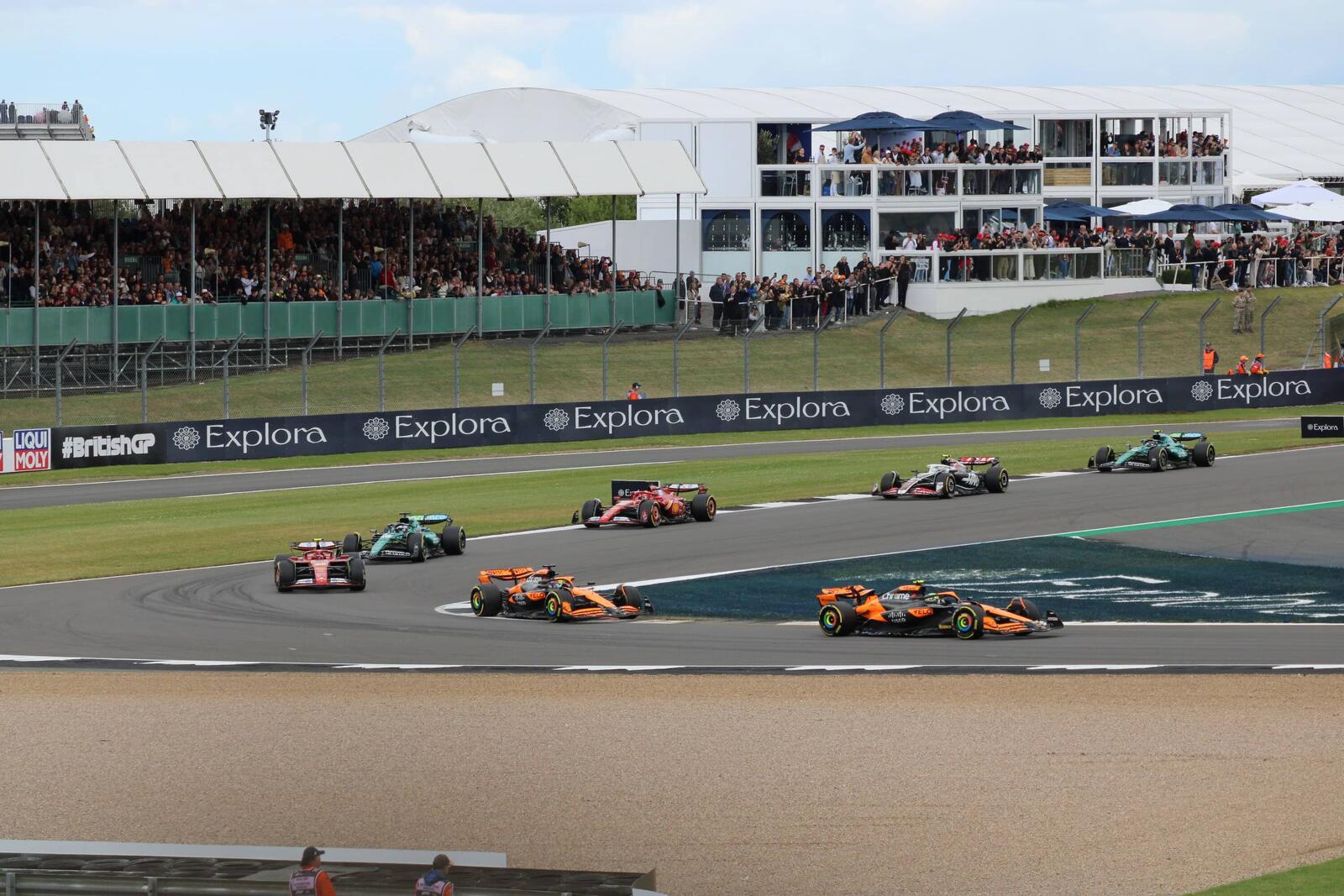
An F1 car from 1950 and one from 2026 would barely look like they belong to the same sport. The earliest championship cars relied on front-mounted engines, mechanical grip and pretty simple bodywork, while today’s machines combine turbo-hybrid power, carbon-fibre construction, complex aerodynamics and huge amounts of electrical energy.
That transformation happened gradually as teams found new ways to make their cars faster, lighter and more efficient. Engines moved behind the driver, wings turned airflow into downforce, carbon fibre changed chassis construction and hybrid systems made energy recovery part of the race strategy. Across each generation, new technology has changed what an F1 car needs to do to find performance.
Why F1 Cars Have Changed So Much
F1’s technical regulations have constantly been rewritten since 1950, affecting everything from engine capacity and aerodynamics to chassis construction and energy recovery. Every major change gives teams a new technical puzzle to solve, while successful innovations can influence the rules that follow.
That creates a constant cycle of development; teams searching for performance within the regulations, while the FIA adjusts those regulations when certain technologies become too effective, expensive or unsuitable. Some ideas disappear completely, while others become fundamental to the next generation of cars.
It’s really less a straight line of progress and more a very expensive game of “what if we tried this?”
The Technology Behind F1’s Evolution
Engine technology moved from supercharged units to naturally aspirated V10s and V8s before arriving at today’s turbo-hybrid power units. Aerodynamics went from being quite irrelevant to becoming one of the biggest factors in how an F1 car generates performance.
Materials changed too, with carbon fibre eventually becoming central to chassis construction and driver protection. Electronics and data also transformed how teams develop and operate their cars, giving engineers increasingly detailed information about what is happening on track.
Modern F1 cars now effectively combine these revolutions all at once, with the engine, aerodynamics, materials and electronics all working as part of one highly integrated machine.
More from Tech
- Antivirus vs The Smart Home: Can It Protect IoT Devices?
- Building It Twice: How Digital Twins Are Changing Construction And Management
- What Role Does Tech Play In Solving Criminal Investigations?
- How Does The FIA Police Race Technology To Keep F1 Competition Fair?
- Technology Is Making Counterfeit Products Both Easier To Make And Easier To Detect
- How Tech Shaped The Design of Mclaren’s F1 Technology Centre
- Behind Arsenal’s Applied AI Experiment – Automating Analysis Without Replacing The Coaches
- The £629 Million Reason You Need Antivirus Software
1. 1950s: The Early F1 Cars
When the first F1 World Championship began in 1950, the cars were a very different breed. According to Formula 1’s history of the Alfa Romeo 158, the regulations allowed either 1.5-litre supercharged or 4.5-litre naturally aspirated engines. Alfa Romeo’s 158 used a 1.5-litre supercharged straight-eight mounted ahead of the driver and had actually been designed before the Second World War. It was still competitive enough for Giuseppe Farina to take the first World Championship title.
Performance at this point was largely about the engine, chassis and mechanical grip. Aerodynamics had yet to become a dominant part of F1 car design and there was nothing resembling the energy recovery systems or electronic controls that are found in today’s cars.
2. 1960s–1970s: Rear Engines And Aerodynamics
The Cooper team helped overturn the traditional front-engine layout by placing the engine behind the driver. Jack Brabham won the 1959 and 1960 World Championships with rear-engined Coopers, while the 1960 Italian Grand Prix became the last World Championship race won by a front-engined car. From there, the rear-engine layout became the foundation for the modern F1 car.
Aerodynamics then started to play a much bigger role – wings began appearing on F1 cars in the late 1960s, giving teams another way to generate downforce rather than relying mainly on mechanical grip. Lotus took things a step further with the Lotus 78 in 1977, using the shape of the car’s underside to create low pressure and pull it closer to the track. Formula 1 describes the Lotus 78 as the car that ushered F1 into the ground-effect era, while the Lotus 79 refined the idea and helped Mario Andretti win the 1978 World Championship. F1 had discovered that air could be just as useful as horsepower.
3. Late 1970s–1980s: Turbo Power And Carbon Fibre
Renault introduced turbocharging to F1 with the RS01 at the 1977 British Grand Prix. Formula 1 identifies the Renault as the first turbocharged F1 car, and the technology eventually became one of the defining features of the 1980s. Turbo engines could produce huge amounts of power, but their development also brought new challenges around reliability, fuel consumption and heat.
The same period brought a major change in chassis construction. McLaren’s MP4/1, introduced in 1981, was the first F1 car to use a carbon-fibre monocoque, which changed how teams approached chassis design. Electronics were also beginning to become more prominent, with Ferrari introducing a semi-automatic gearbox in 1989 that allowed drivers to change gear using paddles while keeping their hands on the steering wheel.
4. 1990s–2000s: The Electronic Era
By the 1990s, computers and electronics were becoming a really important part of F1 car development. Active suspension was one of the standout technologies, with Williams’ FW14B using the system in 1992 to control ride height and help maintain the car’s aerodynamic performance. Formula 1 notes that the technology, alongside systems including traction control, helped Williams win 10 of 16 races and both championships that year.
Other electronic driver aids, including traction control and anti-lock brakes, also appeared before being banned alongside active suspension for 1994. Telemetry and computer-assisted development continued regardless, giving teams a lot more information about how their cars were behaving. The car was becoming something engineers could measure, model and adjust in increasingly precise ways, rather than relying mainly on mechanical changes.
5. 2014–2021: The Hybrid Revolution
In 2014, F1 replaced its 2.4-litre naturally aspirated V8s with 1.6-litre turbocharged V6 hybrid power units. The change was about more than reducing engine size. The MGU-K recovered kinetic energy under braking, while the MGU-H recovered energy from the turbocharger, turning energy recovery into an important part of the car’s performance.
Formula 1 describes the 2014 rules as a major overhaul of F1’s power units, with the hybrid system making energy recovery a central part of performance. Drivers and engineers had to think about how energy was harvested, stored and deployed across a lap, alongside fuel consumption and the combustion engine itself. F1 had effectively moved from asking how powerful an engine could be to asking how efficiently an entire power system could produce performance.
6. 2022–Present: Ground Effect and Active Aerodynamics
Ground-effect aerodynamics returned in 2022, with the cars using shaped Venturi tunnels in the floor to generate a lot of their downforce. Formula 1 explains that the new regulations were designed to make it easier for cars to follow one another by reducing the aerodynamic disruption experienced behind another car. It brought back an idea from the late 1970s, although in a very different regulatory environment.
The 2026 generation then changes the aerodynamic approach again. The FIA says the cars use active front and rear wings that can switch between a higher-downforce configuration for corners and a lower-drag configuration on straights. The new power units still have the 1.6-litre V6 but remove the MGU-H and increase the maximum electrical power of the ERS-K to 350kW.
What Does The Future Of F1 Technology Look Like?
F1’s history shows that future technological changes will come from the same cycle that has shaped the sport for decades.
New regulations create boundaries, engineers find ways to work within them and successful ideas eventually influence what those boundaries look like next.


