


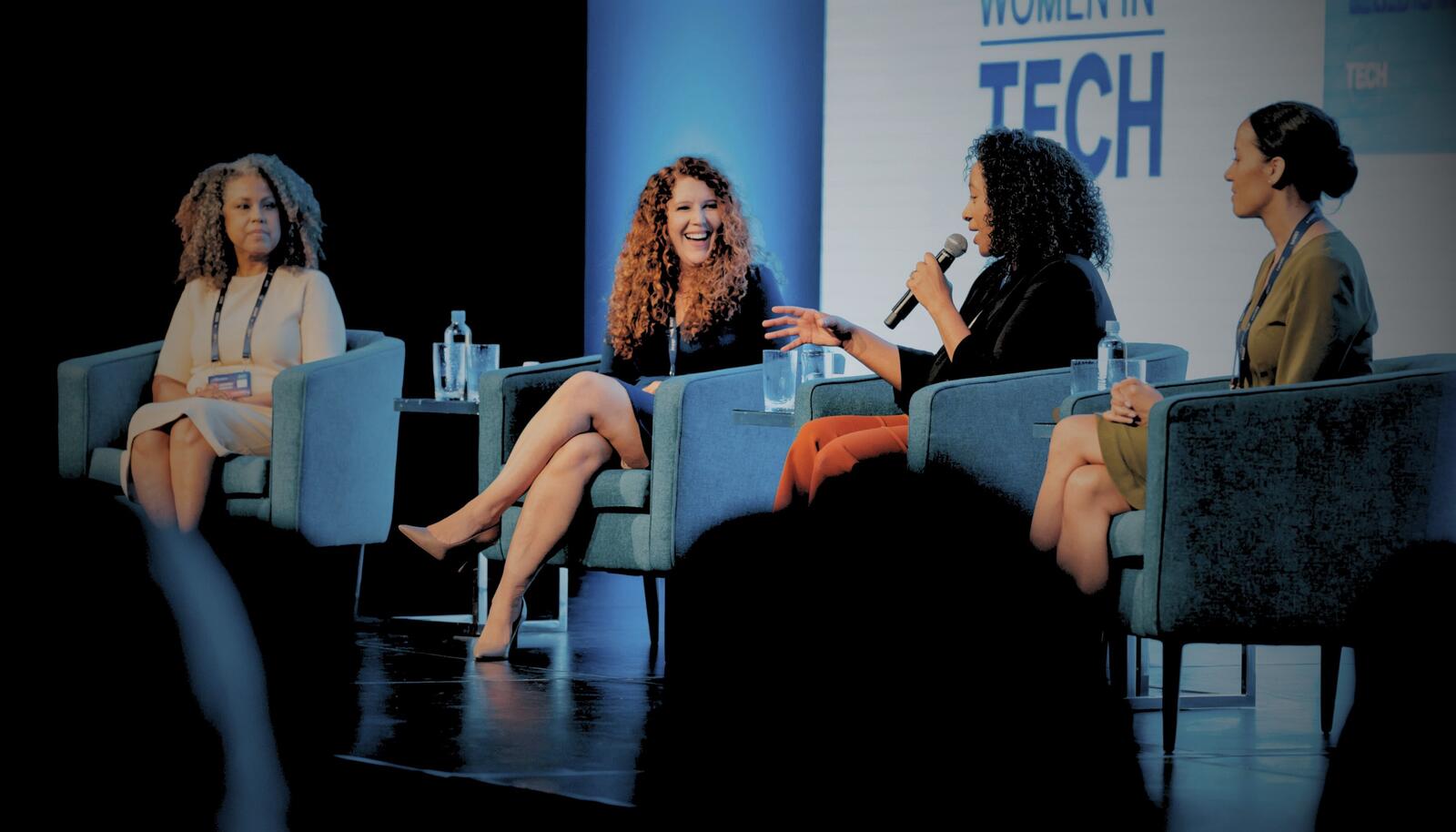
As Women In Tech Week unfolds from 12 to 16 October, the conversation centres on some pressing industry challenges. Key themes on the agenda include halting the tech talent exit, boosting career progression and examining the disparities in artificial intelligence adoption.
AI has evolved into an essential skill in the technology sector. Generative tools are now baked into daily tasks like drafting, analysis, coding and research, prompting the UK government to partner directly with tech firms to upskill the workforce.
Research suggests women are using these tools less often than men. A Harvard Business School working paper by Otis, Delecourt, Cranney and Koning, first released as a preprint in 2024, brings together 18 studies covering more than 140,000 people. The school’s AI Institute describes the findings as women being about 20% less likely to engage directly with generative AI.
Different industries adopt AI at different paces too. A 2025 JAMA Health Forum analysis of US Census Bureau business survey data found healthcare slower to adopt AI than sectors such as finance, education or information services. Where healthcare organisations have applied it to well-defined workflows, though, a Bessemer Venture Partners and Bain scorecard of 226 executives found average returns of 3.5 times the investment, typically within about 12 months.
The dynamic intersects with an industry still struggling to retain female talent. Research published by Akamai in April 2026 highlights deep retention hurdles in the sector. It found that 55% leave tech roles or tech companies within five years and 87% within 10 years, with progression among the factors cited. Meanwhile, the 2025 Lovelace Report estimates that up to 60,000 women left tech roles over the course of just one year.
Why Women’s AI Use Matters For Progression And Retention
Simply having access to technology fails to explain the disparity. Even in a controlled experiment in Kenya where resources and instructions were identical, women were approximately 13% less likely to test out ChatGPT. Furthermore, in the majority of 18 reviewed studies, female AI adoption trailed male adoption by margins ranging from 10% to 40%.
Researchers point to lower self-assessed familiarity and concerns about privacy, trust and risk, as well as a fear that using AI will be judged as cheating or as a sign of reduced expertise. The healthcare findings add another angle to the discussion. Slower tool adoption hasn’t stopped strong returns where AI is integrated, which suggests usage rates alone say little about how well the tools are working.
The researchers also warn of a feedback loop. If women contribute less to the data these systems learn from, AI could reinforce existing bias and unequal economic outcomes. With employers competing in the race for AI talent, a difference in who builds AI fluency early could shape who gets visibility and progression, and who decides to stay.
We asked leaders, founders and specialists from across tech, business and education: why are fewer women using AI at work, and how could that difference in adoption affect women’s career progression and their decisions to stay in or leave tech?
More from Tech
- Same Car, Different Driver: The Tech Behind F1’s Custom Set-Ups
- From Web3 Hype To Commercial Advantage: How The Next Phase Of Emerging Technology Will Be Won
- Who Controls The Thermal Skies? The Security And Privacy Questions Behind SatVu’s New Satellite
- The Drone Technology Helping Farmers Cover More Ground In Less Time
- F1’s Pitlane Has Its Own Race, And Technology Is Driving It
- Top Deep-Tech Startups In Finland To Watch In 2027
- Are VoIP Calls Secure? Let’s Talk About Who Could Be Listening
- The Tech That Shapes F1 Car Performance From Circuit to Circuit
Our Experts:
- Paula Mantle, VP of Communications and Transformation, Branch
- Petra Wilton, Director of Policy and External Affairs, Chartered Management Institute (CMI)
- Osnat Lidor, Owner, Demand Gen Studio
- Zarah Khondoker, Co-Founder, Khora Health
- Karen Smetana, VP, Product Management, Neurologyca
- Sonia Dorais, CEO, Chaser
- Tabitha Jean Naylor, Owner, TabithaNaylor.com Inc.
- Ed Fidoe, CEO, LIS
- Olga Kokhan, CEO, Tinkogroup
- Kimberly Ray, Co-Founder, Narracomm
- Aisha Srivastava, Founder, Aelios Co.
Paula Mantle, VP of Communications and Transformation, Branch

“Women aren’t less interested in AI or less willing to embrace it. I think we need to look at what we’re asking people to do to keep up.
“I remember coming back from maternity leave and feeling like three or six months in tech meant coming back into a completely different environment. Now imagine that pace of change with AI. Women are often balancing careers with childcare, ageing parents and other responsibilities. If learning AI requires hours of experimentation after work, who’s actually going to have that time?
“At Branch, AI learning is intentional. We’ve rolled out tools across the company, encouraged a blocked hour a week, offered hands-on training, office hours, guided things to try and community learning. People need the space to experiment and figure out what’s possible for their own work, at work.
“My concern is that the people who have the most time to experiment outside of work will be seen as the people with the most potential. That affects who gets opportunities to advance. If women feel they can’t keep up without sacrificing more of their lives outside work, we’re going to miss out on talented people harnessing impactful technology to its full capability.”
Petra Wilton, Director of Policy and External Affairs, Chartered Management Institute (CMI)

“The reality is that too many women are experimenting less with generative AI at work. CMI’s latest Ready to Lead research found that while half of men (50%) are actively using generative AI in their roles, only 37% of women are doing the same. At a time when AI fluency is rapidly becoming a core career benchmark, holding back from day-to-day adoption risks slowing women’s progression into management.
“Exploring emergent tech requires confidence. Our findings show that a third of managers already perceive young women as less confident when putting themselves forward, and 42% of young women say they do not know how to ask for a promotion. When professionals feel they need to completely master a tool before deploying it, informal trial-and-error stalls.
“Closing this gap requires moving beyond ad-hoc experimentation toward structured training and recognised professional accreditation. Formal accreditation provides an objective benchmark of competence, giving women the validated credibility and confidence to step forward and lead.
“Crucially, organisations must invest in programmes focused specifically on the management and leadership of AI adoption – not just technical prompt-writing. Navigating AI deployment requires strategic oversight, ethical governance, risk management and team communication. Equipping women to steer that adoption positions them at the centre of tech transformation. With 71% of young women aspiring to lead, pairing formal accreditation with AI leadership training provides the clear, safe framework needed to turn technical skills into sustained career progression.”
Osnat Lidor, Owner, Demand Gen Studio

“Women’s hesitance to use AI at work comes down to workplace positioning.
“Recent survey results revealed that half of women think using AI on the job is ‘cheating’. That fear gets amplified in tech, where women already feel they have to prove their competence twice over. Turning to automated tools triggers immediate worries about perception: Do they look like they’re taking the easy way out? Will their contributions be seen as less valuable? Are they making themselves look replaceable?
“Those fears are understandable, but they treat the technology like an end-to-end replacement rather than what it actually is: an operational lever.
“Working with AI isn’t about having software do your entire job. The value is stripping away manual friction and administrative drag so you can operate at a higher level. Using software to handle routine research and first drafts buys back time to focus on strategic systems, high-empathy leadership and actual business judgement. That’s the work algorithms can’t replicate.
“When female professionals hold back out of concern over appearances, they stay trapped in low-leverage execution while male peers use the tech as leverage to step into strategic roles. That divide is what stalls careers and drives women out of tech. Using AI is not cutting corners. It is how you clear out the busywork so you can lead.”
Zarah Khondoker, Co-Founder, Khora Health

“I think women have seen the rise of ‘AI-pilled’ tech bros not only in the companies they work at, but also in the companies now being created in Silicon Valley. There’s been a movement to push back against this, because women are naturally more cautious about its dangers and what it could become. This genuinely serves as a double-edged sword because if someone isn’t adapting to the ‘newest technologies’, companies equate this to ‘you’re not qualified for the job’.
“In any company, there are important decisions only women can make or would think of; and if we don’t have enough women in those positions of power, we’re limiting our ability to make a change in these spaces. It should be even more of a reason to use AI as an equaliser and enter these spaces so we have an equal say in the future we’re creating. We’re living in an era where ‘software is eating the world’, and we need every single person involved if we want to use AI for good, design guardrails and actually design a sustainable future.”
Karen Smetana, VP, Product Management, Neurologyca

“Women aren’t using AI less because they can’t. From what I’ve seen, it comes down to three things: risk, permission and time.
“Risk. Many women I work with are in jobs where a mistake is easy to see and hard to fix. If the AI gets it wrong, it’s their name on it. Caution is a rational choice, not a lack of confidence.
“Permission. A lot of companies still haven’t said what’s okay. When the rules are fuzzy, people who already feel watched tend to hold back.
“Time. Getting good at AI takes practice, and that time has to come from somewhere.
“The cost is real. Using AI well is becoming part of how people are judged at work. Start later, and you can look slower rather than more thoughtful, and that shows up at promotion time. And when you feel passed over for being careful, it’s easy to decide this industry isn’t built for you. That’s how small gaps turn into women leaving.
“But careful use pays off. In my work on emotion AI, we don’t ship anything until we’ve tested it and understand what the person on the other end gets from it. It’s slower at the start, but the results hold up, and customers trust them faster.
“The fix is simple. Make the rules clear. Give people time to learn. And reward good judgement about when not to use AI, not just how often people do.”
Sonia Dorais, CEO, Chaser

“I don’t think lower AI adoption by women should be read as a lack of interest or confidence. People are more likely to use tools when they have clear guidance, time to experiment and a workplace where it feels safe to ask questions or get something wrong. If access to those things is uneven, adoption will be too.
“That matters because AI can help people move beyond repetitive work and spend more time on analysis, problem-solving and decisions. If some employees get more opportunity to build those skills and demonstrate that impact, while others are left out, the gap could affect who gets noticed and progresses. Over time, feeling excluded from the tools shaping a role could also make people question whether they have a future in that workplace or in tech.
“In our work at Chaser, we use AI to help businesses make better sense of payment behaviour and decide when to chase customers. The value isn’t simply using AI more; it’s applying it to a clear problem and keeping people involved in decisions that need judgement. Employers should give everyone practical opportunities to try AI, explain its limits and recognise the skills people build. That makes adoption more useful and more inclusive.”
Tabitha Jean Naylor, Owner, TabithaNaylor.com Inc.

“I’d like to push back on the framing a little. I don’t think the gap is about confidence or skill. I think it’s about how AI gets introduced.
“Most people are handed a tool and told to ‘go use it’. Nobody starts with the actual problem.
“My work has always gone the other way. I’m a fractional marketing leader with 20+ years in demand generation and lifecycle systems, including in financial services and healthcare, where cautious is the default. I start with the business problem, not the software. I’m far more interested in what a system accomplishes than how impressive it sounds.
“That’s also where AI works best. It adds speed and consistency, and it can respond when a human can’t, like following up on a form someone filled out three days ago. It still needs strategy, judgement and a clear read on the customer. AI can do a lot. It cannot care. That part still belongs to us.
“So if women are using it less in cautious, high-stakes sectors, I’d read that as judgement, not hesitation. The risk is that ‘less’ gets mistaken for ‘behind’. Careers get shaped by who decides where AI belongs, not by who logs in the most.
“One limitation: I can’t point to gender-split data. This comes from my own work, not a study.
“The takeaway: adoption isn’t the goal. Better decisions are.”
Ed Fidoe, CEO, LIS

“An AI adoption gap can start as a training gap. LIS polling from May 2026 found that 26% of women felt unprepared for the future workplace because their institution had not taught them to use AI properly, compared with 23% of men. Just 39% of respondents said their academic institution allowed or encouraged responsible AI use during assessments.
“These findings don’t measure workplace adoption, but they raise important questions about how prepared people are to use AI professionally. It would also be a mistake to assume women are less interested in AI. Our polling found that 19% of women said they relied on AI so heavily that they would struggle to complete their education without it, compared with 16% of men.
“In technology, unclear expectations around AI can make experimentation feel risky, particularly where accuracy and accountability matter. If employers reward those who use AI most visibly, rather than those who use it effectively, differences in training and opportunity could translate into differences in career progression.
“Over time, being overlooked for AI-focused projects or promotions could become another factor influencing women’s decisions to remain in technology.
“The priority should be giving everyone access to practical AI training, clear guidance and opportunities to develop these skills. Particularly in higher-stakes sectors, knowing when to question an AI-generated output is just as valuable as knowing how to produce one.”
Olga Kokhan, CEO, Tinkogroup

“A reason some women may be slower to adopt AI at work is that using a new tool feels like an added risk when you already have to prove your expertise. If you’re worried about mistakes or being judged for using AI, it feels safer to stick with what you know. But the bigger problem is whether people can obtain useful guidance and whether they feel comfortable trying things out.
“In my own work I used AI for brainstorming, drafting and summarising reports as founder and CEO of Tinkogroup. AI tools can also help us with research and checking facts in our work. The main difference is that artificial intelligence can speed up parts of the process, but it doesn’t take away the need for human judgement. There is a need to verify information, understand context and evaluate the final output. It can affect career progression if some employees can use these tools to explore ideas faster, do less repetitive work and take on more complex work, but others don’t have the same opportunity to learn. That gap could affect confidence and access to new responsibilities over time.
“The conclusion is not to encourage women to use AI more, unsupported. I’d like it to be about democratising experimentation, providing practical training and a culture that encourages asking questions about AI. AI should help people do what they are already doing better, not make them feel they have to justify their existence by using every new tool that comes along.”
Kimberly Ray, Co-Founder, Narracomm

“The more individuals are concerned about the societal risks of AI, the less likely they are to use AI. Women are proving more concerned about the societal risks than men, which explains their reticence to adopt the new technology. They could currently be experiencing more severe punishments than their male colleagues when they are caught using non-permitted AI apps in the workplace.
“It is likely this delay in adopting AI technology will hurt the career prospects for many women as AI tools become a requirement in the workplace.”
Aisha Srivastava, Founder, Aelios Co.

“I’m a young female entrepreneur, with 3+ years starting my own marketing agency called Aelios Co. in Hong Kong. I’m closely affiliated with a number of locally based groups, particularly tailored towards women entrepreneurs.
“Personally, I’ve noticed that the younger generation of women are increasingly empathetic towards the fact that AI is causing harm in the world; particularly the environment, and causes the undervaluing on human-made art. On the other hand, older women are keen to move forward with AI, particularly when it comes to marketing materials. They understand that it does the job, but are not able to discern between when something is or is not AI.
“In my professional opinion, I’ve seen that across the board, a lot of women in these spaces give more weight to the negative impacts of AI than men do, which is probably the reason as to why less women use AI, even if it costs them their competitive advantage.”


