


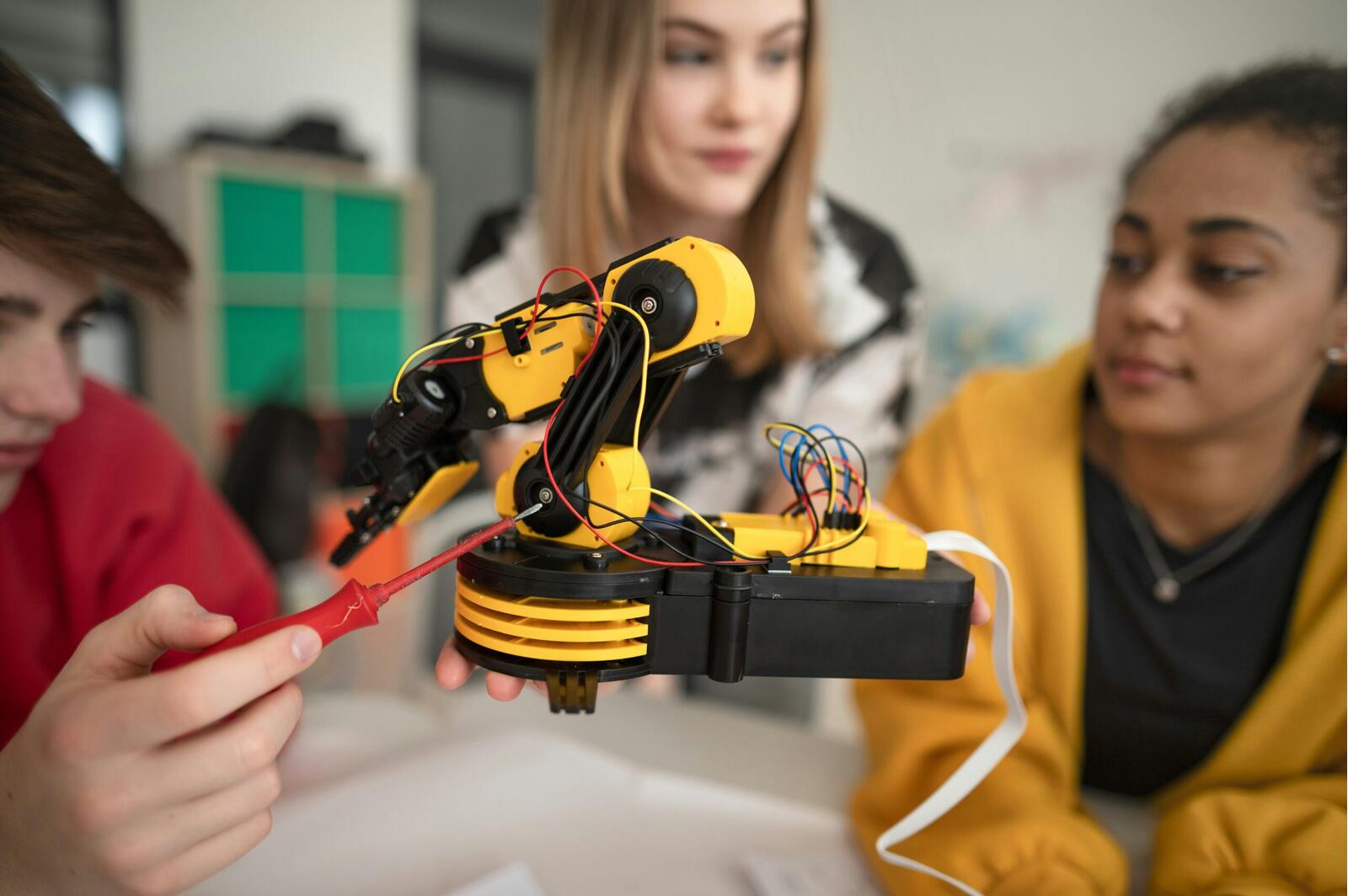
Researchers at the German Aerospace Centre just developed a system that lets robots detect the human touch without needing artificial skin to do so. Using 6 sensors, embedded within a robotic arm, that captures subtle pressure changes as a way to determine or sense exactly where and how humans would be interacting with it.
The system uses advanced algorithms to interpret these interactions for a direct way for robots to understand human commands directly from physical touch.
How Does This Improve Interactions Between Robots And Humans?
This new tech turns every part of the robot to a touch responsive surface, where humans can directly interact using the robot itself as the ‘interface’, the way a touch screen works, for example.
This then takes away a need for external devices to command and interact with robots. The elimination of the ‘middle-man’ makes for a smoother and more intuitive communication process.
“Human-robot interaction, where a human can closely interact with and command a robot, is still not optimal, because the human needs an input device. If you can use the robot itself as a device, the interactions will be more fluid,” says lead author of this study, Maged Iskandar.
More from News
- I Woke Up To A Meta Account. When Did I Agree To That?
- Vidoser Launches AI-Powered Platform To Streamline Creator Marketing For Brands And Agencies
- Office Freedom Named Agency Of The Year And Deal Of The Year 2026
- A “Power Event” At Google Cloud’s London Region Affected Revolut And European Banks – What Happened?
- Anchor Launches Action Index, Cutting Computer-Use Agent Token Costs By 100X
- Anthropic Selects Build Circle As A UK Partner To Help Supercharge AI Realisation For Clients
- An OpenAI Engineer Is Charged Over A $14 Recording Device – What Does It Say About Security At AI Labs?
- Mhance Acquires CPS And City Dynamics To Strengthen Its Copilot, Modern Work And Business Solutions Capabilities
Where Can This Be Used?
Introducing this new system is especially useful for industries such as manufacturing, where a robot is an important part of the production process. The tech is software reliant, as opposed to hardware and this makes for a more efficient and economical way to upgrade the system when needed. Also, with the industry seeing a rise of humanoid robots being invested in, this is an inviting opportunity for such fields.
Also, users can perform actions such as drawing characters, or pressing virtual buttons directly on the robot’s surface for better ease of use. Although currently, the version developed is limited to only 2 contact points being recognised, which makes it difficult to work in more complex interaction cases, this is still a great innovation.
MIT shared, “In a fairly controlled setting like a factory floor that might not be an issue, but in environments where human-robot interactions are less predictable, it could present limitations.” As time goes, the development will continue to become more complex. The sensors are also relatively pricey due to it still being rare.
What Will We See From This Technology?
From here, we might start to see a combination of joint-based sensors and artificial skin tech, as Calogero Maria Oddo, a lead roboticist for Neuro-Robotic Touch Laboratory at the BioRobotics Institute believes.
Perhaps, they will even begin to look into more cost-effective solutions so that this technology can be adapted widely and across industries.
Human-Like Skin And Robots
In other news, a different and unusual development has been made by the University of Tokyo as it relates to senses and robots. Scientists have began exploring the use of lab-grown, living skin on robots. This is to enhance robots’ appearance to look more human-like, with the skin having self-healing properties.
This could mean we’d start to see robots that are longer-lasting and realistic when it comes to mimicking human expressions, and interacting in a more natural way within different environments.


