


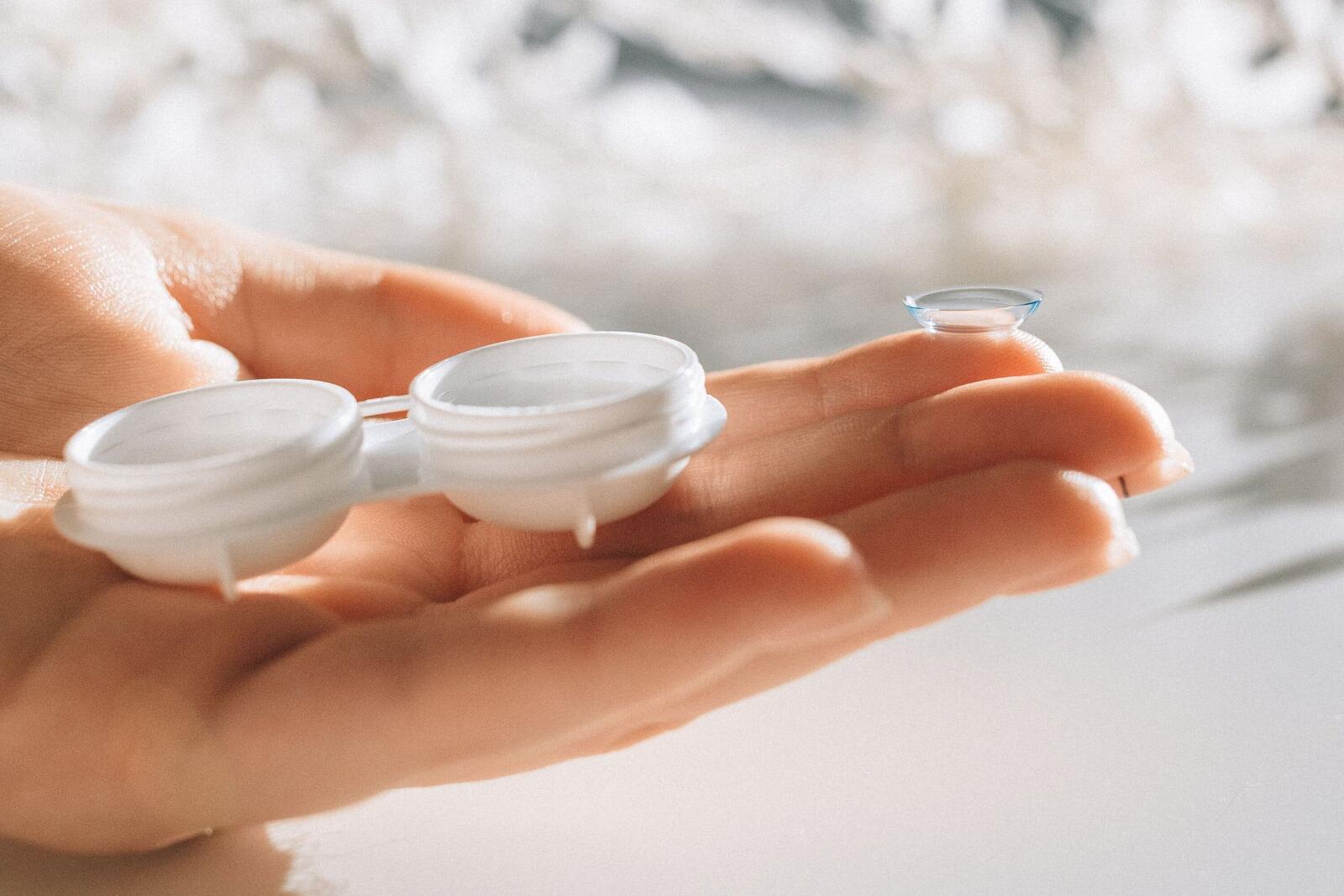
A contact lens is about 14 millimetres across, sits on a delicate, constantly lubricated surface and gets blinked over thousands of times a day, which makes it a spot most engineers would cross off the list of places to put a computer. A handful of companies have read that list and carried on anyway, developing contact lens technologies involving sensors, tiny radios and, in a couple of cases, a screen.
Smartwatches have claimed the our wrists and smart glasses are still fighting for the face, so the eyeball is about the last piece of the head that nobody has tried to sell a subscription for – just yet. Now, companies are trying to turn contact lenses into everything from tiny health monitors to miniature screens, which raises the slightly ridiculous prospect of checking your messages by blinking.
A Contact Lens With A Day Job
Ordinary lenses bend light so you can read a road sign; smart ones add a layer of miniature electronics on top, which can mean sensors, a chip, an antenna and, in some designs, a display. Plenty of headlines treat these as one gadget when they’re really two different families: one reads information about your body while the other puts information in front of your eye.
That split decides how close each type is to real life, because a lens that measures something in your tears faces a different set of challenges from one that has to show readable text on a surface pressed against your eyeball.
Your Tears Have Been Holding Out On You
Tears contain glucose, lactate and a whole menu of other biological markers, which is why researchers keep trying to turn a contact lens into a tiny lab bench. XPANCEO showed a health-monitoring prototype at VivaTech in Paris in June 2026 that uses an electrochemical sensor to detect selected biomarkers in tear fluid and sends the readings to a phone in real time, according to the company.
There’s already an electronic contact lens with FDA marketing authorisation, although it does something different. In 2016 the FDA allowed marketing of Triggerfish, a single-use lens from the Swiss company Sensimed, that detects changes in the eye’s dimensions associated with fluctuations in eye pressure over a period of up to 24 hours. According to the FDA, the device helps clinicians identify the best time of day to measure a patient’s eye pressure. It sends its data to an adhesive antenna worn around the eye, so it’s a contact lens that comes with a sticker for your face. It doesn’t directly measure eye pressure or diagnose glaucoma, but it can help clinicians identify patterns in pressure changes throughout the day.
Glucose is where the technology has run into problems; Google announced a glucose-tracking lens back in 2014, but its life sciences division, Verily, put the project on hold in 2018 after clinical studies found that tear glucose readings weren’t consistent enough to reliably indicate blood glucose levels.
More from Tech
- Women In Tech: Top 6 Women In E-Commerce In 2026
- How Does A Clipping Agency Scale Reach Without Losing Control?
- The Tech Behind F1 Driver Training And Its Role Among Elite Athletes
- The Technology Behind F1’s Most Iconic Liveries
- Could You Actually Taste A Product Before Buying It Online?
- Women In Tech: Top 8 Women In Proptech In 2026
- The Battle Between Car Theft Technology And Anti-Theft Innovation
- The Technology Changing How Football Finds Its Next Stars
Augmented Reality Without The Glasses
The display side is where the engineering gets a little silly. A lens has very little room for a battery, so XPANCEO has been exploring wireless power alongside miniature displays. The company has demonstrated an optical system that allows users to view an image from a microdisplay held close to the eye, rather than showing a finished display integrated into a wearable contact lens.
The pitch is directions floating in your vision while you walk, translations appearing under a menu and messages that show up without you reaching for a phone. That would at least solve the problem of walking into lampposts while staring at a maps app (a win is a win am I right?).
Notifications You Can’t Flip Face Down
One attraction of a contact lens is how discreet it could be. There’s no headset on show and no glasses with a camera that makes people at the pub uneasy; there are just eyes that look like eyes. However, the wearer can’t hide from it either, because a phone can go in a pocket and a smartwatch can be switched off, while a notification on your eyeball is hard to ignore in the most literal sense.
Some people will love having information appear without lifting a finger. Others might decide they prefer their technology somewhere they can put it down, which is a perfectly reasonable position to take about a computer you’d be wearing under your eyelids.
The Companies Betting On Your Eyeballs
XPANCEO, based in Dubai, is one of the companies making the most visible progress, with more than 28 prototypes behind it, according to the company. It says its first fully integrated lens, combining a display, health sensors and wireless power, will be demonstrated publicly in early 2027. It has also partnered with the lens-material manufacturer Contamac to work on integrating its technology into contact lenses.
Mojo Vision is the cautionary tale. After years of showing off a lens with a display at tech conferences, it announced in January 2023 that it was shifting its focus towards the micro-LED screens developed for the project. The company had demonstrated a feature-complete prototype in 2022 and its CEO had personally worn and tested it. According to CEO Drew Perkins, however, difficulties securing further investment meant development of the lens had to be scaled back and around 75% of its workforce was also cut as part of the change.
InWith, a California company, showed its electronic soft contact lens platform at CES 2022, demonstrating stretchable circuitry designed to be incorporated into soft contact lens materials. According to the company, the technology was intended to support future augmented vision applications, but the demonstration was not a finished contact lens with a working digital display.
What’s Still Standing Between Lenses And Your Eyes
According to the College of Optometrists, no fully integrated smart lens is currently available for mainstream clinical practice. So basically, the impressive in a demo video isn’t something you can actually pick up at your local optician just yet. The list of problems is long; the electronics need a safe power source that doesn’t generate uncomfortable heat, the lens still has to let oxygen reach the cornea and it has to stay comfortable at hour nine of a working day when ordinary lenses already start to feel like sandpaper.
A lens that reads your tears or shows you private messages also collects a lot about you, which raises the matter of who gets to see it. Nobody has announced an established consumer price for these devices either, so whether they’d cost about the same as daily disposables or closer to a smartwatch is anyone’s guess (something tells me these won’t be making it into the monthly toiletries budget).
Medical Uses Are Closer Than Screens In Your Eye
Health monitoring looks like one of the more immediate applications for smart lenses, because detecting biological markers or monitoring changes in the eye doesn’t require the same display technology as projecting a sharp image into someone’s field of vision. Triggerfish already shows that an electronic contact lens can be used for a specific type of medical monitoring, while newer projects are exploring what else sensors in a lens could detect.
Whether people want a computer sitting under their eyelids is something no prototype can answer. It’ll come down to how comfortable the lenses are, who sees the data they collect and what the first pair costs.


