


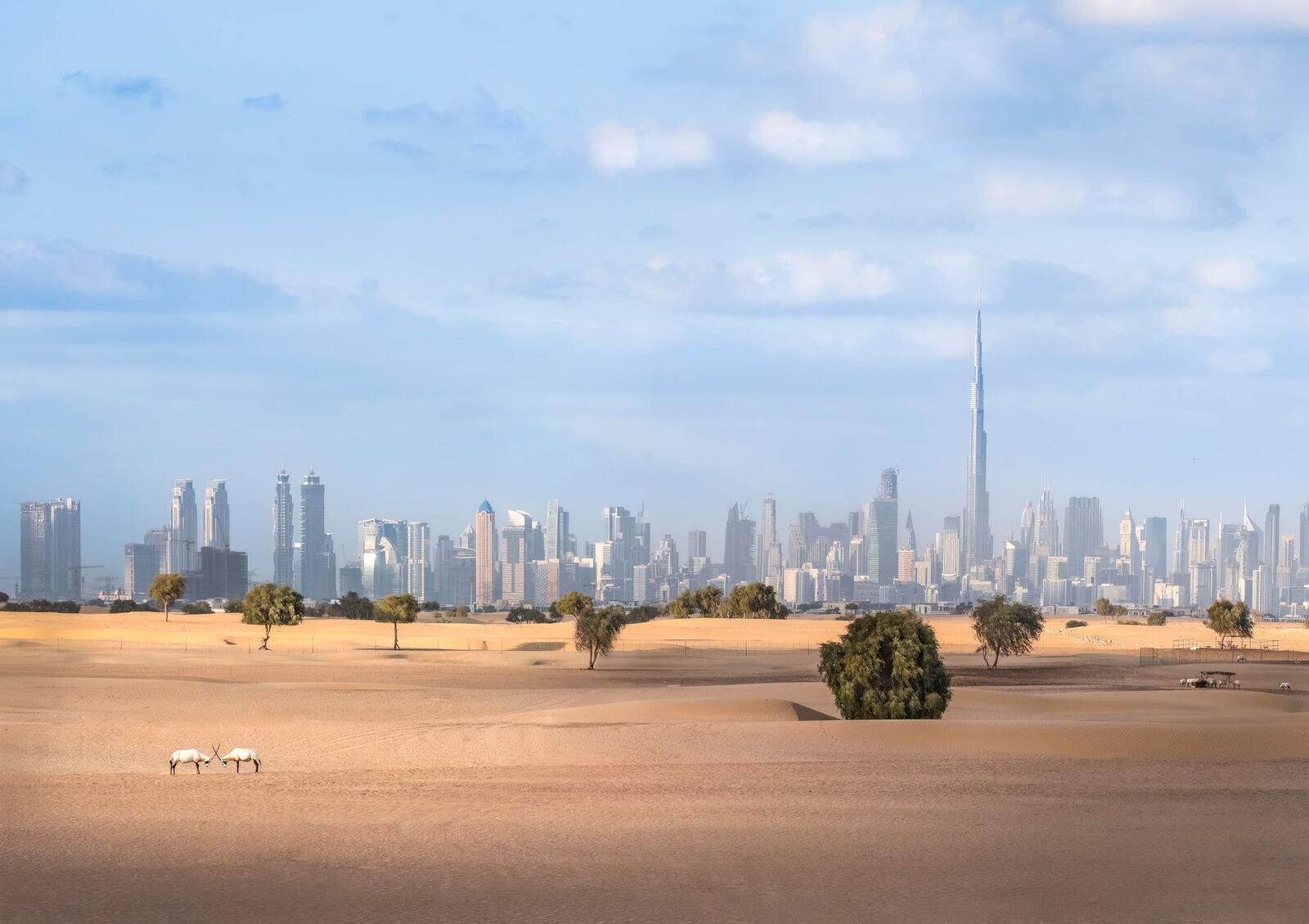
Summer temperatures in the UAE can approach 50°C (I mean at this point, even the sun has to be taking things personally). Desalination plays a major role in meeting the country’s water needs, and the government has committed to reaching net zero by 2050. These conditions have created a massive demand for technology that tackles problems ranging from extreme heat and water scarcity to industrial emissions.
Startups in the UAE are developing solutions across carbon accounting, desert agriculture, urban heat, recycling, water production, mangrove restoration and renewable energy. Their progress ranges from operating projects and commercial partnerships to technologies still being tested.
The UAE’s Climate Tech Push
The UAE has a few pressing reasons to invest in climate technology. Around 42% of the country’s water requirements are met by approximately 70 desalination plants, according to the UAE government. Extreme heat, water demand and industrial emissions create practical challenges that new technologies could help address.
Investment is helping support this work. Abu Dhabi’s state-owned energy company ADNOC has allocated an initial $15 billion (AED 55 billion) towards lower-carbon solutions, new energy sources and climate technologies. Meanwhile, Hub71, Abu Dhabi’s startup support hub, launched a ClimateTech programme at COP28 to help climate-focused startups develop and test their solutions. The programme received funding from ADNOC, Tabreed – a district cooling company and TAQA – an energy and utilities group.
Regulation is also developing; the Federal Decree-Law No. 11 of 2024 establishes a framework for addressing climate change and managing emissions. It doesn’t require every company to publish a sustainability report, but it adds to the regulatory context in which businesses are measuring and reducing their environmental impact.
More from Startups
- Startup of the Week: SnoreLab
- Columbia University: Successful Alumni That Founded Startups
- What Is Germany Doing To Attract More Startups?
- Are Hiring Challenges Preventing Startups From Reaching Their Full Potential?
- Meet The Startups Crowdfunding w/c 12.10.2026
- The Cold Start Problem: Why Getting A Startup Off The Ground Is So Difficult
- Founder Of The Week: Ryta Zasiekina
- Top Industrial Tech Startups To Watch In 2027
1. CarbonSifr
Founded in 2023, CarbonSifr uses AI to help businesses measure their greenhouse gas emissions and identify opportunities to reduce them. Its emissions database is tailored to the Gulf Cooperation Council (GCC), giving companies access to regional data for their calculations.
Aletihad reported in 2025 that more than 100 brands were using its platform. In January 2024, CarbonSifr also signed a memorandum of understanding with Mastercard to explore carbon measurement and climate-action initiatives for small businesses across the Middle East and North Africa.
2. HyveGeo
HyveGeo turns agricultural and forestry residues into biochar, a carbon-rich material produced by heating organic matter with limited oxygen. The company combines biochar with biological materials intended to improve soil conditions, including water retention and nutrient availability.
The technology targets agricultural waste and poor soil conditions in arid areas. CNN reported in 2025 that HyveGeo’s pilot had produced 200 tonnes of biochar and diverted 800 tonnes of waste from landfill. The company was also one of four winners of the UAE FoodTech Challenge announced in January 2026, sharing a US$2 million prize pool.
3. FortyGuard
FortyGuard develops technology that maps urban surface temperatures at a resolution of 10 by 10 metres. Its platform combines artificial intelligence, sensors and satellite data to help planners and developers identify areas affected by extreme heat.
A sun-exposed car park and a shaded pedestrian area can experience very different surface temperatures, even when they’re in the same neighbourhood. FortyGuard’s maps are designed to help decision-makers identify where cooling measures may be needed.
In February 2026, the company was recognised as the winner of the World’s Leading Sustainable Technology Initiative 2025 award from the World Sustainable Travel & Hospitality Awards.
4. Nadeera
Founded in 2021, Nadeera developed Yalla Return, a digital recycling platform designed to encourage households to separate recyclable waste. The system uses digital tools and incentives to encourage people to return materials for collection.
In January 2024, Emirates Global Aluminium partnered with Nadeera to introduce Yalla Return to around 4 000 households near its Jebel Ali site. EGA reported that the UAE consumes around 660 million beverage cans each year, with roughly one-third recycled.
5. Manhat
Founded in Abu Dhabi in 2019, Manhat is developing a system that captures freshwater as seawater evaporates and the vapour condenses. Its greenhouse-style technology is designed to produce freshwater without the high-pressure membranes used in conventional reverse-osmosis desalination.
Manhat has explored using the collected water to irrigate floating farms, linking freshwater production with food growing. The company has also tested prototypes in Abu Dhabi, including a project on Reem Island, and received recognition at the Water Europe Innovation Awards in 2022.
6. Distant Imagery Solutions
Distant Imagery Solutions uses drone technology to distribute mangrove seeds in coastal areas. Mangroves provide habitats for wildlife, help stabilise shorelines and store carbon in their biomass and surrounding sediments.
In January 2023, ADNOC announced a contract with the UAE-based environmental technology company to plant 2.5 million mangrove seedlings across Abu Dhabi. During the first phase, custom-built drones and equipment developed by Distant Imagery were used to plant more than 200 000 seeds at Mirfa coastal lagoon.
7. Enerwhere
Founded in 2012, Enerwhere supplies solar-diesel hybrid power systems to commercial and industrial sites that need reliable electricity. These systems combine solar generation with diesel generators, reducing reliance on fuel while maintaining power when sunlight is insufficient.
One of its projects was Saadiyat Accommodation Village in Abu Dhabi, which housed around 8,000 construction workers. Enerwhere deployed a 5 MVA solar-diesel hybrid system in June 2014. During winter afternoons, the solar installation provided up to 50% of the camp’s power. The site connected to the electricity grid in February 2015.
Enerwhere also signed a long-term agreement in 2021 to operate a solar-hybrid microgrid at a quarry in Fujairah. These projects demonstrate how hybrid power systems can reduce diesel use at sites with substantial electricity demands.
8. Planno
Planno is a Dubai-based company that uses satellite imagery and geospatial data to help solar developers identify commercial and industrial rooftops that could accommodate solar panels. Its platform helps developers identify potential sites and prospective customers without having to assess every building individually.
In July 2026, Planno announced a strategic investment from Incubayt Investments to support its growth. The company says its operations extend across markets in the Middle East, Europe, Africa and the United States.
Planno’s own analysis puts Dubai’s commercial and industrial rooftop solar adoption at 6.6% in 2026, up from 5.6% a year earlier. The company also estimates that around 4.2 GWp of rooftop solar potential remains untapped.
9. Circa Biotech
Circa Biotech uses black soldier fly larvae to process organic waste into products including animal feed, organic fertiliser and biofuel. The process gives suitable food waste an alternative to disposal in landfill.
The company has partnered with Spinneys and the Abu Dhabi Agriculture and Food Safety Authority on a food-waste reduction programme. During a six-month trial at selected Spinneys stores in Abu Dhabi, food waste sent to landfill fell by 54%. In July 2024, the partners announced that the programme would expand to all Spinneys stores in Abu Dhabi.
The 54% reduction applied to food waste sent to landfill at the participating trial stores. Spinneys later reported that the programme had expanded beyond the original trial to include its central warehouse, providing further evidence that the partnership continued after the initial test.
10. Bilqis GreenTech
Founded in Dubai, Bilqis GreenTech is developing B-Meter, a system designed to measure commercial waste before it is mixed into shared bins or collection loads. Its approach aims to record how much waste is produced and identify its source while that information is still available.
The company is targeting commercial settings where waste can come from different vendors or areas, such as hospitality venues and events. By measuring waste before it’s consolidated, B-Meter is designed to help operators identify where rubbish originates rather than relying on estimates for an entire site.
In September 2026, Bilqis GreenTech announced that it had completed an incubation programme at Qatar Science and Technology Park and was preparing for real-world pilot testing in the UAE.
Tackling the UAE’s Environmental Challenges
Each company tackles a different pressure on the UAE, where extreme heat, water demand and waste all present practical challenges. The value of these technologies will really come down to whether they can make farming more viable in dry conditions, reduce the amount of waste sent to landfill and help communities cope with the country’s climate.


