


The global robotics market is approaching $88 billion in 2026, on track to more than double by the early 2030s, with annual industrial installations projected to clear 700,000 units by 2028. While the Asia-Pacific region drives the largest portion of this surge, fast-moving robotics ecosystems are expanding across Europe, North America and South America.
Yet gender disparities persist across the sector, with women comprising under 30% of the global STEM workforce and less than 35% of manufacturing roles. The leaders highlighted below are actively shaping this expansion, advancing tactile sensing, embodied AI, swarm robotics, perception research and industrial automation across five continents.
The Blind Spots In Tech
Flashy walking robots and automated factory floors drive the majority of media coverage. Fundamental layers such as touch perception, swarm management and advanced vision processing are harder to turn into viral stories, yet they address the real challenges between a controlled prototype and a dependable field implementation. A machine might spot a target instantly, but without tactile awareness it can’t manipulate real-world objects safely.
Geographic preference widens the divide further. Advanced robotics research coming out of South Korea, Brazil and regional Europe rarely matches the publicity generated in Silicon Valley or traditional Japanese industrial centers. This selection celebrates women in robotics across the globe.
More from Tech
- Top Maritime, Ocean And Aquaculture Tech Startups In Norway To Watch In 2027
- One Crash, Millions At Stake: The Technology Behind F1’s Costliest Mistakes
- How Can Antivirus Software Guard Against Identity Theft?
- 8 Everyday Tech Inventions Originally Designed For Disabled People
- What Is Multisensory Learning, And How Is Edtech Using It?
- Flying Cars Are Now A Reality, But Is There Really A Market For Them?
- Women In Tech: Top 10 Women In Quantum Computing In 2026
- Self-Reliance By Design: The Best Health Tech Makes You Need It Less
The Top Women In Robotics In 2026
The following profiles a select group of robotics founders and researchers to watch in 2026, spanning tactile sensing, embodied AI, industrial automation, swarm robotics and perception research worldwide.
1. Heba Khamis, CEO and Co-founder, Contactile

Khamis holds a PhD in tactile sensing and co-founded Contactile in June 2019, an Australian company developing sensors that give robots a human-like sense of touch.
Its GAL2 Smart Tactile-Native Gripper is designed to let robots handle delicate or deformable materials with more precision than vision-based systems alone can provide, and its 3D Force Button Sensors have been durability-tested past 20 million compression cycles. Contactile won ARM Hub PropelAir 2.0 in 2026, earning a residency at MassRobotics in Boston.
Touch has historically been the weakest sense in robotics, with most systems relying almost entirely on cameras or motor current spikes as an indirect proxy for contact. Contactile closes that gap by measuring friction and force at the point of contact, giving robots the kind of tactile feedback humans use constantly without thinking about it.
2. Nicole Robinson, CEO and Co-founder, Lyro Robotics

Robinson co-founded LYRO Robotics, an Australian company building AI-powered pick-and-pack robots aimed specifically at transforming the food supply chain. With close to a decade of robotics research behind her, she has first-author publications in Science Robotics, advises Australia’s National AI Centre and lectures at Monash University alongside running the company.
Food processing is a notoriously difficult space for robotics, given the variability of the products involved and the hygiene standards required. LYRO’s use in that space, backed by Robinson’s own research background in computer vision and deep learning, is a genuine test of whether AI-driven robotics can handle the messy, inconsistent conditions that structured industrial settings usually avoid.
3. Alona Kharchenko, Co-founder and CTO, Devanthro
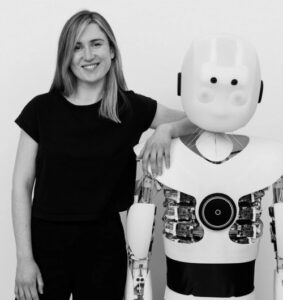
Kharchenko co-founded and serves as CTO of Devanthro, a Munich-based company building Robodies, robotic avatars designed specifically for elderly care.
Named to Forbes 30 Under 30 in 2023, she has spent eight years building full-stack robotics aimed at real-world implementation, with partners including Charité Berlin, the University of Oxford and Diakonie. An early prototype is part of the permanent exhibition at the Deutsches Museum in Munich.
Elderly care is one of the more socially significant and commercially underserved applications of robotics, requiring machines that can operate safely and usefully around vulnerable people rather than in controlled industrial settings. Devanthro is building specifically with this need in mind.
4. Mar Masulli, CEO and Co-founder, BitMetrics

Masulli is a three-time founder and CEO of BitMetrics, a Barcelona-based company applying AI to improve vision and reasoning capabilities in robots and industrial machines. She also sits on the board of AER Automation and was named to both the 2025 Women in Robotics list and the IFR’s 2024 list of women shaping the future of robotics.
Visual input alone falls short of making a machine practical. The underlying reasoning that translates raw imagery into actionable decisions is the primary challenge in industrial automation, and this specific challenge drives BitMetrics’ core focus.
5. Carla Gomez Cano, Co-founder and CEO, THEKER

Gomez Cano co-founded and leads THEKER, a Barcelona-based intelligent robotics and AI company designed, engineered and manufactured vertically.
THEKER closed the largest Series A funding round of the year in Europe’s intelligent robotics sector, and its full-stack robotic systems are now used on factory floors for top-tier multinationals across fashion, logistics and food.
Taking the vertical route by engineering hardware, software and field integration in-house creates a tougher build, but it gives THEKER complete ownership over solving specific physical tasks instead of forcing off-the-shelf machinery into bespoke roles.
6. Younseal Eum, Founder, AeiROBOT
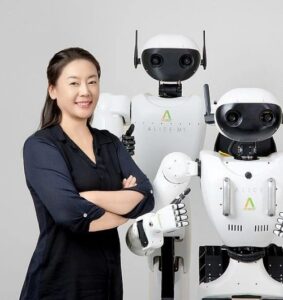
Eum began her career as a kinetic artist and exterior designer for robots before founding AeiROBOT, a spin-off from a robotics laboratory at Hanyang University launched in 2018.
Her work centres on human-robot interaction, focusing on making robot movement feel natural and emotionally legible. AeiROBOT’s robots include ALICE, a human-proportioned humanoid that can play football and navigate grass, and AIMY, an autonomous indoor guide robot for customer service. She was named to the IFR’s 2026 “Women Shaping the Future of Robotics” list.
Because major industrial groups drive the vast majority of South Korean robotics, standalone start-ups remain few and far between. Eum approaches the sector from a design perspective, giving AeiROBOT a clear edge by prioritising how machines actually feel to work alongside instead of relying purely on technical parameters.
7. Asami Sasao, Senior Engineer, Kawasaki Heavy Industries
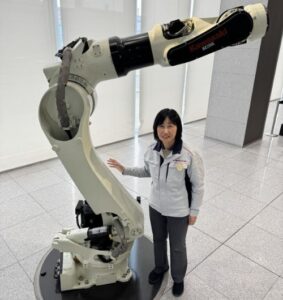
Sasao is a senior engineer in the Robot Business Division at Kawasaki Heavy Industries, one of Japan’s largest industrial robotics manufacturers, where she develops control software for industrial robots.
She joined the company in 1991 during the early surge of industrial robot adoption in manufacturing and taught herself programming on the job to help power full factory production lines. She was named to the IFR’s 2026 “Women Shaping the Future of Robotics” list for her long-term technical contributions.
Given Japan’s position as an industrial robotics powerhouse, Sasao’s three-and-a-half decades embedded in a major manufacturing giant show deep, steady technical leadership. Her career highlights the kind of foundational work that operates behind the scenes.
8. Sabine Hauert, Professor of Swarm Engineering, University of Bristol

Hauert OBE is Professor of Swarm Engineering at the University of Bristol, where her research covers nanorobots for cancer treatment through to larger robots for environmental monitoring and logistics.
Her career prior to Bristol involved creating cancer-fighting nanoparticle swarms at MIT and running flying robot swarms at EPFL. An active advocate for science communication, she co-founded Robohub.org as President and serves as executive trustee of AIhub.org, non-profits dedicated to connecting AI and robotics specialists with wider society, with featured pieces appearing across the BBC, CNN, The Guardian and Nature.
As one of the more research-heavy branches of the sector, swarm robotics operates at a distance from everyday commercial use compared with industrial automation. Hauert targets both environmental and medical challenges with her work, complementing her engineering focus with ten years of public outreach that translates technical progress for non-specialist readers.
9. Shuran Song, Assistant Professor, Stanford University

Song holds a PhD in Computer Science from Princeton and a Bachelor of Engineering from HKUST. She was a faculty member at Columbia University from 2019 to 2023 before joining Stanford, where she now leads the Robotics and Embodied AI Lab, building algorithms that help intelligent systems learn manipulation skills from human demonstrations, real-world data and open-source datasets. Her honours include the IEEE RAS Early Academic Career Award, an NSF CAREER Award, an Alfred P. Sloan Research Fellowship and multiple best paper awards at RSS and CoRL.
Open datasets accelerate research across the entire field. Song’s focus on accessibility, both in cost and in openness, reflects a different kind of contribution to robotics than commercial deployment, but one with wide-reaching effects on who gets to do robotics research at all.
10. Kelen Teixeira Vivaldini, Professor, UFSCar
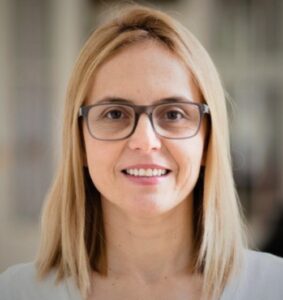
Vivaldini holds a PhD in mechatronics from EESC/USP and completed a postdoc at ICM/USP and the University of Sydney. She has been a professor of autonomous robots at UFSCar since 2015 and is also a senior researcher with the Multi-Robot Systems Group at the Czech Technical University in Prague. Her research centres on using UAVs and standard sensors for monitoring and mapping, developing path-planning systems that maximise the area robots can cover while minimising uncertainty.
Applying autonomous systems to ecological monitoring addresses urgent environmental threats, provided the hardware fits the terrain. Vivaldini creates solutions designed from scratch for demanding conditions instead of simply modifying technology built elsewhere. Splitting her time between Brazilian and Czech institutions underlines how modern research thrives on international knowledge exchange.


